Domingo Añasco-Gaces Samontina, Jr.
Bio
.Professional Member of the Mechatronics and Robotics Society of the Philippines
.Certified Documented Information Controller with TUV Rheinland Qualifications
.Master of Science in Engineering (on-going) with Professional Teacher Certificate
Stories (75)
Filter by community
Computer System Administration: Data Recovery and Backups
Intended Learning Outcome (ILO) At the end of the presentation, students should be able to: Identify the types of Backup Define RAID and classify the Levels Perform planning for Data Recovery Define the Disaster Recovery Plan
By Domingo Añasco-Gaces Samontina, Jr.6 years ago in 01
Fibers and Integrated Optics: Detectors and Receivers
Learning Outcomes Explain the basic concept and operation of a PN photodiode when used in an electrical circuit. Explain the use of PIN photodiodes and the theory of operation. Describe the action of an avalanche photodiode (APD). Compare the factors in photodiode performance characteristics, including Responsivity, Quantum efficiency, and Switching speed. Discuss how fiber optic receivers are typically packaged with the transmitter and how together, the receiver and transmitter form a transceiver. Examine a block diagram of a typical receiver that is divided into three subassemblies: Electrical subassembly, Optical sub-assembly, and Receptacle. Describe the two key characteristics of a fiber optic receiver: Dynamic Range and Wavelength. Describe the performance characteristics of a fiber optic receiver to include: Recommended operating conditions, Electrical characteristics, Optical characteristics, and IEEE 802.3 Ethernet applications.
By Domingo Añasco-Gaces Samontina, Jr.6 years ago in 01
Educational Technology: Examples of (ISTE) Standards in Classroom for Students and Educator
ISTE Standard for Students Empowered Learner Standard says, "students leverage technology to take an active role in choosing, achieving and demonstrating competency in their learning goals, informed by the learning sciences" (ISTE, 2016).
By Domingo Añasco-Gaces Samontina, Jr.6 years ago in Education
Lesson Planning: A Semi-detailed Lesson Plan in Living Things and Their Environment (LTTE)
I. Objectives At the end of the lesson, the students are expected to: Differentiate biotic components from abiotic components of an ecosystem; Manage the given materials to categorize into biotic or a biotic group; Develop a sense of environmental concern; answer at least 3 out of 5 questions correctly.
By Domingo Añasco-Gaces Samontina, Jr.6 years ago in Education
Multi-Cultural Experiences (MCE's)
Multi-cultural Experiences (MCEs) Experience is what a person’s been through, encounters, or lives through (Albarracin, Johnson, Zanna, & Kumkale, 2005) and consists of not only sensory cognition's, but also processes of interaction with people from different cultures (Rogoff, 2003). Multi-cultural experience (MCE) refers to the total of individual’s experiences interacting with foreign cultures or cultures within one country (Leung, Maddux, Galinsky, & Chiu, 2008) and the exposures to cultures that are different from their own (Dong, Day, & Collaco, 2008). As the experiences in multi-cultural context increases the implications in our personal, social, and occupational lives also increases, thus MCEs play a vital part in constructing one’s interest in several fields, such as cross-cultural psychology, diversity, and management research with the past and current exposures to and interactions with different cultures and people (Aytug, Kern, & Dilchert, 2018).
By Domingo Añasco-Gaces Samontina, Jr.6 years ago in Wander
Blended Learning, Collaborative Learning, and Intercultural Communicative Competence
Blended Learning and Collaborative Learning In today's universal world, the prominence of English can neither be denied nor ignored since English is the most communal language spoken everywhere. It is a prominent fact that English is the most broadly used language and the paramount vehicle of international communication in the world that has become the lingua franca in almost every university regardless of the program course is. Based on the Education Committee (EDCOM) Report (1991) identified English as the snag in student achievement. The demand of learning this English-taught course, especially in college, materializes international collaboration, and a growing number of opportunities for student‟s interaction with different countries students. Undoubtedly, having frequent interactions with different people from different countries is the best method to enhance one‟s overall level of intelligence (Yordanova, 2011). The output of this language must be premeditated prudently and vividly so that students can comprehend and communicate effectively and efficiently in the class and outside as well.
By Domingo Añasco-Gaces Samontina, Jr.6 years ago in Education
Creative Teaching: Qualities, Attitudes, Values, Hopes, and Beliefs
Teachers’ perceptions and attitudes have a strong impact on the learning space’s educational and social climate (Vollmer, 2000), and their knowledge, skills, and attitudes are closely interrelated (Bloom, 1956) and both are likely to affect learning space practice (Banks, 2004; den Brok, Bergen, & Brekelmans, 2006). Teachers are expert professionals, knowledgeable, and are granted creative autonomy in the learning space of creative class (Florida, 2002) require creative teaching that emphasizes learning for deeper understanding, rather than mastery of lower-order facts and skills (Bereiter, 2002; Kafai & Resnick, 1996). Teaching in multi-cultural learning space especially requires specific competencies in creating positive teacher-student relations and achieving student engagement (Dubbeld, et al., 2019).
By Domingo Añasco-Gaces Samontina, Jr.6 years ago in Education
Creativity
Creativity Creativity is generally defined as the ability to produce novel, appropriate, and useful ideas (Amabile, 1983). It is about the creation of novel and useful products including ideas as well as concrete objects (Sawyer, 2006; Sternberg & O’Hara, 1999; see also Amabile, 1996) and also about the totality of creative accomplishments (Piffer, 2012) including acts, ideas, or products that change existing domains, or that transforms an existing domain into a new one (Csikszentmihalyi, 1996). Every individual has the potential to become creative as long as he or she effectively utilizes ordinary cognitive processes to produce extraordinary creative outcomes (Finke et al., 1992; Ward, Smith, & Vaid, 1997; Weisberg, 1993).
By Domingo Añasco-Gaces Samontina, Jr.6 years ago in Education
Service-Learning Experience, International Service-Learning Experiences
Service-learning, a "form of experiential education in which students engage in activities that address human and community needs together with structured opportunities intentionally designed to promote students learning and development" (Jacoby, 1996, p.5), can introduce secondary students in network proficiency that has develop from the position that service-learning offers students a means for carrying out extra civic-minded education (Blessinger, Sengupta, & Yamin, 2019; Cushman, 2002; National Service-Learning Clearinghouse, 2009) advance authentic, collective, network commitment profiting student, faculty, and community (Curwood, Munger, Mitchell, Mackeigan, & Farrar, 2011). The relationship between service and learning is further symbolized by the hyphenated accentuation inside the term "service-learning, suggesting fairness between the two words and call for integrated approaches for the stability to not best be maintained however also achieved (Eyler & Giles, 1999).
By Domingo Añasco-Gaces Samontina, Jr.6 years ago in Education
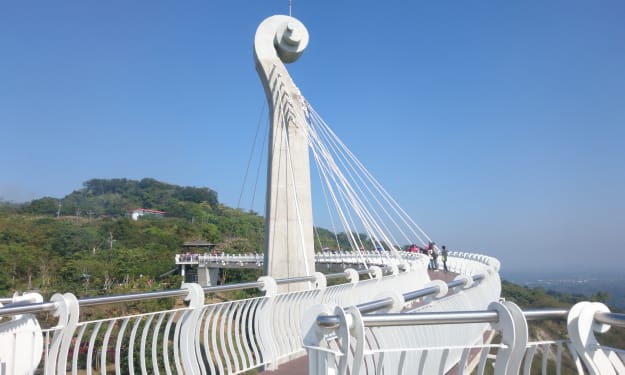
A Day at Siaogangshan Skywalk Park (Gangshan) - Kaohsiung City, Taiwan
Siaogangshan Skywalk Park is located between Gangshan and Yanchao Districts that cover 1.8 hectares of land. I together with my pal Jincky went to the famous skywalk of Taiwan. We agreed to meet at Gangshan South Station through Kaohsiung Mass Rapid Transit (KMRT) that is the last station. From my dorm (Wu-Ling International Villa Dormitory) inside the National Sun Yat-sen University, Kaohsiung City, Taiwan I stroll for approximately 10-15 mins going to Sizihwan MRT station. From Sizihwan station (Orange Line - O1) going to Formosa Boulevard station (Red Line - R10) takes 5 minutes (15 mins’ interval).
By Domingo Añasco-Gaces Samontina, Jr.6 years ago in Wander