
Multi-Cultural Experiences (MCE's)
Multi-cultural experience (MCE) refers to the total of individual’s experiences interacting with foreign cultures or cultures within one country (Leung, Maddux, Galinsky, & Chiu, 2008) and the exposures to cultures that are different from their own (Dong, Day, & Collaco, 2008).


Multi-cultural Experiences (MCEs)
Experience is what a person’s been through, encounters, or lives through (Albarracin, Johnson, Zanna, & Kumkale, 2005) and consists of not only sensory cognition's, but also processes of interaction with people from different cultures (Rogoff, 2003). Multi-cultural experience (MCE) refers to the total of individual’s experiences interacting with foreign cultures or cultures within one country (Leung, Maddux, Galinsky, & Chiu, 2008) and the exposures to cultures that are different from their own (Dong, Day, & Collaco, 2008). As the experiences in multi-cultural context increases the implications in our personal, social, and occupational lives also increases, thus MCEs play a vital part in constructing one’s interest in several fields, such as cross-cultural psychology, diversity, and management research with the past and current exposures to and interactions with different cultures and people (Aytug, Kern, & Dilchert, 2018).
Among personality traits, foreign language skills, and global identity, the MCE is one of the most important antecedents of CQ (Ang, Rockstuhl, & Tan, 2015). Maddux and Galinsky (2009) found that the experience of living abroad and traveling abroad have different effects: while the experiences of traveling abroad have no significant relation to creativity, the experience of living abroad is related to creativity increasing. In the conducted study of foreign work experience and innovation (Godart, Maddux, Shipilov, & Galinsky, 2015) found out that the number of years one had work experience abroad in one’s professional career has interactive effects on innovation. Aytug, et al. (2018) identified MCEs which posit two types, multi-cultural exposure and multi-cultural interaction, and suggested to measure multi-cultural exposures and interactions separately. Multi-cultural exposures are the instances a people observe elements or part of different cultures, of which elements may include architecture, arts, media, language, and social, behavioral, spiritual, and non-verbal practices. Persons are exposed to the diverse culture in varied ways such as hearing people speak a different language or observing people from different cultures. This exposure does not embroil communication or interaction from different people’s culture (Aytug, et al., 2018). Multi-cultural interactions offer a deeper exchange and socialization among people with diverse cultures (Gochenour & Janeway, 1993) that leads to increased levels of cultural knowledge, multi-cultural competence, as well as CQ (Aytug, et al., 2018).
References
Albarracin, D., Johnson, B. T., Zanna, M. P., & Kumkale, G. T. (2005). Attitudes: Introduction and scope. In D. Albarracin, B. T. Johson, & M. P. Zanna (Eds.), The handbook of attitudes and attitude changeHillsdale (pp.3-19). NJ: Erlbaum.
Ang, S., Rockstuhl, T., & Tan, M. L. (2015). Cultural Intelligence and competencies. In International Encyclopedia of Social & Behavioral Sciences (2nd Ed.,Vol. 5). Elsevier. doi:10.1016/B978-0-08-097086-8.25050-2 .
Aytug, Z. G., Kern, M. C., & Dilchert, S. (2018). Multicultural experience: Development and validation of a multidimensional scale. International Journal of Intercultural Relations, 65, 1-16.
Dong, Q., Day, K. D., & Collaco, C. M. (2008). Overcoming ethnocentrism through developing intercultural communication sensitivity and multiculturalism. Human Communication, 11(2), 27-38.
Gochenour, T., & Janeway, A. (1993). Seven concepts in cross-cultural interaction: A training design. In T. Gochenour (Ed.). Beyond experience: An experimental approach to cross-cultural educationYarmouth(pp.1-10). ME: Intercultural Press.
Godart, F., Maddux, W. W., Shipilov, A., & Galinsky, A. D. (2015). Fashion with a foreign flair: Professional experiences abroad facilitate the creative innovations of organizations. Academy of Management Journal, 58(1), 195-220.
Leung, A. K.-Y., Maddux, W. W., Galinsky, A. D., & Chiu, C.-Y. (2008). Multicultural experience enhances creativity: The when and how. American Psychologist, 63(3),169-181.
Maddux, W. W., & Galinsky, A. D. (2009). Cultural borders and mental barriers: The relationship between living abroad and creativity. Journal of Personality and Social Psychology, 96(5), 1047-1061.
Rogoff, B. (2003). The cultural nature of human development. UK: Oxford University Press.
About the Creator
Domingo Añasco-Gaces Samontina, Jr.
.Professional Member of the Mechatronics and Robotics Society of the Philippines
.Certified Documented Information Controller with TUV Rheinland Qualifications
.Master of Science in Engineering (on-going) with Professional Teacher Certificate
Keep reading
More stories from Domingo Añasco-Gaces Samontina, Jr. and writers in Wander and other communities.
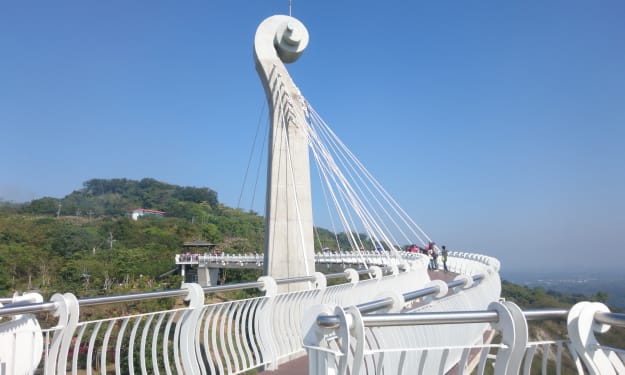
A Day at Siaogangshan Skywalk Park (Gangshan) - Kaohsiung City, Taiwan
Siaogangshan Skywalk Park is located between Gangshan and Yanchao Districts that cover 1.8 hectares of land. I together with my pal Jincky went to the famous skywalk of Taiwan. We agreed to meet at Gangshan South Station through Kaohsiung Mass Rapid Transit (KMRT) that is the last station. From my dorm (Wu-Ling International Villa Dormitory) inside the National Sun Yat-sen University, Kaohsiung City, Taiwan I stroll for approximately 10-15 mins going to Sizihwan MRT station. From Sizihwan station (Orange Line - O1) going to Formosa Boulevard station (Red Line - R10) takes 5 minutes (15 mins’ interval).
By Domingo Añasco-Gaces Samontina, Jr.6 years ago in Wander
Worth the Wait: Puerto Viejo, Costa Rica
Beach bumming in a small Caribbean beach town sounded like a perfect way to end our 6-month trip through Mexico and Central America. Or so we thought. The foul, fishy stench of rotten seaweed hit our nostrils as we stepped from the cramped bus and looked out at a rather depressing, empty, and underwhelming black sand beach. It was pouring with rain, and we had to quickly fish out our ponchos. We thought, this couldn’t be it, could it?
By Sh*t Happens - Lost Girl Travel3 days ago in Wander



Comments
There are no comments for this story
Be the first to respond and start the conversation.