
Xiangliu
The Primordial Legend and Ecological Metaphor of the Nine-Headed Serpent Monster

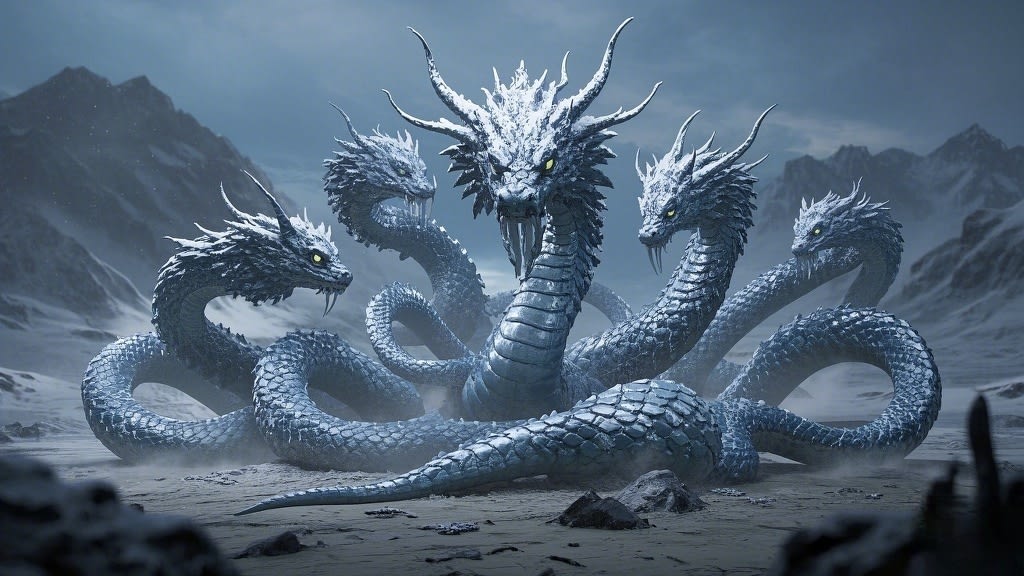
In the fantastical world constructed by Shan Hai Jing (Classic of Mountains and Seas), countless strange and bizarre mythical beasts roam through mountains, rivers, and seas, becoming the earliest codes of Chinese civilization's fantasy. Among them, Xiangliu, the nine-headed serpent monster coiled on the northern wilderness, stands out as a highly recognizable symbol of calamity in ancient Chinese mythology, thanks to its eerie appearance, terrifying destructive power, and mysterious legends. This monster that roamed the primordial era not only embodies the awe of ancient people towards the forces of nature but has also given rise to cultural metaphors that transcend time and space over thousands of years.
I. The Ferocious Figure in Ancient Texts: Prototype Research and Physical Characteristics
The earliest records of Xiangliu can be found in The Northern Region Beyond the Seas of Shan Hai Jing: "The minister of Gong Gong was named Xiangliu. It had nine heads and fed on nine mountains. Wherever Xiangliu passed, swamps and streams were formed. Yu killed Xiangliu, and its blood was so toxic that grains could not be planted there. Yu tried to fill the land, but it sank three times. Eventually, platforms for the emperors were built on that land." The The Great Wilderness in the North further supplements: "Gong Gong's minister was named Xiang Yao. It had nine heads, a snake body, and coiled around itself, feeding on the soil of nine regions. Where it spat or stopped, springs and swamps were formed. The water there was either unbearably pungent or bitter, and no beasts could inhabit it." These two passages outline its basic image: a coiled snake body with nine heads that could simultaneously devour the vegetation on nine mountains. Wherever it went, its body would crush the ground into swamps and streams, and the saliva or venom it spat out would turn into bitter and poisonous water, rendering the land barren.
It is worth noting that "Xiangliu" and "Xiang Yao" might be different transcriptions of the same monster. The "nine heads" are not just a bizarre feature but a concrete expression of "multitude" and "strength" in the thinking of ancient people. In primitive thinking, the number of heads often symbolizes the level of power. The nine heads not only correspond to the spatial concept of "nine provinces" or "nine regions" but also imply that its destructive power can cover a vast area. The description of its cyan snake body might be related to the Five Elements theory, where the north is associated with water, and the color of water is dark blue (cyan-black), further strengthening its attributes as the god of floods.
II. The Arch-Nemesis of Dayu's Flood Control: Calamity and Conquest in Mythological Narratives
The core legend of Xiangliu revolves around Dayu's flood control efforts, making it a typical "villain boss" in ancient heroic narratives. Legend has it that Gong Gong caused floods to harm the world, and as Gong Gong's important minister, Xiangliu assisted in creating disasters. Its massive body wandered across the land, leaving behind bottomless swamps wherever it passed. The poisonous water it spat out contaminated rivers, causing crops to wither and people and livestock to be poisoned. When Dayu led the people to channel the floods, Xiangliu obstructed several times, spitting poisonous water from its nine heads, creating a desperate situation where "nine springs and swamps were formed, and toxic gas spread."
Finally, Dayu used divine power and tools and joined forces with mythical beasts like Yinglong to slay Xiangliu. However, the monster's blood was highly toxic, and where it flowed, it turned into a stinking abyss, making the land unsuitable for farming. The Northern Region Beyond the Seas records that Dayu "tried to fill the land three times, but it kept sinking." Eventually, he had to build "platforms for the emperors" (including the platforms of Yao, Shun, Yu, etc.) to suppress the evil. These platforms, located north of Kunlun Mountain, became the spiritual symbols of ancient people's resistance against natural disasters. The death of Xiangliu not only marked a crucial victory in Dayu's flood control but also implied the awakening of human civilization from "passive endurance" to "active conquest" of nature.
III. Ecological Metaphors: From a Symbol of Calamity to an Environmental Warning
If we strip away the mythical cloak, the legend of Xiangliu is actually a poetic record of flood disasters by ancient people. In primitive agricultural societies, disasters such as floods, mudslides, and soil salinization directly threatened survival. Xiangliu's characteristics of "forming swamps and streams wherever it went" and "contaminating the land with its blood" are exaggerated reflections of the swamps and poisoned land after floods. Its action of "feeding on nine mountains" might metaphorize the ecological imbalance caused by excessive deforestation. When the vegetation is completely devoured, the soil and water conservation capacity is lost, triggering a chain of disasters.
More profoundly, the confrontation between Xiangliu and Dayu is essentially an early exploration of the relationship between humans and nature. Through myths, ancient people acknowledged the destructiveness of nature (the invincibility of Xiangliu), but also emphasized human initiative through heroic narratives (the wisdom and tenacity of Dayu). This attitude of "coexisting with awe and conquest" laid the foundation for the ecological concept of "harmony between man and nature" in traditional Chinese culture: recognizing the majesty of nature while advocating for rational use rather than excessive exploitation. The fact that Xiangliu's blood polluted the land and eventually required the "platforms of the emperors" to suppress coincides with the ancient people's simple understanding of "post-disaster restoration" — humans must pay the price for damaging nature, and only by establishing order (the platforms symbolize the 结界 of civilization) can balance be restored.
IV. The Thousand-Year Circulation of Cultural Genes: From Ancient Texts to Modern Adaptations
The image of Xiangliu did not fade away with the end of the mythological era but has become a unique symbol in the cultural genes. In Han Dynasty stone carvings, the nine-headed snake monster often appears alongside Yinglong and Dayu, forming the classic motif of "heroes fighting monsters." In the Illustrated Book of Mountains and Seas from the Ming Dynasty, it is depicted as a nine-headed cyan snake coiling among the mountains, strengthening its connection with the geographical environment. In modern times, Xiangliu continues to "come back to life" in film, television, literature, and games. For example, the monsters in the Ghost Blowing Out the Light series that draw on its poisonous water setting, or the nine-headed snake that appears as a boss in the Xuan Yuan Sword game, all continue the charm of the ancient legend in new media forms.
It is worth noting that contemporary interpretations of Xiangliu have gradually gone beyond the positioning of a "mere villain." With the awakening of environmental awareness today, its image is often given new warning meanings. When human exploitation of nature exceeds the limit, ecological disasters like Xiangliu will emerge. This dialogue between the ancient and the modern makes ancient myths no longer distant legends but mirrors that reflect reality — are we repeating the mistake of "devouring nine mountains"? Xiangliu's poisonous blood might be a silent accusation against excessive development.
Conclusion: Civilizational Self-Reflection Behind the Monster
The legend of Xiangliu is like a bond connecting the thunder of the primordial era with the contemplation of contemporary society. This nine-headed snake monster is not just a fantastic footnote in Shan Hai Jing but also the collective memory of ancient people facing nature. It is both the incarnation of calamity and a mirror of human self-examination during the conquest of nature. When we reread this myth thousands of years later, what we should see is not just the ferocity of the monster but the eternal game between civilization and nature. The most profound enlightenment Xiangliu leaves us might be how to maintain awe in development and understand restraint in conquest.
Just as the story of Dayu's flood control ended with the wisdom of "channeling rather than blocking," the relationship between humans and nature also requires a balance. Although Xiangliu's poisonous blood has long dried up, the ecological metaphors it carries continue to resonate in the context of modern civilization. Perhaps this is the power of myths: they wrap eternal propositions in a fantastical shell, allowing people of every era to see their own reflections within.
About the Creator
hello-word
As a Chinese person, love for the culture of my own country. Nowadays, the global exchange of information is becoming increasingly rapid. I also hope that more people can gain a deeper and more detailed understanding of Chinese culture.
Keep reading
More stories from hello-word and writers in Art and other communities.
The Chinese Mythical Creature That’s a Cross Between a Panda and a Transformer
If you’re a fan of Guardians of the Galaxy or Pacific Rim, prepare to meet your new favorite mythical beast: 呲铁 (Cītiě), the metal-eating, sword-pooping dragon bear from ancient Chinese folklore. This creature sounds like it was ripped straight from a Marvel script, but it’s actually been chilling in Chinese mythology for over 2,000 years. Let’s dive into this ironclad oddity.
By hello-word12 months ago in Art
'Till Death We Do Art
There would be nothing divine in this world without art. Nature may surpass the divine to all intents and purposes, but like everything it absorbs and is absorbed by, it remains here, stuck on the surface of this world, ever-present, physically bound to the universe.
By Avocado Nunzella BSc (Psych) -- M.A.P 16 days ago in Art
Who is your "Person"?
It's important to recognize that you cannot go through life as easily on your own. My name is Elizabeth and I'm a survivor of child abuse and horrific trauma. Healing from trauma is not a quick fix and recognizing that it will take time, is part of the struggle.
By Elizabeth Woods2 days ago in Psyche


Comments
There are no comments for this story
Be the first to respond and start the conversation.