
Why Do Some Birth Charts Have More Aspects Then Others?
Birth Charts

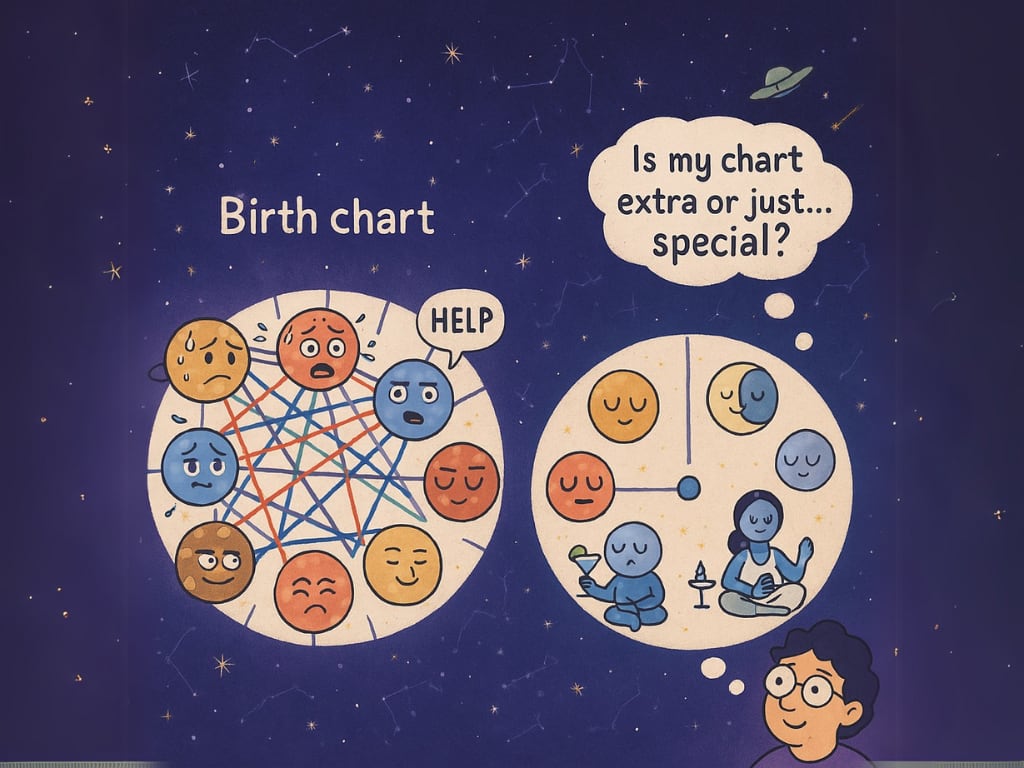
Hey there, starry-eyed friend! Ever stared at two birth charts side by side and thought, “Why does one look like a cosmic spider web while the other resembles a minimalist art project?” I’ve been there too—scratching my head, coffee in hand, wondering if the universe just plays favorites. Spoiler: It doesn’t (or at least, it’s not that petty). Let’s unpack this astrological mystery together, no PhD in astrophysics required.
What’s the Deal with Aspects, Anyway?
First off, let’s get cozy with the basics. Aspects are those lines you see connecting planets in a birth chart. They represent relationships between celestial bodies—like whether Mars and Venus are BFFs, frenemies, or straight-up ignoring each other. The more aspects a chart has, the more… let’s say dramatic that person’s cosmic storyline might be.
But here’s the kicker: not all charts are created equal. Some have enough aspects to give a conspiracy theorist a headache, while others are so chill they’re basically meditating. Why? Let’s dive in.
Factor #1: Planetary Roommates vs. Lone Wolves
Imagine the planets in your chart are guests at a party. If most of them are clustered in one area (looking at you, stellium folks), they’re bound to interact—aka form aspects. But if your planets are spread out, sipping cocktails in different corners of the chart? Fewer connections, fewer aspects.
- Tight clusters = more aspects: Think of it like a group chat that won’t shut up.
- Spread-out planets = fewer aspects: More “read receipts” than actual replies.
Pro tip: Check your chart for stelliums (3+ planets in one sign/house). If you’ve got one, congrats—you’re basically hosting a planetary rave.
Factor #2: The Orb Police (And Why They Matter)
Ah, orbs—the astrological equivalent of “how close is close enough?” Orbs determine how tightly planets need to align for their relationship to “count” as an aspect. Some astrologers use strict orbs (like a picky bouncer), while others are more… flexible (hello, free-spirit hippie vibes).
- Tighter orbs = fewer aspects: Only the strongest connections make the cut.
- Wider orbs = more aspects: “Sure, you’re 8 degrees apart—close enough!”
Fun fact: I once compared my chart using two different orb systems. One gave me a “you’re destined for greatness” vibe; the other basically said, “meh.” Choose your orb wisely, folks.
Factor #3: Angles, Houses, and Cosmic Real Estate
Not all chart placements are created equal. Angular houses (1st, 4th, 7th, 10th) are the VIP sections of your chart. Planets here form more aspects because they’re closer to the chart’s “action points” (Ascendant, Midheaven, etc.). Meanwhile, planets in cadent houses (3rd, 6th, 9th, 12th) are like that friend who lurks on social media but never posts—they’re just… there.
Quick cheat sheet:
- Angular house planets: Social butterflies, extra aspects.
- Cadent house planets: Wallflowers, fewer aspects.
Factor #4: Birth Time—The Ultimate Wild Card
Here’s where things get spicy. Your birth time doesn’t just affect your rising sign—it shifts the entire house system, which changes which planets are aspecting each other. A difference of 10 minutes could turn your “quiet night in” chart into a “why is everyone yelling?!” chart.
True story: My friend’s chart went from 5 aspects to 12 when she corrected her birth time. She’s still in therapy. (Kidding… mostly.)
Also Read- Mars in Virgo: What it Means and How to Take Advantage Of It
But Here’s Why It All Matters
You might be thinking, “Cool story, but does this actually affect my life?” Short answer: Yes, but not how you’d expect.
- Lots of aspects: Your life’s a rollercoaster of events, relationships, and ~growth opportunities~ (read: drama).
- Fewer aspects: You’re the zen master of your friend group, but might need to hustle harder for change.
IMO, neither is “better”—just different flavors of human experience. Like choosing between espresso and herbal tea.
How to Work With Your Chart’s “Aspect Style”
Got a chart that’s busier than a TikTok algorithm? Lean into it! Use those aspects as clues for where your energy flows (or clashes). For example:
- Trines and sextiles: Your cosmic cheat codes—effortless talents.
- Squares and oppositions: Plot twists that push you to grow (or rage-quit astrology entirely).
If your chart’s more “minimalist chic,” don’t panic. Focus on the aspects you do have—they’re your power players. And hey, fewer aspects mean less noise to drown out your intuition. Silver linings, right?
Final Thoughts
At the end of the day, your birth chart is like a fingerprint—uniquely yours, flaws and all. Whether it’s a Jackson Pollock painting or a clean line drawing, it’s telling a story only you can live. So next time you compare charts with a friend, just smile and say, “Mine’s ✨differently magical✨.”
About the Creator
Maria Hayes
Maria Hayes is a seasoned astrologer and fortune-teller with 38 years of experience. She has guided thousands of clients worldwide to transform their lives through her unique gift. Driven by a passion for helping others.
Keep reading
More stories from Maria Hayes and writers in Art and other communities.
How to Attract a Taurus Woman
So, you’ve got your eye on a Taurus woman? Buckle up, my friend—this isn’t a ride for the faint of heart. She’s the type who’ll text you a five-star restaurant menu “just for fun,” debate the merits of cashmere versus Egyptian cotton sheets, and somehow make not leaving her couch on a Sunday look like a power move. But hey, if you’re here, you already know she’s worth the effort. Let’s cut through the astrology fluff and talk real strategies to catch her attention (and keep it).
By Maria Hayes11 months ago in Art
'Till Death We Do Art
There would be nothing divine in this world without art. Nature may surpass the divine to all intents and purposes, but like everything it absorbs and is absorbed by, it remains here, stuck on the surface of this world, ever-present, physically bound to the universe.
By Avocado Nunzella BSc (Psych) -- M.A.P 26 days ago in Art
The Front Seat
I found myself waking up in the front seat of the bus. My eyes were filled with the early morning darkness. I had been asleep, but I wasn’t sure for how long. I tried to wake up my body, but my head felt heavy, as though I had been sleeping for an eternity, although I couldn’t pinpoint how much time had passed.
By Aunty Sada3 days ago in Art




Comments
There are no comments for this story
Be the first to respond and start the conversation.