
Why Analog Summing Still Matters in a Digital World
So why are so many home and pro engineers still reaching for analog summing?


If you’re producing music today, chances are you’re working entirely in-the-box. DAWs offer convenience, precision, and total recall. It’s never been easier to stay fully digital — and for good reason. So why are so many engineers and producers still reaching for analog summing mixers?
It’s not just about nostalgia. It’s about sound. Feel. And the little bit of magic that happens when your mix leaves the screen and enters the real world.
Let’s break it down: Why analog summing? How does it work? And what can you actually hear?
The Why: What Makes Analog Summing Different?
Inside your DAW, mixing is all math. When you blend vocals, drums, guitars — the software adds everything up using digital calculations. It’s clean and precise… maybe a little too precise.
Analog summing works differently. It happens in the physical world — using voltage, circuitry, and components like resistors or transformers. That introduces subtle variations that digital systems just can’t replicate.
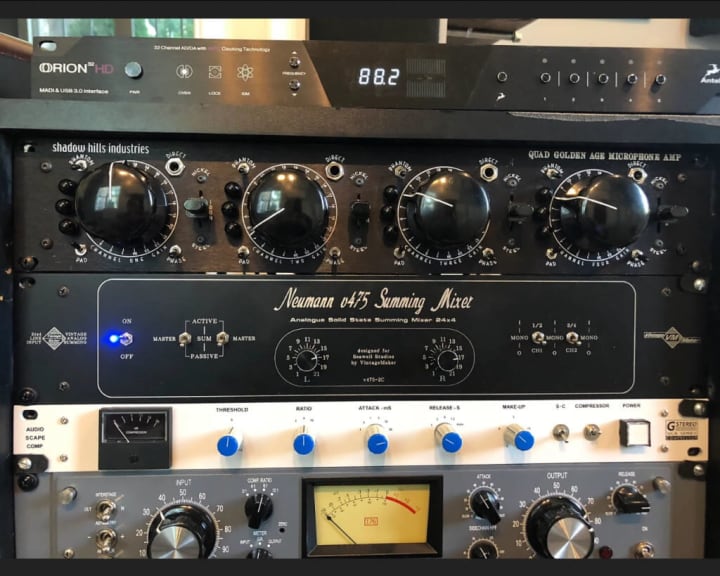
The result? A set of sonic characteristics that add depth and life:
- Harmonic richness
- Gentle analog saturation
- Wider stereo image
- Natural glue between elements
These aren’t mistakes — they’re enhancements. Engineers call this euphonic distortion — the kind of imperfection your ears actually love.
Custom Analog Gear, Built for You
At VintageMaker, we design and hand-build custom analog summing mixers to match your personal workflow — whether you’re chasing clean headroom or vintage-style saturation.
Every unit is compact, efficient, and made by hand — tailored to your exact needs. No two are the same. Because no two producers are the same.
👉 Learn more at vintagemaker.net
About the Creator
Paul Taylor
VintageMaker is one of the last manufacturers, professional handmade studio gear builders in the world. This possibility is almost unique in the market since 2010′. More than 1000 different and unique custom studio solutions.
Keep reading
More stories from Paul Taylor and writers in Art and other communities.
6 Reasons to use Analog Summing Mixer Box
Unlock True Analog Depth in Your Mixes When it comes to mixing, achieving depth, clarity, and warmth is crucial for a professional sound. While digital summing has its advantages, it can sometimes lead to a mix that feels flat and congested. This is where analog summing comes in, offering a more immersive and natural sonic experience.
By Paul Taylor12 months ago in Education
'Till Death We Do Art
There would be nothing divine in this world without art. Nature may surpass the divine to all intents and purposes, but like everything it absorbs and is absorbed by, it remains here, stuck on the surface of this world, ever-present, physically bound to the universe.
By Avocado Nunzella BSc (Psych) -- M.A.P 17 days ago in Art
Ink & Imagination
In a small town named Inkwood, nestled between hills and rivers, there existed a peculiar bookshop called “The Imagination Hub.” The shop was run by a kind old man named Mr. Penrose. He was the type of person who could bring stories to life with just a few words. Every child in Inkwood believed that Mr. Penrose had a magical power. They would gather around him every Saturday to hear tales of adventure, bravery, and far-off worlds.
By Hamad Afridi 4 days ago in Art




Comments
There are no comments for this story
Be the first to respond and start the conversation.