

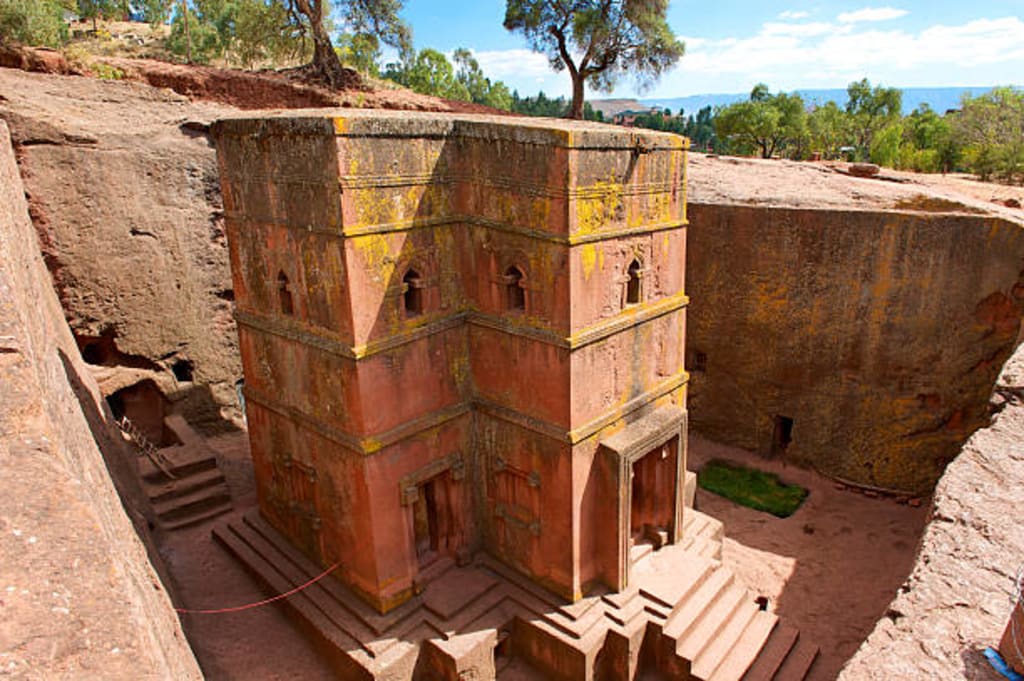
King Lalibela: The Builder of a New Jerusalem
King Lalibela was one of the most famous rulers of the Zagwe dynasty, which ruled Ethiopia from the 10th to the 13th century. He is best known for his remarkable legacy of building 11 churches carved out of solid rock in the town of Roha, which was later renamed Lalibela after him. These churches are considered to be among the wonders of the world and are a UNESCO World Heritage Site. They reflect Lalibela’s devotion to Christianity and his ambition to create a new Jerusalem in Ethiopia.
Lalibela was born in 1162 in Roha, a town in the province of Lasta. His father was Jan Seyum, the governor of Bugna, and his mother was Kirwerna, a housemaid. According to legend, a swarm of bees surrounded him at his birth, which his mother interpreted as a sign of his future greatness. His name means “the bees recognize his sovereignty” in Old Agaw, the language of his ancestors. However, his birth also aroused the jealousy of his uncle Tatadim and his brother Kedus Harbe, who were the rightful heirs to the throne. Lalibela had to flee from their hostility and seek refuge in Jerusalem, the holy city of Christianity.
Lalibela spent many years in Jerusalem, where he learned about the faith and the culture of the Christians. He also married Meskel Kibra, a noblewoman from Ethiopia. He eventually returned to his homeland, but he faced more opposition from his brother, who had become the king of the Zagwe dynasty. Lalibela had to fight for his right to rule, and he managed to defeat his brother with the help of the Amhara people, who supported him in exchange for key positions in his administration. Lalibela became the king of the Zagwe dynasty in 1181 and ruled until 1221.
Lalibela’s reign was marked by his zeal for Christianity and his vision of building a new Jerusalem in Ethiopia. He wanted to make his capital a place of pilgrimage and a symbol of the Ethiopian church, which had been isolated from the rest of the Christian world since the Muslim conquest of Egypt in the 7th century. He also wanted to honor the memory of his beloved Jerusalem, which had fallen to the Muslim forces led by Saladin in 1187. He ordered the construction of 11 churches, each with a different architectural style and a unique name, such as Bete Medhane Alem (House of the Savior of the World), Bete Giyorgis (House of St. George), and Bete Golgotha (House of Golgotha). He supervised the work personally and even participated in the carving of the rock. He also established a monastic community and a clergy to serve the churches and the pilgrims.
The churches of Lalibela are remarkable for their engineering and artistic achievements. They are not built from blocks of stone, but rather hewn from the living rock of the mountain. They are connected by tunnels, passages, and trenches, creating a complex network of underground structures. They are also decorated with elaborate carvings, paintings, and crosses, reflecting the influence of various styles, such as Axumite, Byzantine, Romanesque, and Coptic. The churches are still in use today and attract thousands of visitors every year, especially during the major festivals of the Ethiopian Orthodox Tewahedo Church.
Lalibela died in 1221 and was buried in one of his churches, Bete Golgotha, where his tomb can still be seen. He is revered as a saint by the Ethiopian Orthodox Tewahedo Church and his feast day is celebrated on June 19. He is remembered as one of the greatest kings of Ethiopia and one of the most influential figures in the history of Christianity in Africa.
About the Creator
Keep reading
More stories from writers in Art and other communities.
What is abstract sculpture?
Abstract art often feels mysterious because it does not rely on recognizable figures, realistic animals, or a clear narrative. Abstract sculpture follows the same principle. Rather than imitating the real world, it uses form, line, surface, volume, and space to convey ideas, movement, or emotion.
By Shenzhen Ruiheng Crafts5 days ago in Art


Comments (1)
I really enjoyed ur post its very informative and detailed yet very attractive to read I have got alot of information about it keep up with the good work👏👏👏