
When Two Names Become One Symbol: The Quiet Poetry of Rotational Words
How a forgotten typographic art form is helping people say “forever” in a single line
The Gift That Spoke Without Saying a Word
Last month, my cousin handed me a small velvet box at her wedding reception. Inside wasn’t jewelry—but a folded piece of handmade paper. On it, two names: hers and her wife’s. At first glance, it looked like elegant calligraphy. But when I turned it upside down… the same design still read perfectly.
“It’s an ambigram,” she whispered, eyes shining. “We wear it on our rings, but this? This is the original sketch.”
I was stunned. Not just by the beauty, but by the intention: a visual promise that no matter how life flips you—upside down, sideways, through joy or grief—you still see each other clearly.
That moment sent me down a rabbit hole I didn’t expect: the quiet renaissance of ambigrams in everyday love, friendship, and self-expression.
More Than a Tattoo Trend
Once confined to niche design circles and Dan Brown novels, ambigrams are now appearing everywhere:
On matching friendship bracelets that spell both names when rotated
In memorial tattoos where a child’s name transforms into “always”
As minimalist logos for queer-owned businesses embracing duality
What makes them powerful isn’t just symmetry—it’s shared meaning encoded in form. Unlike a regular monogram, an ambigram demands participation from the viewer. You have to turn it, engage with it, to unlock its full message.
But here’s the catch: designing one by hand takes skill. Most of us aren’t typographers. We just want to say something beautiful in a way that feels personal.
A Tool That Feels Like Collaboration, Not Automation
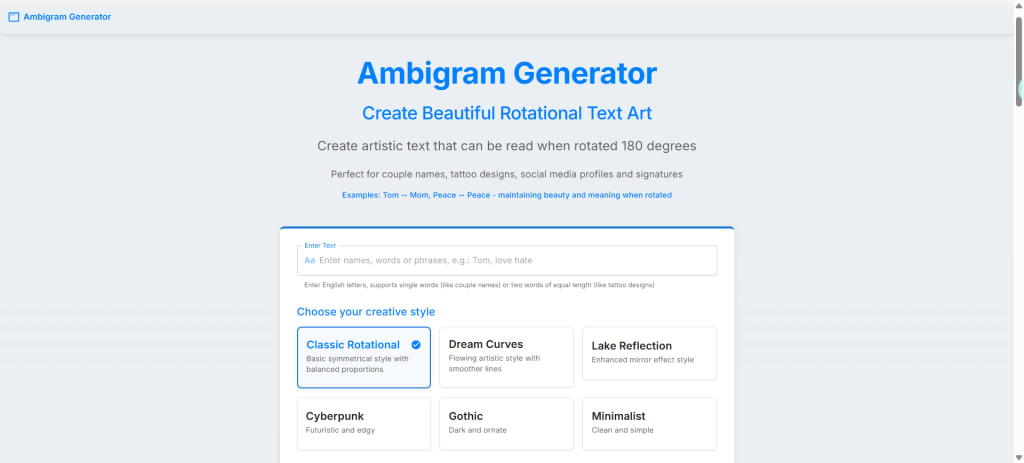
While researching, I tested several online generators. Many felt robotic—forcing letters into awkward shapes just to meet symmetry rules. Then I found a surprisingly thoughtful interface that treats ambigrams like art, not algorithms. It offers styles that honor the emotion behind the words: soft curves for tenderness, sharp lines for resilience, mirrored flows for unity.
I typed in two names—my brother’s and his late dog’s—and within seconds, I had a design that made me pause. It didn’t just work; it felt right.
If you’ve ever wanted to turn a pair of names, a mantra, or even a private joke into something visually enduring, I’d encourage you to explore this expressive little platform. It’s free, browser-based, and respects the soul behind the symbols.
Why This Matters Now
In an age of fleeting digital messages, there’s something radical about creating a single mark that holds two truths at once. Ambigrams remind us that love, identity, and memory aren’t linear—they’re cyclical, reversible, resilient.
And sometimes, the most profound declarations don’t need volume. Just a line that reads true, no matter which way you hold it.
If you’re looking for a way to give form to a bond that defies simple words, you might find inspiration in the same creative space I did. No design degree required—just heart.
Art isn’t always about making something new. Sometimes, it’s about seeing what’s already there—from a different angle.
About the Creator
yzbkaka
The internet could use a little less noise. So I try to add tools that are quiet, fast, and actually work.
Keep reading
More stories from writers in Art and other communities.
The River and the Drops
High in the mountains, where no one watched and no one applauded, tiny drops of water slipped from melting snow. Each drop was small, almost invisible, and carried a quiet fear within itself. They began their journey without knowing where they were going, only knowing that they were moving away from where they began.
By Sudais Zakwan6 days ago in Art



Comments
There are no comments for this story
Be the first to respond and start the conversation.