
What price the lady's eyes
$236.4m in case you are wondering


Don’t you think it’s fascinating that a single painting can command such a price at auction? I do. I sometimes wonder how much I would pay for a work of art, were money no object to me. I have a similar personal question about what car I would buy for myself, if I had enough money to buy any car I took a fancy to. I suspect I would go no further than a state-of-the-art Audi or BMW. I really couldn’t buy a Rolls Royce, Aston Martin or Ferrari.
I think if I were able to pay hundreds of millions of dollars for a single work of art I would have to put it on public display. Why would a person want to hide such a remarkable work from public view? Presumably to satisfy some petty vanity that has something to do with having command of an unconscionable level of financial clout.
“Are you a collector?” Is a question I have sometimes been asked when I have attended a private viewing at a small art dealer’s gallery in London. “Not really,” I might reply, a little dishonestly. Certainly I do not make a habit of buying art to add to my collection but I have bought a small number of works over the years. Little things I have taken a shine to. £20, £50, and one or twice as much as UK£200. Some are hanging in our suburban home, some awaiting wall space. Some are just kept for future appreciation.
Once, I spent what was to me a huge sum of money on a work I saw in an exhibition. How could I justify this? Well, I had recently benefited from a small legacy from my parents. I know my father would have approved, though I suspect Mum would have questioned the cost of such a frivolity.
There is one work in particular that I would like to see hanging in my home. It is the Weeping Woman by Picasso.
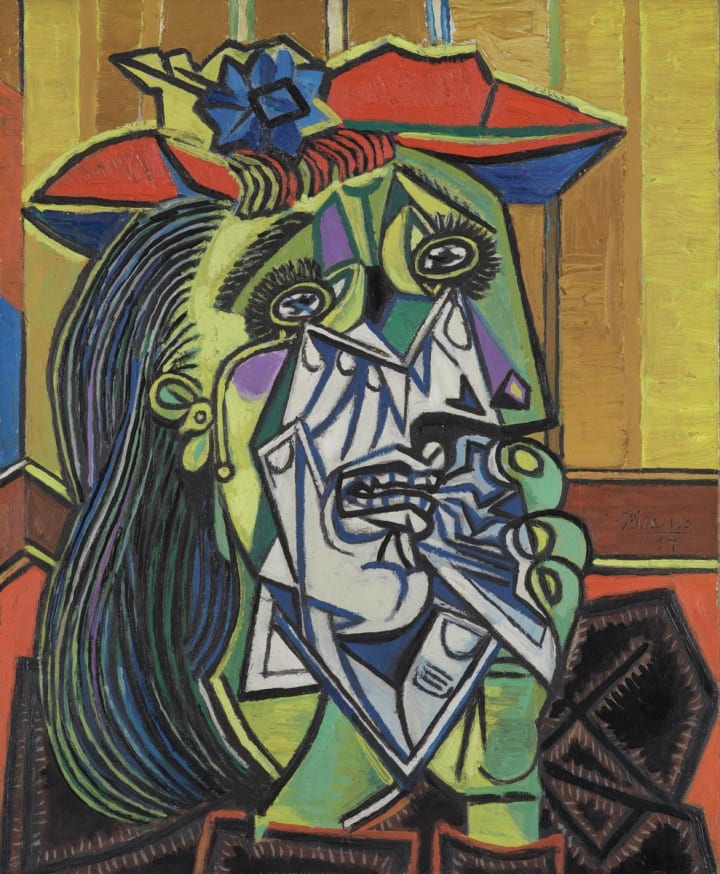
It currently resides in Tate Modern in London. I am a volunteer visitor host at Tate’s two London Art museums. Whenever I see this painting I try to think how I could steal it. I wouldn’t keep it, you understand. I would just hang it on a wall and study it for a week or two, love it, appreciate it.
It would be worth the jail time, really. I would in any case have to return it to the public collection that Tate, and so many art museums around the world, are responsible for. I would just like to be selfish enough to want to admire and study this glorious painting for a short while. To be able to wake and sleep with it.
To this extent I am at one with the anonymous buyer of this astounding painting by Klimt. I do not think I have seen eyes like this in any work outside of the British Museum’s Egypt collections. To me, what is the difference between having hundreds of millions of dollars in a 'let's buy some art' fund, and stealing a work worth $200 millions or more? No, tell me, really. What is the difference?
There is some interesting history to this painting. I could summarise it in my own words but I wouldn't do a better job than my AI friend Gemini. A great resource for historical and other research work. You think AI is a shit of a development for this 21st century? Think what you like. I am not going to put time and effort into researching something that can be got at a touch of a button. Bite me!
Here is what Gemini has to offer about this painting...
Life and Persecution
Marriage and Divorce: Elisabeth, daughter of Klimt's major patrons, the wealthy Jewish industrialist Lederer family, married Wolfgang Freiherr von Bachofen von Echt in 1921 and converted to Protestantism. They had a son, but divorced in 1938 following the child's death at age four.
Nazi Annexation: When Nazi Germany annexed Austria in 1938, Elisabeth and her family, who were Jewish, became targets of persecution. The Nazis confiscated the vast Lederer art collection.
The Life-Saving Lie: To escape deportation and death, Elisabeth claimed that the non-Jewish Gustav Klimt was her biological father, the result of an adulterous affair with her mother, Serena Lederer. Her mother backed up the story in writing. Art historians later determined this was a fabrication.
Temporary Safety: The Nazi Reich Department for Genealogical Research accepted the claim, allowing Elisabeth to be classified as "half-Aryan." This deception protected her from the worst of the Holocaust and spared her from being sent to a concentration camp.
Death: Tragically, Elisabeth did not survive the war; she died from a severe illness in Vienna on October 19, 1944.
The story of Elisabeth Lederer after her portrait was painted by Gustav Klimt (between 1914 and 1916) is marked by her marriage, the tragic loss of her child, and a desperate act that ultimately saved her life during the Holocaust.
The Portrait's Fate
Looting and Survival: Unlike a significant portion of the Lederer art collection, including many Klimt works, which were destroyed in a fire at Immendorf Castle in 1945, the Portrait of Elisabeth Lederer survived the war. It was believed that the family portraits were separated from the main collection, possibly deemed "too Jewish" to be worth stealing, according to some reports.
Restitution: After the war, the portrait surfaced on the art market but was eventually restituted in 1948 to Elisabeth's brother, Erich Lederer, an artist and prominent art collector.
Later Sales: The painting remained in Erich Lederer's possession until he sold it in 1983. It was later acquired by American collector Leonard A. Lauder in 1985. In November 2025, the portrait sold at auction for over $236 million, setting a record for the most valuable piece of modern art sold at auction at that time.
Elisabeth Lederer's portrait is now a poignant symbol of the family's patronage of Klimt and her own dramatic story of survival against Nazi persecution.
End of AI text
Fuck what the portrait is a poignant symbol of. I would like to see the painting someday and suspect I never will.
To me, those eyes have it
Thanks for reading my arty-farty ramblings
Love you all
Raymondo
About the Creator
Raymond G. Taylor
Author living in Kent, England. Writer of short stories and poems in a wide range of genres, forms and styles. A non-fiction writer for 40+ years. Subjects include art, history, science, business, law, and the human condition.
Keep reading
More stories from Raymond G. Taylor and writers in Art and other communities.
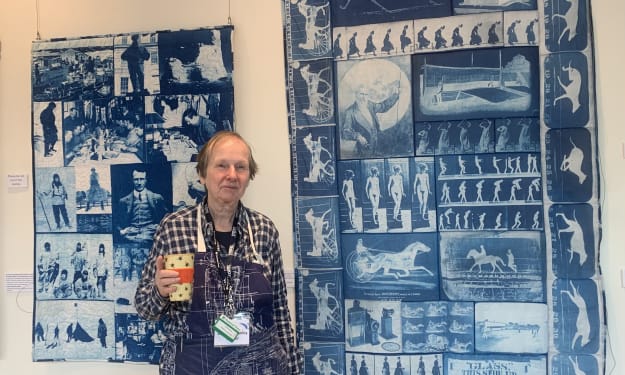
History in blue
Like many people who have retired from full time employment, Cathy Corbishley Michel has used some of her time to develop an interest in art. In Cathy’s case the results are quite astounding. Her remarkable cyanotypes have been designed using images sourced from the historical collections of the British Museum and other institutions in England, Scotland and around the world.
By Raymond G. Taylor10 months ago in Art



Comments (8)
What a great art review and who wouldn't want a classic painting hanging in their home even for a little while. Picasso was a great and that work is something for you are right the eyes have it.
Really enjoyed this. I've never seen the painting. Gorgeous. Her eyes outshine the ornamental robe. It's interesting how the blur of an ornamental robe further accentuates her eyes. Also, you said, "I am not going to put time and effort into researching something that can be got at a touch of a button. Bite me!" ---agreed. hahahahaha
It is great you have such a strong connection to art. Your thoughts on value and public display are really thought provoking. Keep enjoying those small personal treasures you have collected. It sounds like you have a wonderful passion for paintings. I too have a strong connection to art, but I like art from Appalachia and own several pieces.
You are right, those eyes are worth looking at in person, Raymond. I suspect that the anonymous buyer, just like with Da Vinci's Salvator Mundi, has been bought by some Saudi prince or Russian oligarch to launder money. It would be a miracle if it ever appears in public again.
I've seen the painting of Elisabeth before (not in a studio or exhibition...only online) but couldn't recall the historical/personal background. AI helped, but I am still stuck wondering why the Asian backdrop? You bring up many good points about the true worth of what captures our heart's desires and the price we are willing to pay for them. As I looked at Picasso's piece, I can say I truly understand it, even if I think it quite ugly...like the reality and truth of grief and the fractured life that death leaves in its wake. I lost my oldest son in September and I can relate. So, in that respect, the artist brilliantly captured the grotesqueness most effectively. But I would rather take a jail term than be subjected to it. On the other hand, the beauty of getting anything past the Nazis makes me feel better about life and humanity, so I find that priceless. (Maybe the mysterious Asians are having a good chuckle about that, too?) I truly love your artsy stories, by the way.
I'm with you, Ray. The eyes definitely 'have it'. I don't recall having seen this painting in the past, which surprises me since I adore Klimt. Thanks for sharing!
This was such an interesting read. I loved your honesty about the tug-of-war between public art and private longing.
I'm the kinda person that doesn't like to travel. I don't get paying to go somewhere to see something when I can just see a picture of it for free. To me, seeing a picture of something and actually seeing something is the same. Unless it's food because we can't eat a food pic. But to some people, seeing it in pictures and seeing it in person if different. I'm not saying that's wrong but I'll never understand it. So back to your question, would I pay for art? I think you know my answer hehehe