
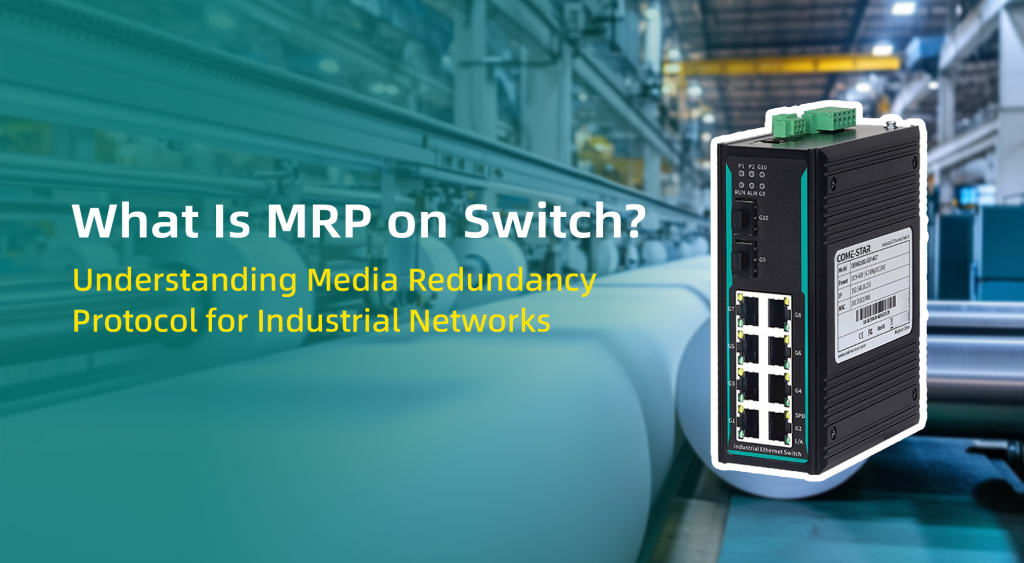
In the field of industrial automation, the reliability and real-time performance of network communications directly impact the stable operation of production systems. The Media Redundancy Protocol (MRP) is a key technology developed specifically to address this challenge. By establishing redundant ring network topologies and enabling millisecond-level failover, MRP provides robust network assurance for high-risk industries such as power, manufacturing, and transportation. This article will delve into the working principles of MRP, its core advantages, and its irreplaceable role in industrial environments.
What is MRP on Switch
MRP (Media Redundancy Protocol) is a redundancy network protocol specifically designed for Industrial Ethernet communication, defined by the international standard IEC 62439–2. It enables Ethernet switches to be connected in a ring configuration and is suitable for most industrial Ethernet applications.
The core idea of MRP is:
Connecting multiple industrial Ethernet switches into a ring topology.
Preventing broadcast storms and network loops through a standardized protocol mechanism.
Ensure that when a link or device in the ring network fails, the network can quickly switch over and restore communication, thereby minimizing downtime.
MRP maximum switching time of 500ms.
How MRP Works
MRP requires switches or controllers to form a physical ring. One switch acts as the Media Redundancy Manager (MRM), while the others function as Media Redundancy Client (MRC).
Normal Operation: The MRM blocks one port to avoid loops, making the ring behave like a simple line.
Link Failure: If a fault occurs, the MRM instantly unblocks the port to restore communication.
Link Recovery: Once the fault is fixed, the MRM blocks the port again, maintaining loop protection.
MRP Protocol Mechanism
Hello Messages
To monitor the network and link status, MRP uses Hello messages:
These small, periodic probe packets are exchanged between devices to confirm active links.
If a device stops receiving Hello messages within a specific time, it assumes a link failure and triggers a failover.
Standby State
In normal operation, devices remain in standby state, continuously exchanging Hello messages.
Devices are ready to switch into active mode if a fault is detected.
Active State
When a link or device fails, MRP quickly switches devices into active state, activating backup paths.
Why Industrial Networks Need MRP
Industrial networks differ fundamentally from standard office networks, imposing extremely stringent requirements on communication quality:
Ultimate reliability: Even a one-second production line stoppage can cause significant economic losses
Deterministic latency: Data must arrive within precise time windows
Rapid fault recovery: Network outage recovery times must be extremely short (far faster than standard network protocols)
Key Advantages of MRP:
Fault tolerance with continuous link monitoring and fast switchover
High reliability for critical data and control signals
Fast recovery times (sub-500 ms in most cases)
Flexible deployment with scalable topologies
Compatibility with standard Ethernet protocols and devices
Reduced downtime and maintenance costs
Simplified network management with automated recovery
Application of MRP in industrial scenarios
Industrial Production Lines
In automotive manufacturing, controllers connected via MRP ensure that if the primary controller fails, the backup controller immediately takes over, preventing downtime.
Power Systems
Power distribution systems demand extremely high availability. MRP offers redundant communication between monitoring and control devices, helping to maintain a stable and reliable electricity supply.
Smart Transportation
Traffic signal control systems require uninterrupted communication. MRP ensures instant switchover to backup devices in case of failure, preventing potential traffic disruptions.
Mining Operations
Large-scale mining facilities depend on real-time data from heavy machinery, conveyors, and ventilation systems. MRP provides redundant network connections so that even if part of the underground network fails, operations and worker safety systems continue without disruption.
Oil and Gas Industry
In oil refineries and offshore drilling platforms, MRP ensures reliable communication between sensors, controllers, and safety systems. If a communication link is lost due to harsh environments, backup links are instantly activated to maintain continuous monitoring and prevent safety hazards.
Conclusion
Media Redundancy Protocol (MRP) is a fast, reliable, and standardized solution for ring-based Industrial Ethernet networks. Compared with traditional protocols like STP or RSTP, MRP offers faster recovery and better reliability.
Not only does it significantly reduce system downtime risks, but it also drives the deep integration of the Industrial Internet through standardization and flexible deployment. Facing increasingly stringent demands for network reliability in future industrial scenarios, MRP will continue to serve as an "invisible guardian," safeguarding the stable operation of critical infrastructure.
About the Creator
Keep reading
More stories from ethernet-network and writers in Art and other communities.
What is the Voltage Output of Poe Switch?
In industrial network deployments, industrial PoE (Power over Ethernet) switches have become key components for connecting various devices, thanks to their ability to simultaneously transmit data and power. The PoE switch voltage output directly affects device compatibility, stability, and application range, making it a crucial parameter to consider during selection.
By ethernet-network6 months ago in Art
Golden Journey
Once in a small town named Willow Creek, something extraordinary was about to happen. The sun was setting, casting long shadows and a golden glow across the landscape. Among the townspeople was a curious boy named Ethan. A dreamer with bright green eyes and messy brown hair, Ethan was often lost in his thoughts. He wanted to explore worlds beyond his own, driven by the tales of adventure his grandmother used to tell him.
By Hamad Afridi about 16 hours ago in Art


Comments
There are no comments for this story
Be the first to respond and start the conversation.