
What I Painted When Words Failed Me
How a brush became my voice when I had nothing left to say
I don’t remember when the words stopped.
Maybe it was after the third sleepless night, staring into the ceiling’s blank stare. Or the phone calls I never answered. Or the days I sat in my room, surrounded by walls that felt too close, too loud, too judgmental. I had always been the one with the right things to say, the shoulder for others to cry on, the "resilient one." But suddenly, language betrayed me. It dried up. I couldn’t form a sentence without crying or shaking or going completely numb.
The world kept moving—fast and loud and demanding—and I had nothing to offer it. No caption for my pain. No script for the sadness. Just silence, and a heavy one at that.
And then, one morning, I found my old paint set.
Buried under some books and half-folded clothes in the corner of my closet. I hadn’t touched it in years—since high school maybe. The tubes were dried at the edges, the brushes stiff with time. But something in me stirred. Not hope, not inspiration—just a quiet instinct.
I laid an old bedsheet on the floor, taped a blank canvas to the wall, and began.
The first painting wasn’t beautiful. It wasn’t meant to be.
It was messy, angry, full of harsh strokes and colors that clashed—charcoal black slashed across red, fading into bruised purple. It looked like a storm in reverse. It looked like my mind. And for the first time in weeks, I felt... heard.
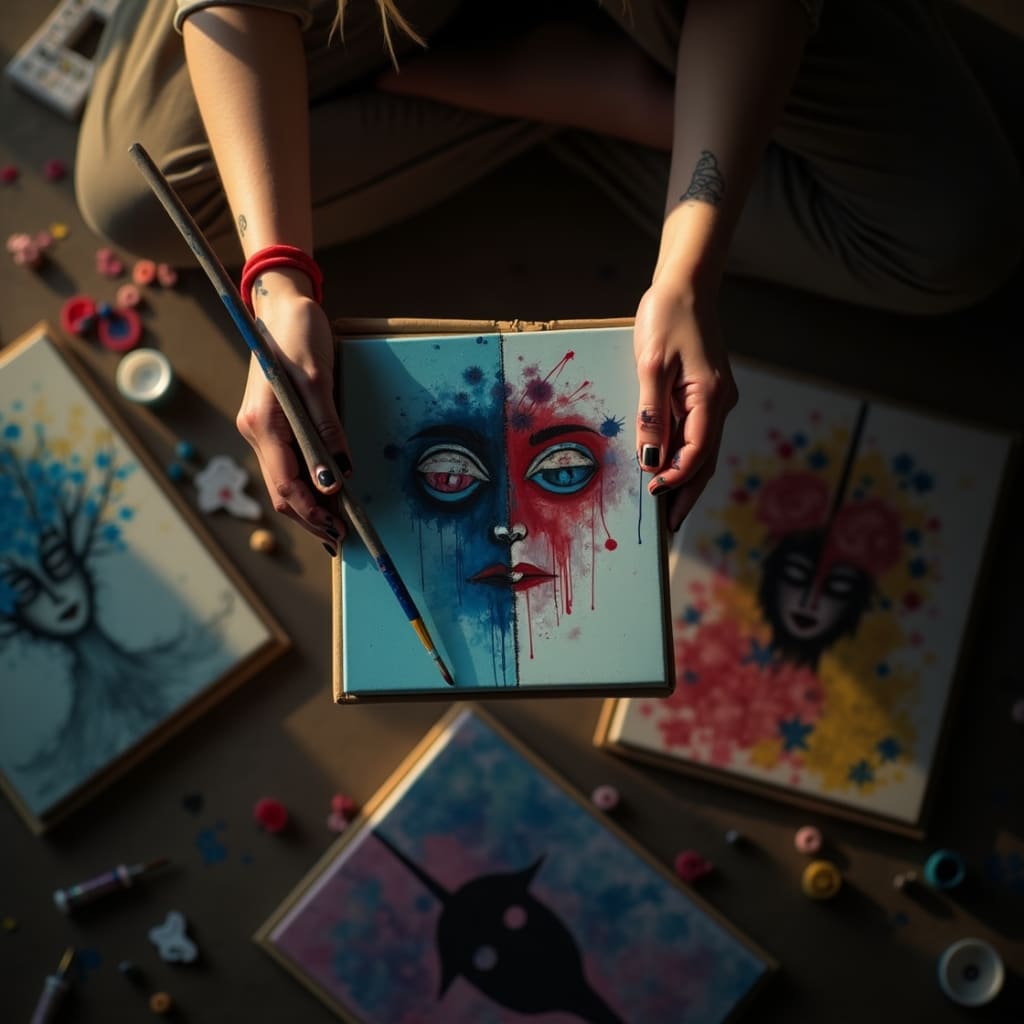
By the second canvas, my hands knew what to do even when my mouth didn’t. The brush became my voice. The colors, my emotions. I stopped trying to explain what I was feeling and let the paint speak instead.
There was a woman in blue with no mouth but wide, terrified eyes.
There was a tree with broken branches but roots that glowed gold.
There was a sunrise that looked more like a wound than a promise.
Each painting gave shape to what my thoughts could not. And slowly, in the quiet hours between painting and drying, I realized something: I wasn’t trying to be understood anymore. I was simply trying to exist again.
Art didn’t ask me to justify my sadness. It didn’t flinch when I made something ugly or dark. It didn’t interrupt me or offer advice or tell me to "get fresh air" or "just be positive." It held space. Unconditionally. Gently.
And in that space, I began to breathe again.
I painted every night. Sometimes for an hour, sometimes until the sun came up. I didn’t post anything online. I didn’t show anyone. These paintings weren’t for the world—they were for the parts of me I had abandoned in order to survive.
My therapist once asked me what I feared the most during that time. I told her, "Not being able to explain it." That the hardest part of my depression wasn’t even the sadness—it was the invisibility. The inability to express it. But art gave my pain a form. And once I could see it, I could confront it. Touch it. Heal it.
One night, months later, I painted a field of wildflowers.
They weren’t perfect—some tilted too far, others blended into the sky—but they felt alive. There was light in them. Soft light. The kind that doesn’t shout but lingers long after the sun goes down.
That was the night I cried—not out of despair, but out of recognition. I had made something gentle. And it came from me.
I still have all those paintings stacked in a corner of my studio apartment. Some are framed. Some remain on raw canvas. I don’t look at them every day. But I know they’re there—evidence that I survived. That I spoke, even when my mouth couldn’t move.
Art saved me.
Not by fixing me, but by receiving me.
When words failed, I painted.
And that was more than enough.
About the Creator
Keep reading
More stories from hazrat ali and writers in Art and other communities.
The Things We Throw Away
When I was a child, my grandfather would wash and reuse plastic bags. At the time, I found it embarrassing. While my friends brought shiny new lunchboxes, mine came wrapped in a slightly crinkled bag that had already seen a dozen sandwiches. “We’re not poor,” I’d protest. “Why can’t we just buy new ones?”
By hazrat ali6 months ago in Lifehack
Ida shaghoian and the Inner Geography of Painting
In contemporary painting, the most compelling work often resists easy definition. It lingers, unfolds, and asks the viewer to participate emotionally rather than observe from a distance. Ida shaghoian belongs to this tradition. Her paintings explore the fluid relationship between memory, feeling, and the natural world, creating spaces that feel both deeply personal and widely resonant. Through a refined balance of abstraction and suggestion, her work challenges conventional ideas of place, time, and perception.
By Ida Shaghoiana day ago in Art



Comments
There are no comments for this story
Be the first to respond and start the conversation.