
Urban Strokes: The Art of Resilience"
How Street Artists Breathe Life and Meaning into the City’s Forgotten Spaces
Urban Strokes: The Art of Resilience
How Street Artists Breathe Life and Meaning into the City’s Forgotten Spaces
In the heart of a city long bruised by neglect and indifference, a forgotten alleyway once reeked of decay—cracked bricks, garbage bins overflowing, and walls coated with years of vandalism and rain stains. Most people hurried past, heads down, avoiding the stench and sadness that clung to the space. But to Adeel, it was a blank canvas.
Adeel was a street artist—not the kind that sought fame or fortune, but the kind that carried spray cans like sacred instruments, with paint-stained fingers and eyes that could see beauty in brokenness. He had grown up just a few blocks from that very alley, in a crumbling apartment above a shuttered textile shop. His earliest memories were of sirens echoing through narrow streets, and of his mother painting henna patterns on glass jars to sell in the market.
Art had always been a way out for Adeel. Not out of the city, but out of despair. At age 14, he had discovered a set of spray paints in a junkyard, abandoned but still half full. That night, he tagged his first wall—a shaky, clumsy rendition of a dove breaking free from a cage. By morning, it was painted over by municipal workers. But he knew something had changed.
Years passed. Adeel refined his craft, mentored by other underground artists who saw graffiti not as crime, but as a form of protest and preservation. He learned how colors could clash or harmonize to express emotion, how a single line could tell a story of oppression or hope. While others painted to be seen, Adeel painted to be heard.
When the city council launched an initiative called "Revive the Walls", inviting local artists to transform derelict areas into public art spaces, Adeel applied immediately. His proposal was simple yet profound: reclaim the alley that once smelled of decay and give it a second life. He called it “Resilience Lane.”
His concept was approved. He gathered a small team of volunteers—fellow artists, students, even a retired carpenter. They cleaned the space first, hauling out years of trash, power-washing mold off bricks, repairing broken fencing. Then came the paint.
The first mural was of a young girl holding a lantern, standing in front of a storm. Her eyes were filled with courage, and the swirling clouds around her were painted with Urdu poetry that spoke of endurance and grace. On the opposite wall, Adeel painted a portrait of an elderly man with a long beard, holding a paintbrush instead of a walking stick, surrounded by wildflowers sprouting from concrete.
Passersby began to pause. Some stared in silence, others pulled out their phones. Children pointed, recognizing their own neighborhoods hidden in the colors. Even the local tea vendor, once wary of “those graffiti types,” started offering chai to the crew, often staying to chat about the murals’ meanings.
As the weeks went by, the alley transformed. What was once a dark shortcut avoided by most became a vibrant corridor of expression. More murals appeared—each telling stories of migration, memory, loss, celebration. Adeel included pieces inspired by real people: the widow who fed stray cats daily, the young boy who sold flowers outside mosques, the refugee who played violin in the park. “This,” Adeel would say, “is our museum.”
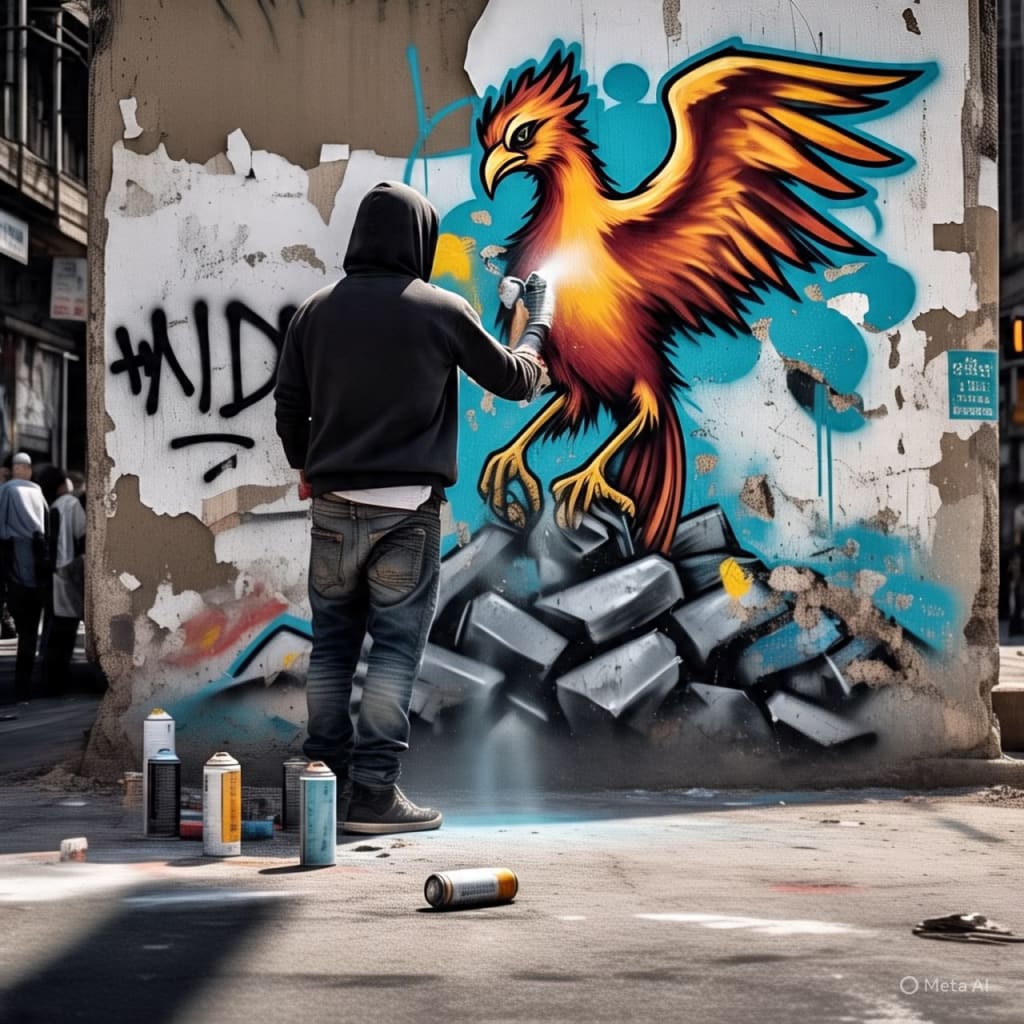
But not everyone approved. One morning, Adeel arrived to find a section of the wall vandalized—crude slogans sprayed over a mural of a mother and child. His heart sank, not just for the damage, but for the message behind it. Yet he didn’t erase it. Instead, he incorporated the vandalism into a new piece: a phoenix rising from black flames, with the words “Still We Rise” written beneath it.
The media took notice. Journalists came, asking questions about Adeel’s background, about the stories behind each piece. A short documentary aired, and soon, Resilience Lane became a destination. Tourists wandered in, guided by GPS pins and hashtags. But Adeel never let it become commercial. He refused to sell the wall. He wouldn’t take sponsorships. “This is for us,” he insisted.
What began as one man’s mission became a movement. Other neighborhoods followed, launching their own street art initiatives. Painters, poets, sculptors—each joined in to bring light to neglected corners of the city. And amidst it all, Adeel remained, quietly adding strokes to the ever-growing tapestry of resilience.
Years later, when city planners asked him to replicate Resilience Lane in other districts, Adeel smiled and said, “It’s not about replication. It’s about transformation. Find the story, and the walls will speak.”
And so they did.
About the Creator
Keep reading
More stories from Muhammad Ansar and writers in Art and other communities.
What is abstract sculpture?
Abstract art often feels mysterious because it does not rely on recognizable figures, realistic animals, or a clear narrative. Abstract sculpture follows the same principle. Rather than imitating the real world, it uses form, line, surface, volume, and space to convey ideas, movement, or emotion.
By Shenzhen Ruiheng Crafts4 days ago in Art



Comments (3)
Very interesting 🤔
Amazing art
This article about street art is really interesting. I've seen some amazing murals around town that transformed dull spaces. It's great how Adeel turned that alley around. Made me wonder, what other forgotten spots in our cities could use a dose of creativity like this? I like how art became a way for Adeel to deal with tough times. It shows how powerful creativity can be. I'm curious, what kind of impact do you think initiatives like "Revive the Walls" have on the overall feel of a neighborhood? It's cool to see how he grew as an artist, learning from others. I bet his early tags were rough, but look at him now. Makes me think about how we all start somewhere and can develop our skills over time.