
Two Popes: Reform In Church
A Cinematic Exploration
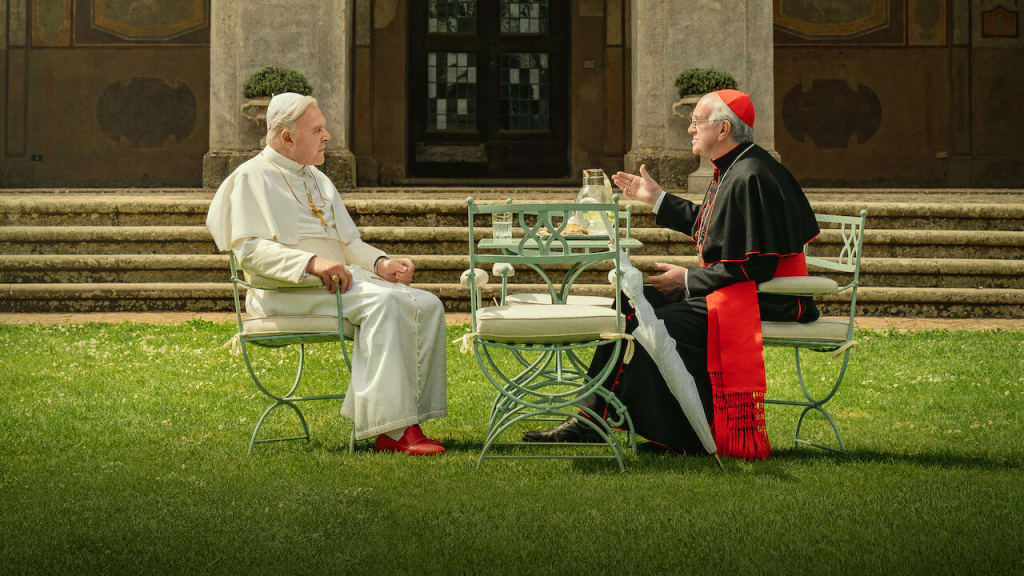
Two Popes is a film that can be read in two levels. These two levels are not independent of each other; one of them is about the film's narrative on Christianity and the other one is about the way the religion has evolved in today's world. Christianity is one of the most closed religions with its clergy and the power of the church as an institution. The institution of the church and the clergy have been closed to the outside world for centuries, maintaining a secret existence within itself. This existence is a hierarchical structure with strict rules and rituals. Through two different Popes, the film raises questions such as the necessity of change, the need for change, whether the church should be reformed or not, and whether change is possible in an institution that has been rooted in a certain closedness and rules for centuries.
The differences and contrasts between the two cardinals who are successive popes are clearly shown in many different ways from the beginning to the end of the film. The two cardinals represent two different ideas in the Catholic Church. Before we move on to the differences represented by these two people, we should talk about the transformation of religion today and how the Catholic Church is affected by this situation. In the post-modern world, religion has not completely disappeared, as had been predicted, but it has evolved into a different form. Today, religion has lost its authority over many masses. People no longer look at religion as an apparatus that has certain limits and commands and governs life; they simply place it where they want/need it in their own life experience. The phenomenon of believing in a single religion has been replaced by a religious life in which people take the parts of different religions and beliefs that suit them and meet their needs and use them to give meaning to their lives. People no longer feel dominated by the religion to which they belong; on the contrary, they incorporate elements of religion into their lives as much and as much as they want and do not feel responsible for anything more. Religion is no longer a phenomenon to which postmodern man belongs, to which he is dominated; it is merely an object of consumption. Christianity is also affected by this situation. In a world where religion no longer has authority, the church no longer has the authority it once had in the world of faith. For many Christians, the church is a place they visit only when they get married or when someone dies. Moreover, in this globalised world where social, economic and political problems are on the world agenda, people no longer respect an institution that does not respond to these problems, is not pluralistic and embracing, and has an elitist structure. This is one of the messages clearly given in the film. In addition to this, the long-standing corruption and immorality within the church and the allegations that these have been swept under the carpet have shaken the church's reputation. People want this religious institution to be more transparent and closer to the public.
From here, we can move on to the main questioning and message of the film. The main conflict of the film is the ideas of traditionalism and reformism in the church, and these two ideas are represented by two Popes who are the successors of each other. Pope Benedict wants to preserve the traditional structure of the church and strictly adheres to the rules, while Pope Francis is the opposite of him. While Pope Benedict adheres to the traditional structure and makes no concessions on controversial issues such as homosexuals joining the church and church members being able to marry, Pope Francis has liberal thoughts and argues that the church should change and keep up with the times. His justification for this is that the world is not static but constantly changing. In this regard, he criticises the current structure of the Church and accuses it of ignoring these events and dealing with "unnecessary" details such as "whether it is right or not to celebrate Mass in a language other than Latin" while people are starving, inequality is increasing and wars are taking place in the world. At this point, the film clearly takes a stand in favour of Pope Francis and liberal thought, presenting his vision as the innovation that the Church now needs. After all, in a world where gender is no longer a biological necessity, but a choice one can make, an anti-homosexual religion cannot be embracing, according to the film. It too must adapt itself to the value judgements of postmodern man so that it can find a place in the new world. Throughout the film, we are constantly reminded of how "right" Pope Francis is to be Pope. Details such as living in a modest house instead of a private residence, wearing modest clothes, sitting in the front seat of the car instead of the back seat, constantly being with poor people show how much of a "man of the people" he is. His preaching to the people on the street while Pope Benedict was blessing the royal members, his being so far from formalism that he even forgot to wear a Cardinal's hood while Pope Benedict gave importance to the formal clothes of the church members, his refusal to wear ostentatious ceremonial clothes even when he became Pope, and the ordinary shoes he wore under his papal cassock further reinforced his being a man of the people, making him a shepherd like Jesus, who had compassion for his people.
Moreover, this shepherd is a religious leader who plays the tango and loves football; in other words, he is not isolated from life, but in tune with his age. As Pope Benedict talks to him, he "breaks down his walls" and surrenders to this inevitable and necessary change. He becomes a "man of the people" like him, eating pizza and watching football matches with him. The church gets the reform it needs with the scenes shown in succession near the end of the film, where Pope Francis, after becoming Pope, is with poor and lower class people and takes care of them, and talks about the refugee problem.
About the Creator
Keep reading
More stories from writers in Art and other communities.
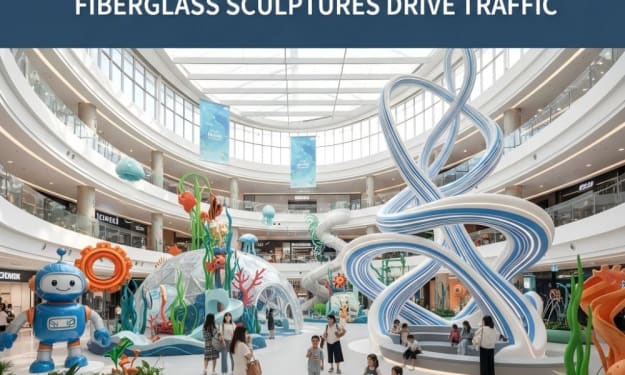
2026 Commercial Space Design:How Fbierglass Sculpture Drives Traffic
Today, offline commercial spaces are facing continuous pressure. With e-commerce offering convenient and fast services, physical stores must showcase unique features to attract customers. In this context, fiberglass sculptures are no longer merely decorative items; they have become visual focal points in shopping malls, brand stores, pop-up shops, and mixed-use commercial projects, playing a crucial role in increasing foot traffic.
By Shenzhen Ruiheng Craftsa day ago in Art
Why Strategic Branding Is Essential for Long-Term Business Growth
In today’s fast-paced digital environment, businesses face constant pressure to stand out. Consumers are exposed to endless choices every day, making attention harder to earn and trust harder to keep. While quality products and services are important, they are no longer the only factors that determine success. Strategic branding plays a key role in helping businesses grow steadily and remain relevant over time.
By Ayush Bagwaria day ago in Art



Comments
There are no comments for this story
Be the first to respond and start the conversation.