
The Village of Jamal From Fields to Future
How one young man’s education turned a forgotten village into a beacon of knowledge.

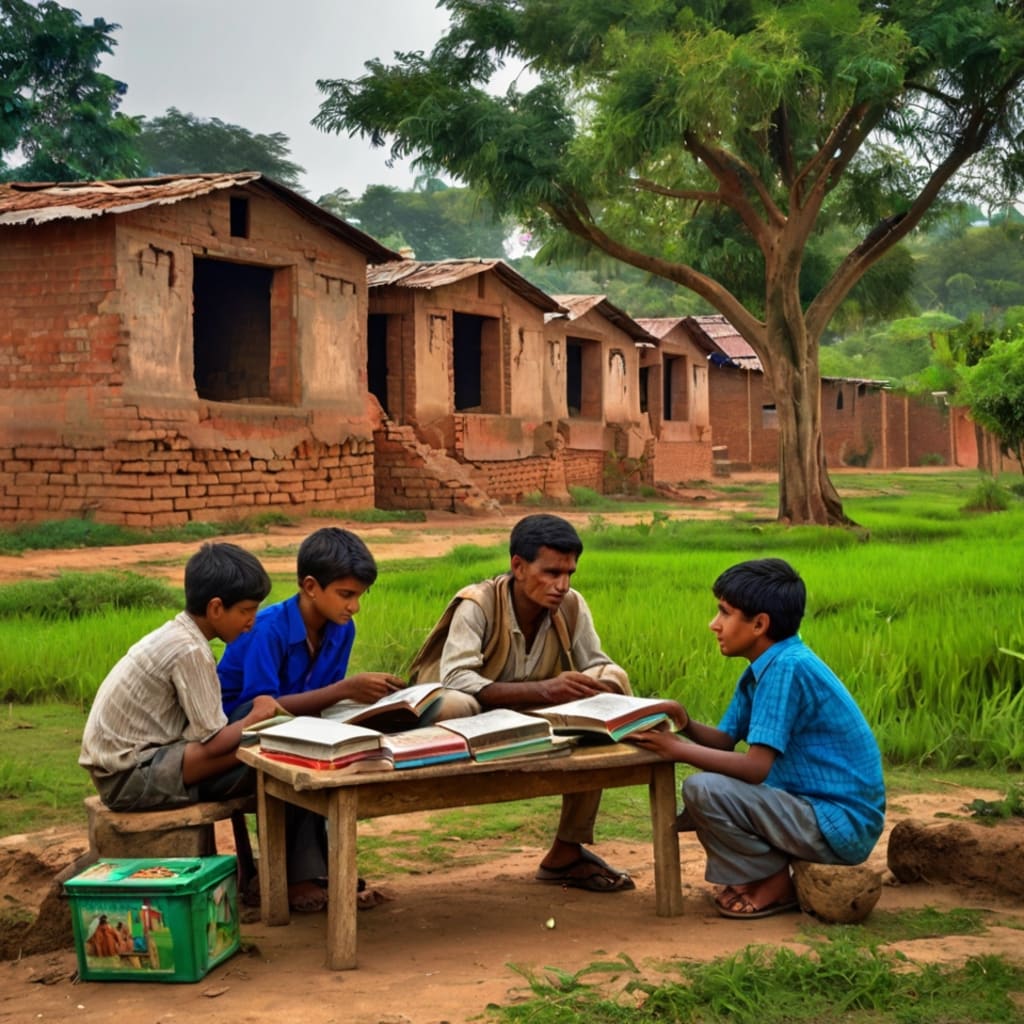
The Village of Jamal
BY: Ubaid
There was once a small village named Rizwan Malghani. It was a quiet settlement where people lived simple lives, relying entirely on farming for survival. The men tilled the fields from dawn to dusk, while the women worked alongside them, ensuring that the family hearth never went cold. Life was modest; people ate what they grew, and a meal of lentils and bread was considered sufficient blessing.
In this village lived a farmer named Shado. For ten long years he prayed and waited for a child. His prayers were finally answered when his wife gave birth to a baby boy. Overjoyed, Shado could hardly contain his happiness. He opened the old wooden chest in his mud house, took out all his savings, and shared them with the villagers. Sweets were distributed, and no household in the neighborhood was left out of his generosity.
Because the boy was born on a Friday, the villagers affectionately named him Jumma Khan. But Shado, with pride in his heart, gave his son a different name—Jamal.
As Jamal grew, something unusual happened. Unlike other children, he insisted that he wanted to go to school. This was shocking to the entire community, for no one in the village had ever spoken of schools before. Farming was the only known way of life. Education was considered unnecessary, almost alien.
The villagers tried everything to discourage the boy. Old men counseled him, women scolded him, and even his friends laughed at his strange desire. But Jamal was unshaken. His determination was stronger than their ridicule. Finally, after much resistance, his parents agreed to enroll him in a school in the neighboring village.
Every morning, Jamal would ride a horse-cart to the paved road, where he would catch a bus that took him to school. There, under the guidance of a kind teacher, Master Kareem Dad, he studied all subjects with remarkable dedication.
By the time he completed middle school, Jamal’s hunger for learning had only grown. He announced his wish to attend high school in the city. This time, the villagers were furious. “Stop chasing impossible dreams!” they shouted. “You are a farmer’s son. Be a farmer like us.”
But Jamal refused to surrender his dream. He left for the city and enrolled in a high school. His hard work paid off—when he completed his matriculation, he stood third in the entire province. This achievement ignited a fire in him, pushing him further toward college and eventually the university.
Years of tireless effort made him a well-educated young man. But when his studies ended, reality struck him hard. Good jobs required strong connections and recommendations, neither of which Jamal had. His high qualifications could not secure him employment. After many failed attempts, he returned to his village.
The villagers advised him to give up his futile dreams and return to farming. But Jamal could not convince himself to live a farmer’s life anymore. Instead, he opened a small grocery shop in the village. Day by day, he expanded it, turning it into a large general store. His business prospered, and soon Jamal became a wealthy man, admired by the entire village.
His mud house was demolished and replaced with a strong brick structure. Two solid rooms, a veranda, and a few trees stood proudly in front of the house. Jamal’s mother often sat under their shade, smiling with contentment, while Shado, now dressed in starched clothes and a turban instead of a farmer’s lungi, carried himself with pride.
Life seemed perfect. Jamal, now known as “Seth Jamal,” was respected as the richest man in the area. His shop attracted not only villagers but also people from neighboring settlements.
But prosperity brought with it a troubling change. Jamal began to notice that the village environment was no longer the same. The younger generation, who once worked shoulder to shoulder with their elders in the fields, were now wasting endless hours on mobile phones. Some even stole money to buy phones, spending their lives in idleness.
Worried parents often came to Jamal’s shop, complaining bitterly:
“Our boys no longer work. They are lost. Please talk to them.”
Jamal tried to counsel the youth, urging them to value hard work and discipline. But his words fell on deaf ears. The boys laughed and dismissed his advice, choosing to spend their days in pointless chatter at his shop.
It was during these dark days that Jamal began to remember something he had buried long ago—his education. The degrees, the knowledge, the enlightenment he had worked so hard to acquire—what had become of it? He had locked it away, just as his father had once locked his savings in a chest.
He wept in regret. If only he had used his education to awaken the minds of his fellow villagers, things might have been different. Instead, he had chosen wealth and comfort. The realization tormented him day and night until finally, he made a life-changing decision.
He told his mother that he wished to hand over the store to her and dedicate himself to educating the children of the village. Both his parents were shocked and upset. His father, especially, argued fiercely against the idea. But Jamal, with calm persistence, convinced them that this was his true calling.
Soon, a school was established in the village. Jamal became not just a teacher, but a mentor, guiding children who were once drifting toward darkness. Slowly, the village began to change. The boys who had wasted their days on mobile phones started attending classes. Knowledge spread like sunlight breaking through clouds.
Years passed, and Jamal’s hard work bore fruit. From that small village emerged doctors, engineers, teachers, and professionals—men and women who carried the torch of knowledge into the wider world.
Had Jamal not realized his mistake in time, the village would have remained nameless, lost to ignorance. But because of him, it rose to prominence and came to be known by a new name—Jamal Wala, the village of Jamal.
About the Creator
'Till Death We Do Art
There would be nothing divine in this world without art. Nature may surpass the divine to all intents and purposes, but like everything it absorbs and is absorbed by, it remains here, stuck on the surface of this world, ever-present, physically bound to the universe.
By Avocado Nunzella BSc (Psych) -- M.A.P 24 days ago in Art
The Beauty of Nature
Once in a small village called Greenvale, surrounded by lush forests and towering mountains, lived a young girl named Lila. She was curious and adventurous, always exploring the beauty of nature that surrounded her. Lila had a special bond with her best friend, a boy named Kai, who shared her love for the outdoors. They spent countless hours wandering through the woods, discovering new plants, flowers, and hidden streams.
By Hamad Afridi 7 days ago in Art
A More Human Vocal
When we launched Vocal nearly a decade ago, the world was a very different place. LLMs did not exist, and stories were created one at a time by people sitting down to write, revise, and share something personal. Many of our assumptions about publishing, trust, and participation were built for a world where effort and output were inseparable.
By Justin @ Vocal7 days ago in Resources




Comments
There are no comments for this story
Be the first to respond and start the conversation.