
The Unnamed: Chronicles of a Faceless Journey
When identity dissolves, what remains? A visual meditation on existence, mortality, and the search for meaning in a cosmos that remembers nothing.

There is a VHS tape somewhere in my mind, dusty and forgotten, labeled simply "LIFE." It sits among relics I cannot name—fragments of bone, the architecture of a ribcage, remnants of what once was. I have been thinking about this tape recently, wondering if anyone would bother to play it. Wondering what they would find if they did.
We spend our existence curating faces—masks we wear for lovers, for strangers, for the mirror at 3 AM when sleep refuses to come. But what happens when you peel away that final layer? When the face becomes not a canvas but an absence?
This is where my journey begins. Not with answers, but with a deliberate unmaking.
I grew up believing that identity was something you built, brick by careful brick. A name. A story. A face the world could recognize. But somewhere along the way—perhaps in the quiet hours before dawn, or in the moments between heartbeats—I realized we spend our lives constructing monuments to a self that never truly existed. We are palimpsests, each version written over the last, until the original text becomes impossible to read.
The figure you see carries no face because it needs none. It is everyone. It is no one. It is the self stripped of pretense, standing in a room where life and death share the same ornate rug, where mortality isn't a distant specter but a close companion, sitting cross-legged beside us, patient and inevitable.
The Weight We Carry
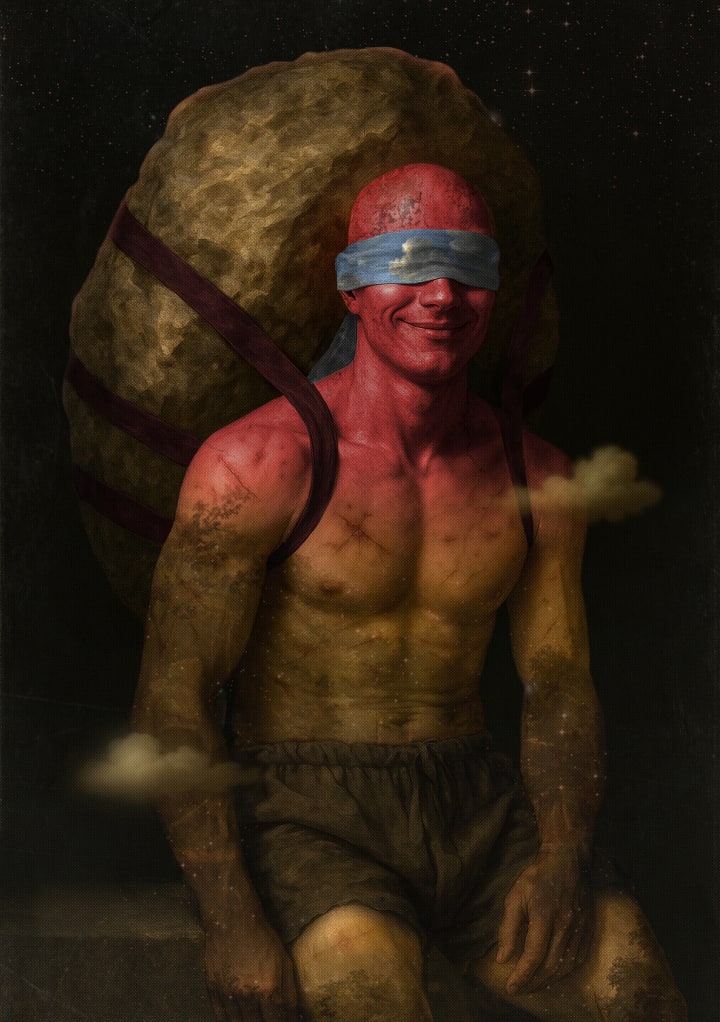
I have often wondered about the weight we carry—not the physical kind, but the accumulated mass of days lived, choices made, words left unspoken. In this image, a figure stands blindfolded, a boulder impossibly large balanced on his shoulders. Yet look closely: there is a smile. Not of madness, but of acceptance.
We are all Atlas in our own myths, bearing worlds we cannot see. The blindfold isn't a punishment; it's a mercy. If we could see the true weight of our burdens—every regret, every missed connection, every version of ourselves we abandoned along the way—we might not take another step.
But we do. We always do.
The cosmic backdrop isn't decorative. It's a reminder that our struggles, however monumental they feel, play out against an infinite canvas. The universe doesn't witness our burdens. It doesn't keep score. We carry these stones because something in us insists we must, because the act of carrying gives shape to existence itself.
There is strange comfort in this. We are small. Our burdens are temporary. And yet, in the carrying, we become briefly significant—not to the cosmos, but to ourselves.
Conversations with Mortality
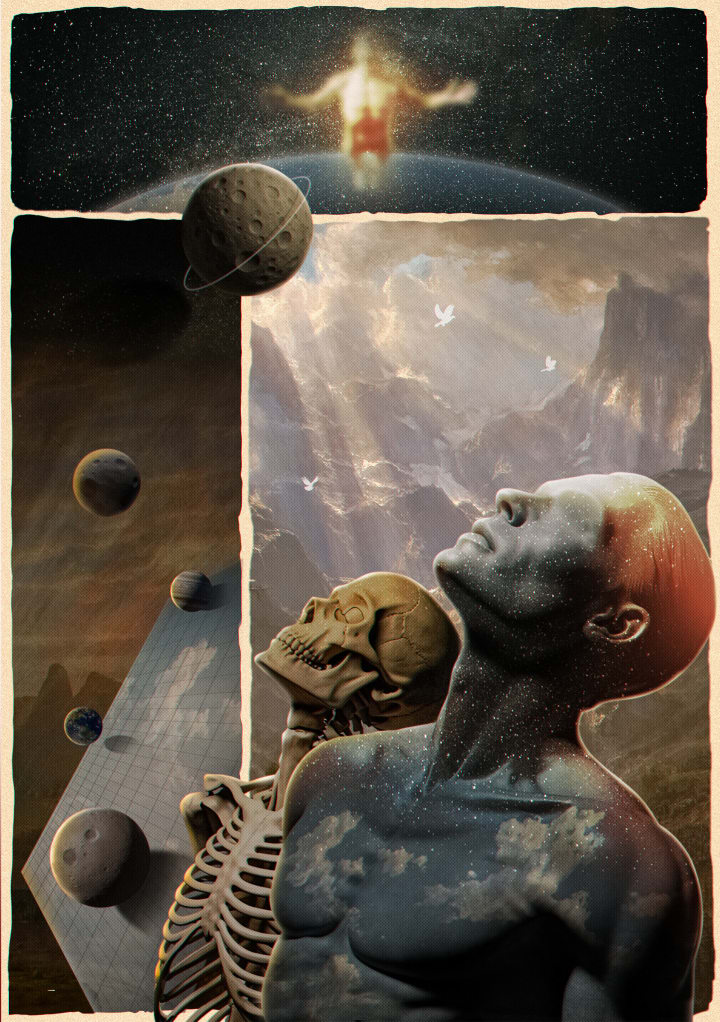
Death has been my studio companion for as long as I can remember. Not as a morbid fascination, but as an honest acknowledgment. The skeleton in these pieces isn't a warning—it's a conversation partner.
Look at the way flesh and bone coexist, how the skeletal form merges with cosmic dust and starlight. There's a tenderness here that surprises even me. The skeleton gazes upward, not in horror but in wonder. The mask-like face reflects a sun that might be setting or rising—we cannot tell, and perhaps that's the point.
We are, all of us, temporary arrangements of stardust. The atoms in our bones were forged in dying stars billions of years ago. We are the universe becoming conscious of itself, if only for a brief, flickering moment. Then we return to the elements, and the conversation continues without us.
This isn't tragedy. It's the natural rhythm of existence.
I think about the generations that came before—people who laughed, loved, suffered, and dreamed just as intensely as we do. They are gone now, every single one from centuries past, and yet something persists. Not in monuments or memories, but in the fact that we continue the conversation they started. We pick up where they left off, adding our verse to an endless poem.
The birds scattered through the composition aren't symbols of the soul escaping the body—I don't presume to know what happens beyond this life. They are simply movement, continuation, the endless flow of existence that neither begins nor ends with us.
The Artist and His Canvas
There is a peculiar intimacy in creation. Not the grand, mythological kind—I make no claims to divine inspiration. But the quiet act of bringing something into being where there was nothing before.
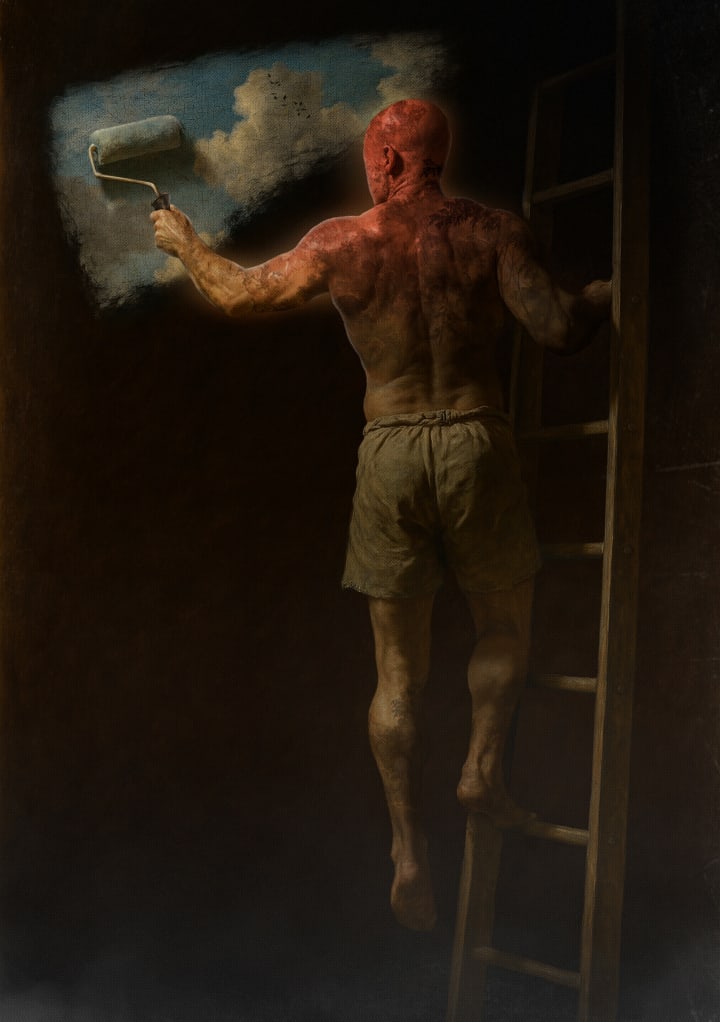
Here, a figure stands on a ladder, paint roller in hand, creating a sky. Or is he covering one? The ambiguity is intentional. We are always simultaneously building and obscuring, revealing and hiding. Every choice we make paints over infinite possibilities. Every word spoken silences a thousand others.
The ladder is precarious. It always is. Creation requires vulnerability—the willingness to reach beyond your stable footing, to risk the fall for the possibility of adding something meaningful to the world. The figure's back is turned to us, not in rejection but in focus. This is the solitary nature of making: you and the work, everything else fading to silence.
I paint because I must. Not because the world needs another image, but because something inside me becomes unbearable if left unexpressed. This isn't romantic—it's closer to hunger, to the body's insistence on breath. You create not to be remembered, but because in the act of creation, you briefly exist more fully than you do in the passive consumption of life.
The painted sky emerges dark and luminous simultaneously—storm and starlight. This is the paradox of artistic work: you cannot control what you create. You can only show up, do the work, and hope that something true emerges from your hands.

Multiplicity of Self
We contain multitudes, though we pretend otherwise. The person you are with your mother differs from the one your friends know, who differs from the stranger you glimpse in department store mirrors, who differs from the self that exists only in the privacy of your thoughts.
In these images, the self fractures and multiplies. A skeleton reaches toward cosmic phenomena, its gesture both plaintive and curious. Blue-tinted hands hold a golden mirror-frame containing not a reflection but a cosmos—a sun, or perhaps a portal to something beyond naming. A figure levitates above a jungle landscape, cosmic windows revealing skeletal truth, while the self continues its journey across an impossible geography.
Which version is real? All of them. None of them. We are not singular beings moving through time, but rather a procession of selves, each one authentic in its moment, each one disappearing as the next emerges.
The mirror doesn't show us who we are—it shows us who we think we are in that instant, filtered through every story we've ever told ourselves. The cosmic backdrop suggests something I've come to believe: that identity is less a fixed point and more a trajectory. We are not beings but becomings, constantly rewritten by time, experience, and choice.
There's freedom in this realization, and terror in equal measure. If you are not the same person you were yesterday, then who is responsible for yesterday's actions? Who receives tomorrow's consequences? We want continuity, a through-line we can call "I," but perhaps that coherence is the kindest lie we tell ourselves.


The Descent and Ascent
Every journey worth taking includes a descent. Not as punishment, but as necessary passage. You cannot reach higher ground without first acknowledging the depths.
In one image, a figure stands at the center of concentric circles—a target, perhaps, or ripples emanating from a point of impact. Above, a crosshair locks onto a celestial body. We are always being aimed at by forces beyond our comprehension: time, circumstance, the random cruelty and grace of existence itself. Yet we stand. Bloodied, anonymous, but standing.
Another shows a figure bowed beneath the weight of what looks like the cosmos itself—the torso carved away to reveal not organs but infinite space. This is closer to truth than we'd like to admit. We carry universes inside us: every person we've loved, every place we've been, every version of ourselves we've left behind. The weight is real, even if invisible.
Then comes the moment of transformation—figures ascending, multiplying, hovering above autumn landscapes while something bright and unknowable beckons from above. Not heaven—I make no such claims. But something. The pull toward meaning, toward transcendence, toward becoming more than the sum of our scars.
The blindfold appears again, but this time on a figure surrounded by birds and light, chest marked with warmth, shadows flanking but not consuming. This is acceptance. This is the moment when you stop fighting what you are and begin working with it instead.
The Assembly of Existence
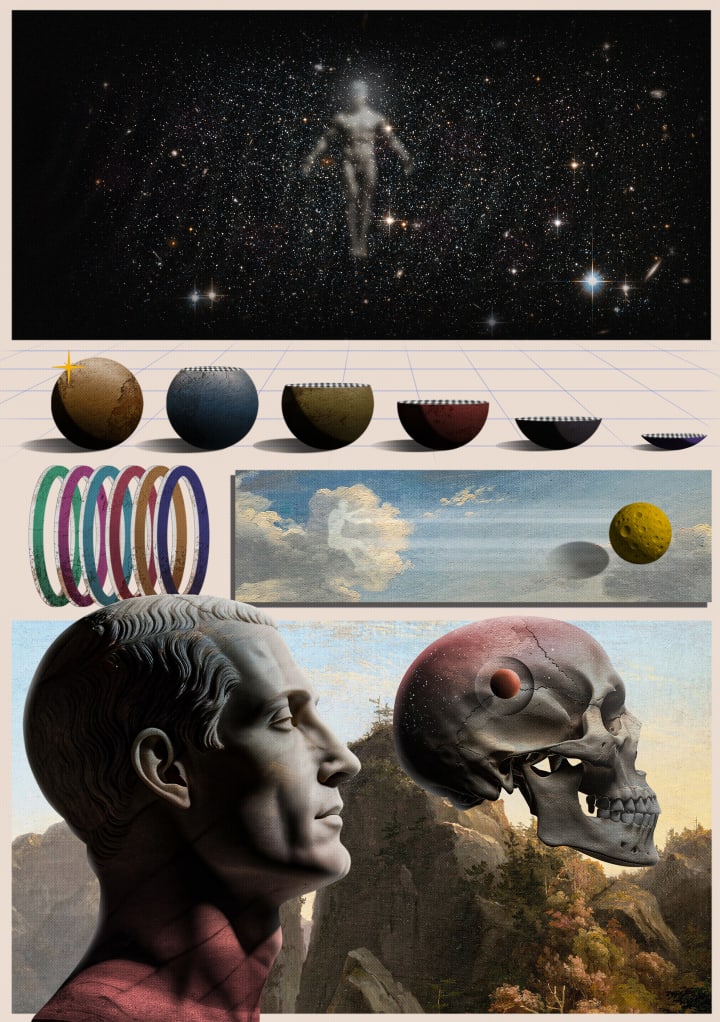
At the end—or is it the beginning?—we find ourselves looking at fragments. A cosmic figure dissolving into stars. Spheres in various states of completion, peeling away to reveal new layers. Colored rings that might be portals or simply decorative elements in a composition that defies linear reading. A classical bust contemplates a skull that contemplates back.
This is how memory works. This is how meaning accrues. Not in neat narratives, but in collages, in juxtapositions that shouldn't work but somehow do. The pieces don't form a clear picture because life doesn't offer clear pictures. It offers moments, fragments, contradictions that we spend our existence trying to arrange into something coherent.
The bust and the skull face each other—life and death, the beginning and the end, having an eternal conversation. Neither judges the other. They simply are, two poles of the same experience, neither possible without its opposite.
The spheres peeling away suggest layers of understanding. Every answer reveals ten new questions. Every truth we uncover shows us how much more remains hidden. This isn't frustrating—it's the fundamental nature of growth. We are always partially blind, always reaching toward comprehension that remains just beyond our grasp.
And perhaps that's exactly as it should be. If we understood everything, there would be nothing left to discover. The mystery isn't a problem to be solved but the very substance of lived experience.


Epilogue
I began this essay with a question about the VHS tape labeled "LIFE," wondering if anyone would bother to play it. I realize now that the tape has been playing all along. We are the content and the audience simultaneously, recording and watching, creating and consuming our existence in real time.
These images aren't answers. They're offerings—visual questions posed to anyone willing to sit with discomfort long enough for something to emerge. They're reminders that beneath our curated identities, our carefully constructed stories, we are all faceless figures carrying impossible weights, having conversations with mortality, painting skies we might never see completed.
There's a particular loneliness in being human. We are each trapped in a single perspective, unable to fully know another person's interior experience, unable to see ourselves as others see us. These artworks are my attempt to bridge that gap—not to close it, but to acknowledge it, to say: I am here, in my isolation, reaching toward you in yours.
If you've stayed with me this far, I hope you've found something worth the journey. Not comfort, necessarily—I have little of that to offer. But perhaps recognition. Perhaps the quiet assurance that whatever weight you carry, whatever face you've lost along the way, whatever conversations you're having with your own mortality—you're not alone in it.
We are all faceless figures on ornate rugs, surrounded by relics of what came before and what will come after. We are all carrying boulders we cannot see. We are all painting skies in darkness, hoping someone, somewhere, will look up and understand.
This is not tragedy. This is not triumph. This is simply what it means to be briefly alive in an indifferent universe—to create meaning where none was given, to continue despite knowing the ending, to reach across the void with paint and pixels and hope that connection, however fleeting, is possible.
The tape keeps playing. The conversation continues. And somewhere, a figure without a face takes another step forward, carrying weight that might crush them, toward a horizon that might not exist, for no reason except this: it's what we do. It's all we've ever done.
Artwork created by Vertigo. A visual exploration of the human soul.

About the Creator
Prompted Beauty
Visual Artist & Storyteller (Design × Poetry)
Keep reading
More stories from Prompted Beauty and writers in Art and other communities.
The Mapmaker of Sleepless Cities
There are cartographers of oceans and of stars, but I have chosen a different trade. I am a mapmaker of the territories we carry within us — the sprawling, sleepless cities of the mind. I chart the highways of thought, the quiet suburbs of nostalgia, and the bustling downtown districts of our anxieties. For years, I believed these lands were invisible, impossible to document. Then, I began to paint them. What you see here are not mere pictures; they are recovered maps of a world we all inhabit but rarely dare to explore. Let us take a journey together.
By Prompted Beauty6 months ago in Art
'Till Death We Do Art
There would be nothing divine in this world without art. Nature may surpass the divine to all intents and purposes, but like everything it absorbs and is absorbed by, it remains here, stuck on the surface of this world, ever-present, physically bound to the universe.
By Avocado Nunzella BSc (Psych) -- M.A.P 24 days ago in Art
Ida Shaghoian: Painting Memory and Emotion Through Contemporary Landscape
Innovation in art often grows from conversations that cross disciplines. Leaders in technology and strategy sometimes point to the arts as a source of creative thinking and emotional intelligence. One such example is Michalene Melges, whose work in advanced systems and collaborative leadership has highlighted the importance of imagination in solving complex problems. Her perspective reflects a broader cultural truth. Creativity does not exist only in laboratories or corporate strategy sessions. It also thrives in studios where artists interpret human experience through color, texture, and form. Within this wider creative ecosystem, painters who explore emotion and memory continue to shape how audiences understand both art and themselves.
By Ida Shaghoian7 days ago in Art




Comments (1)
As I was browsing the web, I came across the article you wrote about my work. One of my biggest questions as an artist has always been how my art is seen through others’ eyes, and whether the visions I had while creating it actually reach the viewer. Reading your beautiful analysis and commentary genuinely answered all of those questions for me, and even gave me new ideas for future pieces. Thank you so much for that, I truly appreciate it. Much love, V.