
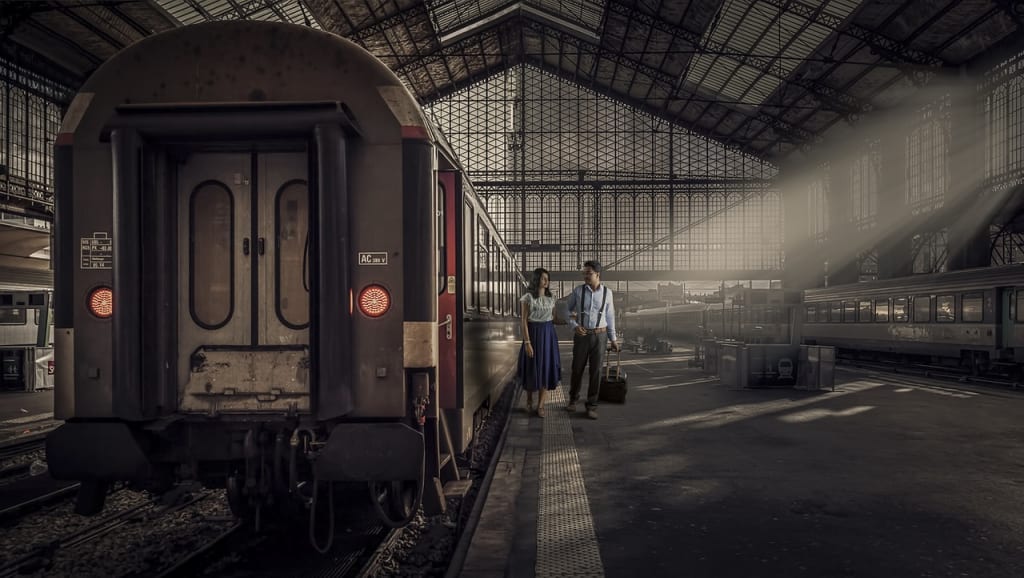
The Last Train to Tanjong Merah: A Journey Through Time, Memory, and Farewell
By [Your Name]
In the deep hours of a humid Southeast Asian evening, long after the cities have dimmed their lights and the hawkers have folded up their stalls, a single train still rumbles along forgotten tracks—its final destination: Tanjong Merah.
A Vanishing Place
Tanjong Merah is not on any modern map. Ask a local, and you might receive a knowing nod or a confused shrug. It’s one of those places that used to matter—once a thriving junction town on the edge of the Malayan Peninsula, where rubber barons and tin miners once passed through. Now, it’s a near-mythical waypoint, hidden behind vines, time, and tide.
The last train that makes its way there is part machine, part memory. It doesn’t run on schedule; rather, it arrives when stories need closure, when regrets call out to be resolved, when someone is finally ready to let go.
Passengers of the Past
The train's passengers are rarely ordinary commuters. They are the forgotten and the remembering—the aging woman seeking the grave of a wartime lover; the disillusioned bureaucrat craving a glimpse of childhood joy; the wayward son returning to say what he never did. Each compartment holds a different decade, soaked in the sepia tones of longing.
There’s no ticket booth, no announcements. If you find yourself on the platform, it means you were meant to board.
The Journey Inward
Though the train physically chugs through old jungle routes and over rusted bridges, the true journey is internal. With every passing station—Kampong Dalam, Serai Junction, and Batu Tiga—the passengers shed something: bitterness, sorrow, fear. The conductor, always silent, seems to understand what each soul needs.
One can never board this train twice. It is not a commuter line, but a pilgrimage. It’s said that those who ride to Tanjong Merah either return transformed or not at all.
Tanjong Merah: Arrival or Departure?
The station itself is less a place than a state of mind. A moss-covered sign leans into the wind. There’s no one waiting. Or sometimes, just one person: someone you thought was long gone. Some passengers disembark and vanish into the misty rainforest. Others step off, only to find themselves standing on the platform of their present life—lighter, somehow, and unburdened.
And the train? It doesn’t linger. It hisses once, as if sighing for all the stories left untold, and disappears down the track, until it’s needed again.
Metal from a metaphor Whether Tanjong Merah ever existed is beside the point. The final train to Tanjong Merah is more about acceptance than geography. It represents a final chance—not of escape, but of reconciliation. With others. With the past. With yourself.
So if you ever hear the low whistle in the middle of the night, don’t be afraid. Maybe it’s your time. Maybe the last train to Tanjong Merah is coming for you—not to take you away, but to bring you home.
Would you prefer that this be published as a short story or with illustrations? During the downpour, Tanjong Merah had greeted the train and served as its much-needed host. The keeper alone kept track of every appearance and departure. Su Min, pale, in a soaked uniform, arrived like clockwork every Friday of the month since then.
Additionally, another individual from Tanjong Merah's platform would vanish. Without footwear Echoes of thunder and lightning were heard as the tram entered the depot. The Keeper opened his logbook, preparing to record that Friday’s names—and saw his own, already penned.
The station bell tolled, without being touched.
Su Min arrived, pale-faced, eyes hollow. She said nothing, but opened her umbrella, revealing tram tickets stitched within.
The keeper didn’t have any—he didn’t need one. But he understood.
Su Min guided him aboard the train, handing him her stitched umbrella.
She stepped off. The tram hissed, breathing for the last time.
At dawn. the depot stands empty, buried under an overnight construction project. Only an old pair of shoes remains, tattered from years of walking and groundskeeping.
About the Creator
'Till Death We Do Art
There would be nothing divine in this world without art. Nature may surpass the divine to all intents and purposes, but like everything it absorbs and is absorbed by, it remains here, stuck on the surface of this world, ever-present, physically bound to the universe.
By Avocado Nunzella BSc (Psych) -- M.A.P 23 days ago in Art
The Beauty of Nature
Once in a small village called Greenvale, surrounded by lush forests and towering mountains, lived a young girl named Lila. She was curious and adventurous, always exploring the beauty of nature that surrounded her. Lila had a special bond with her best friend, a boy named Kai, who shared her love for the outdoors. They spent countless hours wandering through the woods, discovering new plants, flowers, and hidden streams.
By Hamad Afridi 6 days ago in Art
A More Human Vocal
When we launched Vocal nearly a decade ago, the world was a very different place. LLMs did not exist, and stories were created one at a time by people sitting down to write, revise, and share something personal. Many of our assumptions about publishing, trust, and participation were built for a world where effort and output were inseparable.
By Justin @ Vocal6 days ago in Resources



Comments
There are no comments for this story
Be the first to respond and start the conversation.