
The Shot and The Scream
"It was the worst thing I could have done: I tried to love a man who would not be loved."

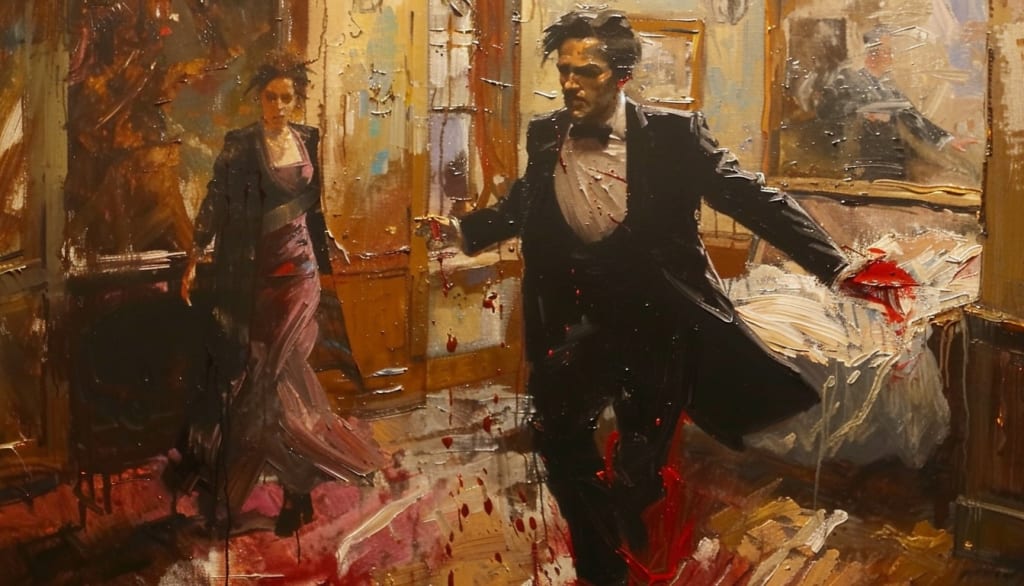
Written for Raymond G. Taylor's "Girl With The Golden Earring" Unofficial Challenge.
This is the penultimate chapter of the novel The Shot and The Scream.
Journalist Missen Purdew is obsessed with The Scream – a painting synonymous with madness. The artist, Edvard Munch, died in 1940, having never married and leaving many questions about his relationships and his sanity.
Now, in 1948, Purdew's quest brings him to the person who knew Munch best, who was present for both 'the shot' and The Scream...

"He was something of a lost soul," Tulla Larsen tells me.
I see the brandy hover at her lip before she takes a sip.
It has been six years – almost to the day – since Edvard's agent gave me access to the great artist's papers. Six years, during which I have criss-crossed the north Atlantic, western Europe, and the Oslo archipelago.
Then, in a hand-written note delivered under my hotel room door, Tulla said that she would speak to me – today.
I had requested such a meeting several times over the years, so Tulla has been aware of my quest for a long time. So why today?
Regardless, I now find myself in the presence of the keystone of my investigation: Tulla Larsen. Edvard Munch's long-held but forever-unrequited lover and muse.
I would be lost for words had I not prepared utterly for this moment.
"Ms Larsen, I wondered if you could tell me how much you know of his life after you separated?"
"Only as much as you, Mr Purdew. Only what was reported."
This is a slight aimed at me. The press had hounded them in those heady early years, and Tulla felt it had enabled Edvard in sidelining her. She pursued him for years, across countries, seeking marriage, but he always refused, claiming the work came first.
I am held for a moment by her confident beauty. Her skin is fair and soft. Her copper hair is held back in a loose bun that rests upon her nape. Though she is a widower now, the young muse still glows within her.

"So you didn't hear from him again after...?"
"After the shooting?"
"Indeed I did not."
The shooting was the final and defining incident of their relationship. If indeed it was a relationship. Truly no one knew but them.
Neither would admit who fired the gun. All anyone knew was that it was Edvard who was seen emerging from their hotel room with his left index finger held on by a bloodied handkerchief.
"But you didn't go to the police," I say.
"And nor did he."
"But was it not a quarrel that precipitated the event?"
She sets her brandy on the table and looks at me directly.
"I'm telling you no more about what occurred in that room than I have to any other newsman who has asked me that question."
She is so direct and so self-assured in person that I wonder why she allowed herself to be mistreated for so long by Edvard. Why did she put up with it? I had always believed that the shot was Tulla's final expression of her frustration with Edvard, one he could not ignore.
But I cannot believe any man would have thought this woman insignificant.
"So afterwards–" I begin.
"I didn't contact him," she cuts me off. "And he didn't contact me. Let me remind you that I got married. Twice. I don't look backwards when it comes to men."
She tucks her blanket under her thighs. It is not yet winter, but the changing seasons bring cold winds. The light turns her skin to marble.

I have touched a nerve, so I change tack.
"Ms. Larsen, I have his journals. Were you aware he kept them?"
She doesn't answer or lift her eyes from the fjord beyond the window, black beneath the clouds. I open the manifold of my briefcase and pull out transcripts which I typed myself.
"The journals mostly describe his travels and exhibitions, occasionally his struggles with low mood, and with narcotics... But he never mentions his relationships."
"Because he didn't have them," she says firmly. "He couldn't trust his sanity, so he couldn't trust himself to be in a relationship."
I hesitate before holding out a page to her.
"You will notice I have underlined some of Edvard's words, curiously written in the third person. He explains in very rational terms why he considers himself 'incompatible' with love."
The page trembles as I hold it out, but she does not look at it.
"His siblings and his father were cursed by melancholy. And then madness," she says. "Edvard, he suffered the former, but he feared the latter. The prospect of one day losing his mind was 'an infinite scream passing through nature.' His own words, and they haunted him. Daily. Constantly."
"If you'll excuse my asking, was this the reason that you and he... why your relationship could not endure?"
She registers my impertinence but doesn't dismiss the question. Fatigue – or a cloud – crosses her face.
"It was his way..."
Her tone is resigned, knowing perhaps such questions are inevitable. I don't interject.
"It made him a great artist, but a tortured man."
She inhales, measuring her words.
"I read your articles, Mr Purdew. I don't know whether you are deliberately courting my anger, or if stoking controversy sells more newspapers..."
"I am paid by the word, Ms–"
"But I can tell you that Edvard was not a cruel man. Indeed, he was only cruel to himself. Knowing his great capacity for love, but not allowing himself to give it."
I hold my tongue, sensing revelation.
"Foolishly, I persisted. But with Edvard it was the worst thing I could have done. I tried to love a man who would not be loved."
I sense her resolve weakening. I push for the answer I came for.
"Who held the gun, Tulla?"
She turns back to the window. For some moments, I'm uncertain if she'll answer. But at last she gives me these words:
"I wanted to show him what he meant to me. But he wouldn't let me. Instead he showed me what he meant to himself."
Then she is lost again in the fjord's black depths.

The final chapter describes Purdew's own descent into melancholy. Then the manuscript ends abruptly.
In an epilogue, Purdew's estranged daughter writes that her father died alone. She does not disclose the circumstances.
She reads the manuscript, hoping to understand why her father abandoned his family. But she is left wondering why men so often shun love only to lose themselves in obsession.

Do you have a short attention span? So do I!
That's why I write short stories with big impact.
Please read, like and comment – your support means everything!
My longer stories are available as eBooks – including darkly hilarious horror story HEAD CASE and outrageous feminist splatterpunk METAGOTH, featuring goth antiheroine Rosa Razor. Out now on GODLESS and Kindle.
About the Creator
Keep reading
More stories from Addison Alder and writers in Art and other communities.
Baby's First Steps (Ending)
The ISS is oscillating, gently but constantly. I am tethered in the Soyuz descent module. It's docked at the far end of the Russian Zvezda module, mothballed and neglected. For decades since the 1960s, these old Russian ships had been our Crew Return Vehicles – our lifeboats – until SpaceX's Dragon programme superceded them.
By Addison AlderExclusive • about a year ago
'Till Death We Do Art
There would be nothing divine in this world without art. Nature may surpass the divine to all intents and purposes, but like everything it absorbs and is absorbed by, it remains here, stuck on the surface of this world, ever-present, physically bound to the universe.
By Avocado Nunzella BSc (Psych) -- M.A.P 13 days ago in Art
Ida Shaghoian: Painting Memory Through Atmosphere and Light
In the world of contemporary art, few painters capture the subtle interplay between memory and environment as compellingly as Ida Shaghoian. Her work stands at the crossroads of abstraction and landscape, where color becomes language and texture becomes memory. Rather than presenting straightforward depictions of nature, she offers immersive experiences that encourage viewers to slow down, reflect, and reconnect with their own emotional landscapes.
By Ida Shaghoian4 days ago in Art



Comments (10)
Extraordinary writing! You handle the slow reveal like an old pro and the revelation burns like a branding iron.
What a hauntingly beautiful piece. Congratulations on winning a runner up spot in Raymond's challenge.
Amazing! Hopefully you continue this. I can’t wait to read more!
Munch is such an interesting figure. I love stories that feature the real life of beloved artists/writers/creatives. Didn't know about this particular affair before. "I tried to love a man who would not be loved." is such a good line. Very emotionally honest and painful.
Beautiful dialogue. Engaging and suspenseful. And so intimate. I felt like I was in the room with them. Nicely done Addison.
This hit me so hard. It was soooo emotional! "Knowing his great capacity for love, but not allowing himself to give it." This line was especially sooo heartbreaking
Interesting
Great dialog and the sense that there is SOMETHING MORE just under the surface of every word comes through.
I have been to a Munch exhibition and I am intrigued by this story. Thank you for this.
Nice article