
“The Price of Gold”
“How Easy Money Almost Cost Everything”

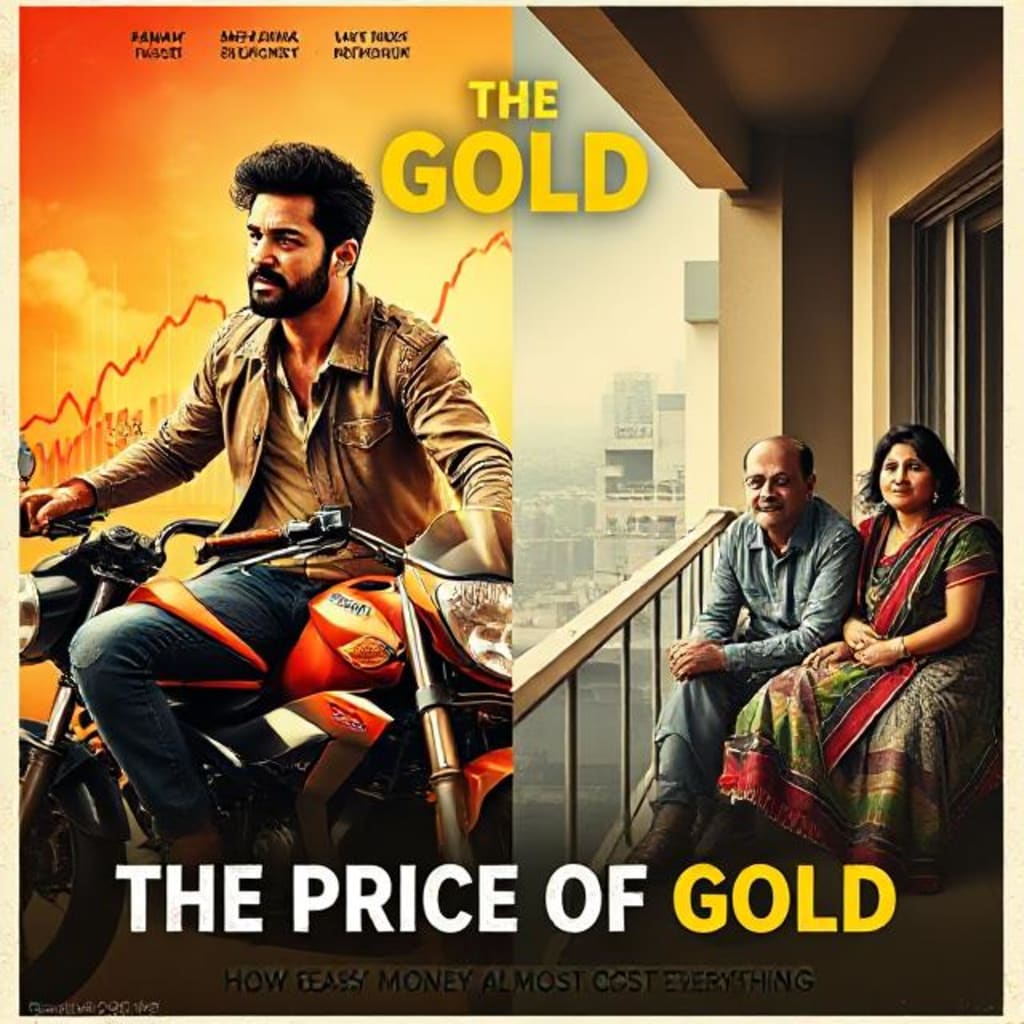
In the heart of Mumbai, amid the maze of concrete and chaos, lived a man named Raghav Mehra. By day, Raghav was a small-time clerk in a government office, earning just enough to feed his family and keep a roof over their heads. By night, he was a dreamer. He dreamed of riches, of silk shirts and imported cars, of power and prestige. But all he had was a cracked cell phone, a rusted scooter, and a wallet that never quite felt full.
Raghav’s life was monotonous, governed by routine and ruled by struggle. His wife, Asha, worked two jobs to help support their children’s education. Their apartment was humble, with peeling paint and windows that let in more dust than light. Yet, somehow, there was love—raw and real.
But Raghav wanted more.
One rainy evening, as Raghav sat in a roadside tea stall, nursing a half-empty cup, he overheard two sharply dressed men talking about the stock market. Words like “dividends,” “bull run,” and “multibagger” floated through the humid air. Raghav leaned in, captivated.
“Just imagine,” one of them said, “I invested ₹50,000 and made ₹5 lakh in six months. Easy money.”
That night, Raghav couldn’t sleep. Easy money. The phrase echoed in his mind like a siren call. He opened an account on a trading app the very next day. At first, he used his savings—just ₹10,000. Then, he borrowed from friends. Then, from a local lender. The returns came fast, and so did his appetite.
Soon, Raghav’s lifestyle changed. He upgraded to a new smartphone. He started wearing designer shirts to the office. He even brought home a shiny new motorbike. Asha was skeptical, but he dismissed her concerns with a wave.
“It’s all under control,” he’d say. “Trust me.”
What he didn’t say was that he had borrowed nearly ₹5 lakh now, and his trades were growing riskier by the day.
Then, the crash came.
A company he had bet heavily on collapsed under a fraud scandal. Within a week, Raghav lost everything—his investment, his borrowed capital, and his peace of mind. The lenders came knocking, not with patience but with threats. His phone rang with ominous messages. His smile vanished. So did his sleep.
The transformation was swift.
He sold the motorbike. Then the TV. Then Asha’s wedding jewelry. But it wasn’t enough. The debt ballooned with interest, and Raghav, once a dreamer, became a shadow of himself.
One evening, Asha found him sitting motionless on the balcony, staring at the traffic below.
“I thought money would save us,” he whispered. “I thought if I had enough, I could finally give you everything you deserve.”
Asha sat beside him. She didn’t speak for a long time. Then she said, quietly, “Money helps, Raghav. But it doesn’t fix a broken foundation. You didn’t need to chase the world. We were enough. You were enough.”
Her words pierced deeper than any lender’s threat. That night, Raghav decided to change.
He took a second job as a night-shift data entry operator. He started repaying his debts, one small chunk at a time. Asha continued working, and together, they rebuilt their lives—not with dreams of gold, but with grit.
Years passed.
Their children grew. One became a teacher, the other an engineer. Raghav never returned to trading. But every time he passed a tea stall, he remembered that conversation that had changed his life.
He had tasted the power of money—its sweetness and its poison. And he had learned that while money can lift you from the ground, it can also bury you beneath it.
In the end, Raghav became a man of modest means but great wisdom. His clothes weren’t designer, but they were clean. His scooter was old, but it still ran. And his heart—scarred but strong—carried the greatest wealth of all: contentment.
About the Creator
Sadiq Muhammad
storeys
Keep reading
More stories from Sadiq Muhammad and writers in Art and other communities.
Salahuddin Ayyubi: The Noble Warrior King of Islam
In the rich tapestry of Islamic history, few names shine as brightly as Salahuddin Ayyubi, known in the West as Saladin. Revered by both Muslims and non-Muslims alike, he was a powerful Muslim king, a skilled military commander, and a man of deep faith and exceptional character. His legacy is not only remembered for his victories, but also for his sense of honor, justice, and compassion—even in times of war.
By Sadiq Muhammad9 months ago in Art
2026 Commercial Space Design:How Fbierglass Sculpture Drives Traffic
Today, offline commercial spaces are facing continuous pressure. With e-commerce offering convenient and fast services, physical stores must showcase unique features to attract customers. In this context, fiberglass sculptures are no longer merely decorative items; they have become visual focal points in shopping malls, brand stores, pop-up shops, and mixed-use commercial projects, playing a crucial role in increasing foot traffic.
By Shenzhen Ruiheng Crafts4 days ago in Art
Why Strategic Branding Is Essential for Long-Term Business Growth
In today’s fast-paced digital environment, businesses face constant pressure to stand out. Consumers are exposed to endless choices every day, making attention harder to earn and trust harder to keep. While quality products and services are important, they are no longer the only factors that determine success. Strategic branding plays a key role in helping businesses grow steadily and remain relevant over time.
By Ayush Bagwari4 days ago in Art


Comments
There are no comments for this story
Be the first to respond and start the conversation.