
*The Painter's muse.🖼️
.She came from the rain give him back his colour 🎨🌧️

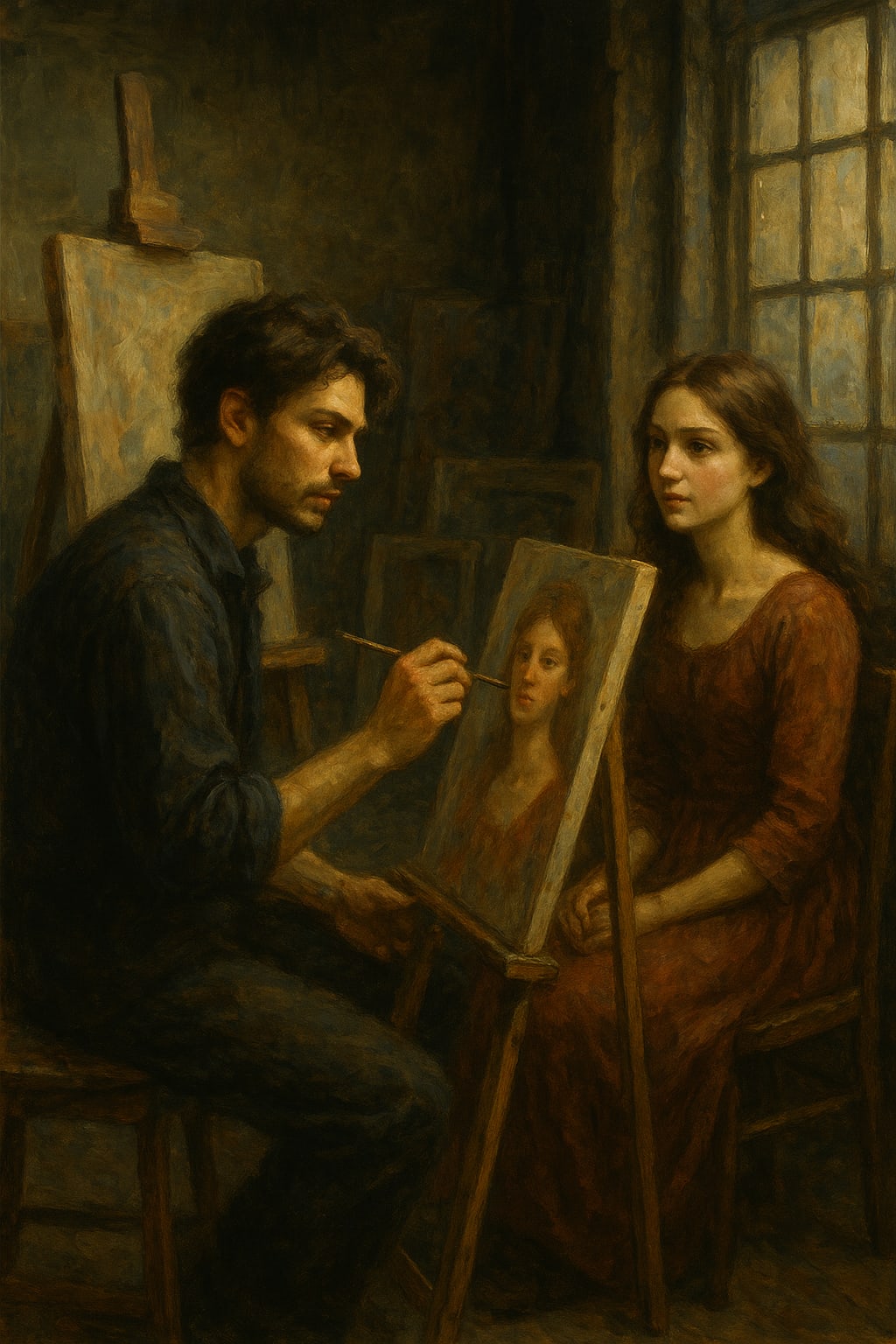
The studio smelled of linseed oil, turpentine, and the faint dust of forgotten canvases. Sunlight filtered through tall, grimy windows, cutting slanted rays across wooden floors scarred with paint. Matteo stood before his easel, brush in hand, staring at yet another blank canvas. He had been standing there for hours, motionless, as though the canvas mocked him with its emptiness.
Once, his paintings had been alive—full of color, emotion, and energy that spoke to those who gazed upon them. Patrons had praised him as a young prodigy, a painter destined to be remembered. But now, every stroke he made seemed lifeless. His critics whispered of decline, and Matteo began to fear they were right.
He placed the brush down, running a hand through his disheveled hair. “What good is a painter,” he muttered to the silence, “if he has nothing left to say?”
And then, the door creaked.
It was late afternoon, the city outside wet from fresh rain. A figure appeared hesitantly at the threshold—a young woman with damp curls clinging to her cheeks. She carried no umbrella, only a quiet curiosity that drew her inside.
“Forgive me,” she said softly. “I saw the light in your window. I didn’t mean to intrude.”Matteo blinked, startled. Strangers rarely wandered into his private world. Yet something about her presence—calm, almost luminous—kept him from sending her away.
“You’re a painter?” she asked, eyes scanning the walls lined with half-finished portraits and abandoned landscapes.“I try,” Matteo said bitterly. “But lately, the canvas refuses to speak to me.”The young woman tilted her head, considering his words. “Maybe it isn’t the canvas that is silent,” she said gently. “Maybe it’s you who’s afraid to listen.”
Matteo felt something stir in him, like a faint ember glowing beneath ashes. No critic, no patron, had ever spoken to him like that. He studied her for a long moment, then asked impulsively, “Would you sit for me?”She smiled faintly, brushing a strand of wet hair behind her ear. “Me? I’m not beautiful enough to be anyone’s muse.”“Beauty,” Matteo said, reaching for his sketchpad, “isn’t what I seek. Presence is.”
And so, she sat by the window, the fading light framing her face. Matteo sketched quickly, his hand moving with an ease he hadn’t felt in months. It wasn’t her features alone that fascinated him—it was the way her gaze seemed both tender and strong, as though she carried untold stories in her silence.When she rose to leave, he asked her name“Elara,” she said simply, before disappearing into the rain.
The days that followed marked a rebirth. Elara returned, sometimes with flowers, sometimes with nothing but quiet company. She didn’t pose like a model for hire, stiff and motionless, but rather existed in the space naturally—reading by the window, humming softly, or staring out at the shifting clouds. Each time, Matteo’s brush came alive, capturing not just her likeness but the emotions she stirred within him.
Colors that had once felt dull now burned with intensity. The blues were deeper, the reds warmer, the golds luminous. For the first time in years, he painted not to please patrons or critics, but to chase the strange fire that Elara awakened in him.One afternoon, as the rain drummed gently against the glass, Matteo paused mid-stroke.
“Elara,” he said quietly, “do you know what you’ve done for me?”She looked up from her book. “What do you mean?”“You’ve given me back my gift. You’ve reminded me why I paint. Without you, I would have drowned in silence.”
Elara closed the book softly, her expression unreadable. “A muse doesn’t give you what you already possess,” she said. “She only helps you remember.”
Weeks turned into months, and the masterpiece took shape—a portrait not of Elara’s face alone, but of the essence she carried. She sat bathed in light, a figure both real and ethereal, with a gaze that seemed to look beyond the canvas into eternity.
When the final stroke was laid, Matteo stepped back, breathless. “It’s finished,” he whispered.Elara rose, approaching the canvas. Her lips curved into a soft smile, but her eyes carried a distant sorrow. “It is beautiful,” she said.
Matteo turned to her. “Stay. Let us make more. Together, we can—”But she shook her head gently. “A muse never stays forever. She only visits to remind the artist of who he is. Once you’ve remembered, her work is done.”
Matteo’s heart ached. “But I don’t want to lose you.”
She touched his paint-stained hand, her touch warm but fleeting. “You won’t. Every color you touch from now on, every canvas you bring to life—you’ll find me there. In the light, in the silence, in the spark you thought you lost.”
And the next morning, she was gone. No note, no farewell, only the echo of her presence lingering in the studio.
Years passed. Matteo became celebrated once more, his art richer and more profound than ever before. Patrons called his style “transcendent,” though Matteo knew the truth: every brushstroke was a conversation with a memory.
Whenever the silence threatened him again, he would look at the portrait—the one he never sold, never let leave his studio. Elara’s painted gaze reminded him of the rainy evening she first stepped out of the shadows and into his world.
She had vanished, yes, but she had left him with something eternal: the fire to create, and the courage to listen to his own silence.
And so, he painted—not for critics, not for fame, but for the muse who had once reminded him that his gift had never been lost, only waiting.
About the Creator
Keep reading
More stories from Hania khan and writers in Art and other communities.
The Man Who Refused to Give Up
In a small dusty town, surrounded by fields and half-finished buildings, there lived a man named Kareem. He was not born into wealth or privilege. His family had always struggled to make ends meet. His father was a farmer who earned just enough to feed the household, and his mother stitched clothes for neighbors to add a little extra income. From an early age, Kareem understood what it meant to live with less—less money, less comfort, fewer chances.
By Hania khan6 months ago in Wander
'Till Death We Do Art
There would be nothing divine in this world without art. Nature may surpass the divine to all intents and purposes, but like everything it absorbs and is absorbed by, it remains here, stuck on the surface of this world, ever-present, physically bound to the universe.
By Avocado Nunzella BSc (Psych) -- M.A.P 13 days ago in Art




Comments
There are no comments for this story
Be the first to respond and start the conversation.