
The music that changed everything
She lost her hearing—but gained a world of color no one else could see

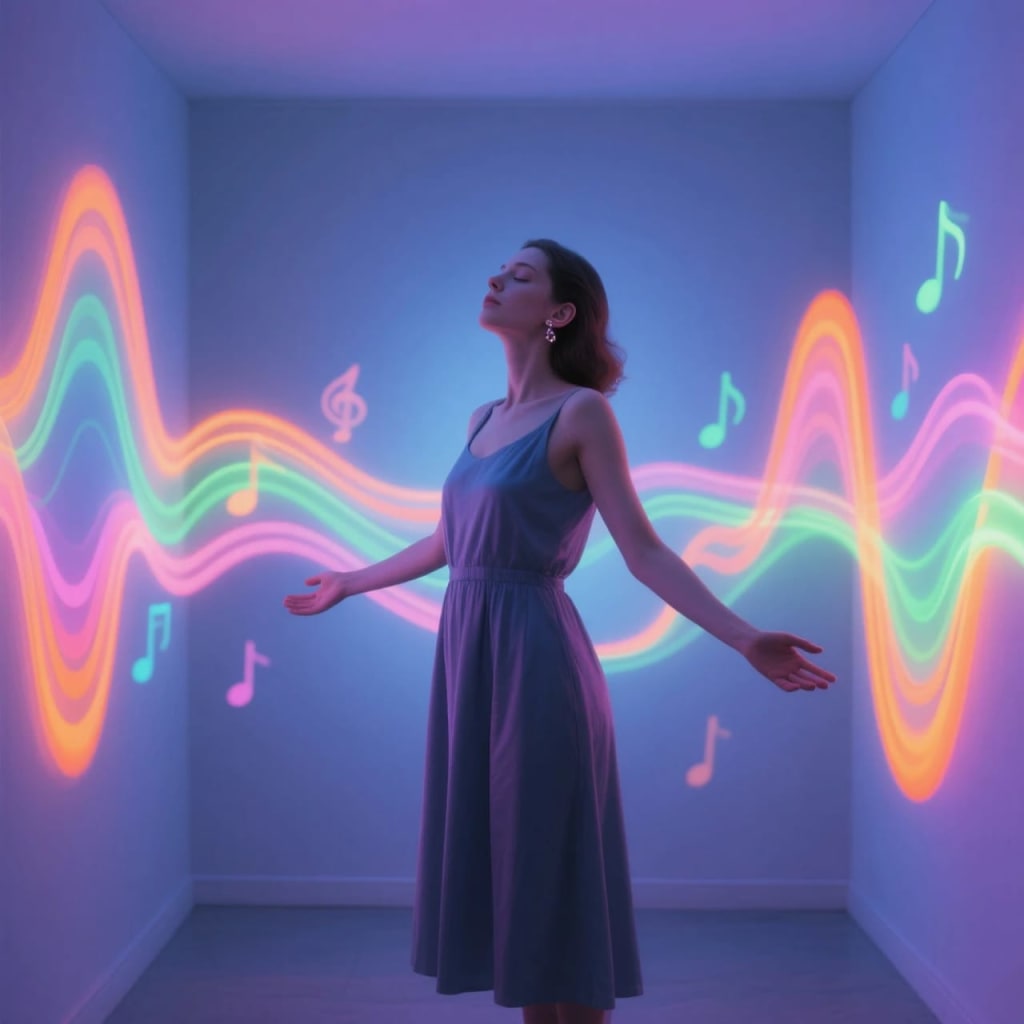
When Clara was eight, she played Beethoven's "Moonlight Sonata" with trembling fingers on her grandmother’s piano. It was the first time her parents noticed something wrong—she kept missing the high notes, ones no one would miss. A few doctor visits later, they had their answer: progressive hearing loss. By twelve, Clara heard nothing at all.
For most, this might be the end of a musical journey. But for Clara, it was only the beginning of something no one could explain.
At first, she was devastated. Her world was a sudden vacuum, a tunnel of silent dinners, closed captioning, and misunderstood intentions. But then came the colors.
It started with vibrations. Clara would sit beside the piano, press her hands against the keys, and feel the way low notes thrummed deep in her bones while higher ones made her fingertips tingle. The vibrations weren’t just physical—they sparked sensations, memories, and, strangely enough, colors. A middle C was pale blue. An E flat shimmered gold. D minor? Deep forest green.
Clara didn't tell anyone. Not at first. She wasn’t sure if it was real or if her brain was simply trying to fill in the absence of sound. But the colors grew more vivid each day. And they weren’t just beautiful—they were emotional.
One evening, when she was sixteen, she attended a live orchestra performance with her art teacher. It was Beethoven again, "Symphony No. 7." She couldn't hear the instruments, but she sat close to the stage and let the vibrations wash over her.
In the middle of the second movement, something extraordinary happened.
The lights dimmed and the music swelled. Clara closed her eyes. And there it was. A slow eruption of violet and indigo, blooming outward like a nebula. The strings pulsed silver. The timpani bursts exploded like orange sparks. It wasn’t sound—it was a synesthetic dance of emotion and memory, color and rhythm. She saw the music.
From that night on, Clara stopped mourning her hearing and started painting.
She painted the symphonies she couldn’t hear, the voices she imagined, the vibrations that colored her mind. Her tiny bedroom soon became a sanctuary of abstract canvases and paint-splattered floors. Her parents, still unsure how to comfort her, quietly encouraged the art. They didn’t understand it—but Clara did. It was hers.
By the time she turned twenty-one, Clara’s work had attracted the attention of a local gallery. They called it “Audio in Color”—a strange but mesmerizing exhibition. Visitors wandered through halls of blues and crimsons, gold-streaked madness and soft pastel silence. Critics were stunned. They called it “emotion in pigment,” “a new form of sensory translation.”
But not everyone understood.
During one of her first showings, an older man in a tweed coat stood before her painting titled The Last Note. He frowned.
“So, you just throw colors around and pretend it's music?”
Clara, who had become skilled at reading lips, smiled.
“No,” she signed. “I translate what I feel. What I see when I don’t hear.”
The man scoffed and walked away. Clara didn’t care. Because the woman behind him stood still, tears in her eyes, gazing into the swirl of indigo and gray, saying nothing at all. And Clara knew she wasn’t alone.
As the years passed, her fame spread. Universities studied her brain. Was it synesthesia? Hallucination? No one had a clear answer. Clara only knew what she saw.
Then, one rainy afternoon, Clara received a letter.
It was from the London Philharmonic. They wanted to commission her to visually interpret an original score—music no one had heard yet. They would play it live while her paintings, created purely from its vibrations, were projected behind them.
It was a challenge unlike any she had faced. How could she paint music she’d never heard and would never hear? But Clara said yes.
She worked in darkness. No previews, no titles. Just the piano’s vibration, and later, the full orchestral arrangement. The painting began with wild reds and ended with the softest shades of dusk-blue. It took four months. She called it Resonance.
Opening night arrived. A hall packed with thousands. A silent Clara sat in the front row, heart thudding. As the conductor raised his baton, the first notes hit the strings—and her painting unfolded behind them.
The audience gasped. People cried. Some stood in awe. A woman in the second row clutched her partner’s hand as colors exploded behind the musicians, matching the music with uncanny precision and emotional depth. When it ended, the hall sat in silence. Then erupted in applause.
Clara stood and bowed. She didn’t hear the clapping. But she saw the joy. She saw the color.
Years later, Clara would say that losing her hearing gave her something more powerful: a new way to see the world. To feel it.
Because music wasn’t just notes. It was memory. Color. Connection.
And Clara had found a way to bring that to life.
About the Creator
Muhammad Sabeel
I write not for silence, but for the echo—where mystery lingers, hearts awaken, and every story dares to leave a mark
Keep reading
More stories from Muhammad Sabeel and writers in Art and other communities.
I Lost Myself in the Fear of Criticism
I used to believe that art was freedom — until I let other people put chains on my creativity. When I first picked up a paintbrush at the age of ten, it wasn’t because someone told me I was good at it. It wasn’t to win awards or impress friends. It was because colors made me happy. Mixing blue and yellow into a shade of green that didn’t exist anywhere else felt like magic. I didn’t think about "good" or "bad." I just painted because it felt like breathing.
By Muhammad Sabeel10 months ago in Art
'Till Death We Do Art
There would be nothing divine in this world without art. Nature may surpass the divine to all intents and purposes, but like everything it absorbs and is absorbed by, it remains here, stuck on the surface of this world, ever-present, physically bound to the universe.
By Avocado Nunzella BSc (Psych) -- M.A.P 13 days ago in Art
5 Ways to Trust Your Creative Ideas
When I go through creative dry spells, I tend to think that generating more ideas is what is going to get me through it. However, I've learned the hard way that this isn't the case. But, having more ideas doesn't make us more creative. In fact, it can have the opposite effect.
By Kathy Tsoukalas3 days ago in Art




Comments
There are no comments for this story
Be the first to respond and start the conversation.