
The "Moon-Eating" Dog That Became China’s 2,000-Year Guardian
Shan Hai Jing’s Adorable Beasts

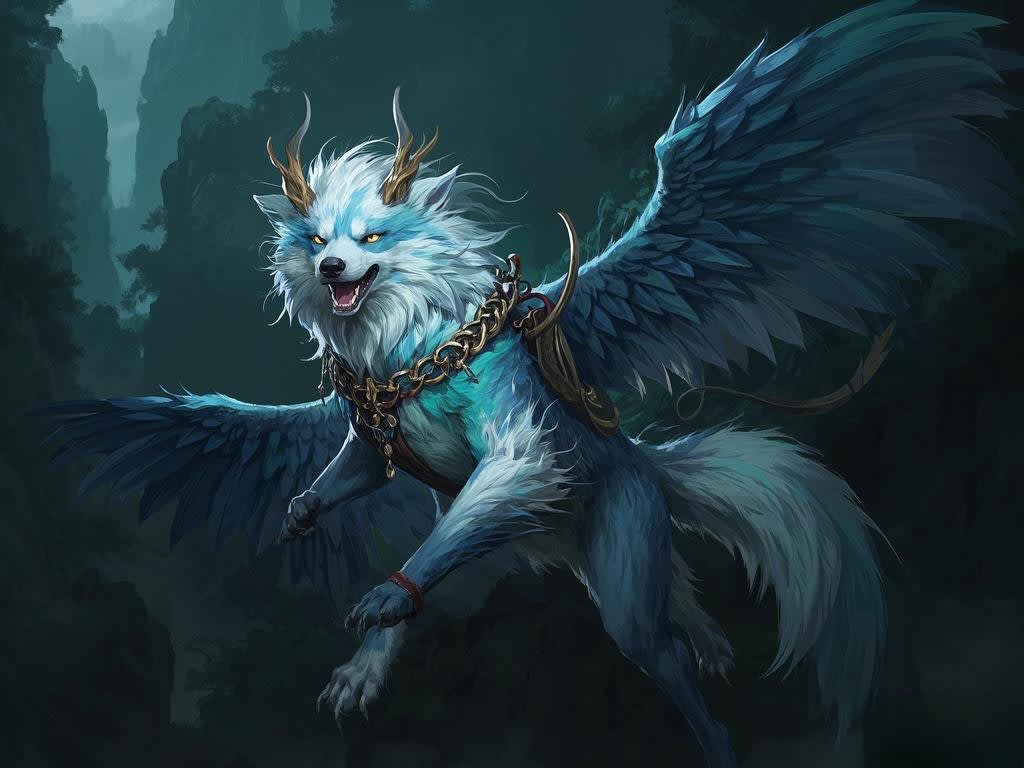
In 300 BCE, a herbalist on Shaanxi’s Lishan Mountain heard a "Liu-Liu" bark echoing from a cliff cave. Peering inside, they found a white-faced civet with dagger-sharp ears and a dandelion-fluffy tail—not fleeing, but bringing a wounded hare. This isn’t Zootopia’s sloth—it’s Tian Gou (天狗), the most unexpectedly cute mythical creature from Shan Hai Jing that evolved from monster to guardian.
1. From "Moon-Devouring Beast" to "Cuddle-Worthy Guardian": Tian Gou’s Transformation
Western Mountains describes Tian Gou as a "civet body with a white head, barking like 'Liu-Liu'." Archaeologists found proof in Marquis Yi of Zeng’s Tomb (2,400 years old): a jade Tian Gou pendant—curled tail, perked ears, holding an evil-repelling jade ornament, resembling an "ancient Shiba Inu." Unlike Western Cerberus (hellhound), Chinese Tian Gou was always a mountain guardian: Han Dynasty texts say it "barks at danger, guards against thieves," just like rural Chinese 田园犬 (village dogs).
The "Tian Gou eats the moon" legend is pure poetry. Tang Dynasty Dunhuang scrolls depict the eclipse as Tian Gou "swallowing evil"—when the moon reappears, villagers 敲锣打鼓 (bang gongs) and toss glutinous rice to "feed the dog." This transforms astronomy into a coexistence myth, softer than Norse Fenrir’s sun-chase.
2. From Erlang Shen’s 哮天犬 to Japan’s "Long-Nosed Tengu": An East Asian Adventure
The Song Dynasty gave Tian Gou "internet fame" as Erlang Shen’s Xiao Tian Quan (Sky Howling Dog), biting Sun Wukong’s ankle in Journey to the West—a symbol of loyalty matching Confucian values. Meanwhile, Japan’s Konjaku Monogatari (11th century) adopted Tian Gou as "long-nosed tengu," keeping its 驱邪 (evil-banishing) power and even the "Liu-Liu" bark (now "Un-Yan" in Japanese).
In Zhangzhou’s Baosheng Dadi Temple, Tian Gou statues lick gourds of medicine—Minnan’s "healing dog" belief: dogs sniff out plagues, hence "Tian Gou bells" on pets today. This shift from "monster" to "mutt" mirrors China’s approach to nature: respect, but believe in taming.
3. Why Gen Z Wants a Tian Gou as Their Pet
In 2023, Chengdu Taikoo Li’s "Shan Hai Jing Cute Beast Pop-Up" sold out Tian Gou plushies—fluffy white faces, floppy "airplane ears," tails curled like clouds. Designers admitted: "We revived Marquis Yi’s gentle Tian Gou, ditching 凶煞 (凶暴), focusing on 'protection'." This taps into Gen Z’s crave for "healing mythical beasts."
Genshin Impact’s Tian Gou-inspired character "Kujo Sara" (犬耳 + 雷之骑士) proves the trend. Players say: "Tian Gou isn’t a monster—it’s a knight who gets hurt too." This reimagining turns 3,000-year myths into anti-loneliness totems.
In Hangzhou’s stray dog shelter, a tailless 田园犬 named Tian Gou protected an old man from a car crash. Director: "Ancestors said Tian Gou blocks disasters—now it’s real." This 时空呼应 (time-space echo) gives myth warm modern meaning.
Epilogue: When Mythical Beasts Become Neighbors
From Lishan’s bark to city plushies, Tian Gou’s journey is China’s story of making peace with fear. It teaches: true guardianship isn’t 消灭 (eradication), but 共处 —like realizing eclipses are 宇宙的呼吸 (cosmic breath), not a dog’s greed.
Next time at Shaanxi History Museum, find the Han Dynasty 鎏金天狗镇墓兽 (gilded tomb guardian). It’s not a 凶神 (demon), but an ancestral love letter: In concrete jungles, leave a window open for the white-faced civet to knock with moonlight. After all, a civilization that cuddles monsters understands 温柔 (tenderness).
Discussion:If Tian Gou were your pet, what superpower would you give it? Danger-alert? Insomnia-cure? Share your mythical pet idea below!
(References: Shan Hai Jing·Western Mountains, Marquis Yi tomb reports, East Asian Dog Beliefs; inspiration from Chengdu Museum’s "Cute Shan Hai Jing Beasts" exhibit)
About the Creator
hello-word
As a Chinese person, love for the culture of my own country. Nowadays, the global exchange of information is becoming increasingly rapid. I also hope that more people can gain a deeper and more detailed understanding of Chinese culture.
Keep reading
More stories from hello-word and writers in Art and other communities.
The Elephant-Swallowing Serpent: China’s 4,000-Year-Old Fable About Greed
In 2100 BCE, fishermen at Dongting Lake watched the water boil—a black serpent surfaced, scales shimmering like obsidian, its moss-green head rising as it swallowed a full-grown elephant whole. This isn’t Anaconda CGI—it’s Ba She (巴蛇), the Yangtze River’s ecological parable from Shan Hai Jing that warns of excess… with surprising warmth.
By hello-wordabout a year ago in Art
'Till Death We Do Art
There would be nothing divine in this world without art. Nature may surpass the divine to all intents and purposes, but like everything it absorbs and is absorbed by, it remains here, stuck on the surface of this world, ever-present, physically bound to the universe.
By Avocado Nunzella BSc (Psych) -- M.A.P 28 days ago in Art
The Stolen Smile: The True Story Behind the Mona Lisa Theft
In the summer of 1911, the art world experienced one of the most shocking and mysterious events in history when the most famous painting in the Louvre Museum suddenly vanished without anyone noticing until it was already gone. The painting was the Mona Lisa, the masterpiece created by the legendary Renaissance artist Leonardo da Vinci, and at that time it was already admired by artists and historians even though it had not yet achieved the global fame it holds today.
By The Curious Writer3 days ago in Art




Comments
There are no comments for this story
Be the first to respond and start the conversation.