
The Legend of Liu Sanjie
The Songstress Who Outwitted Lords and Enchanted a Nation with Her Melodies

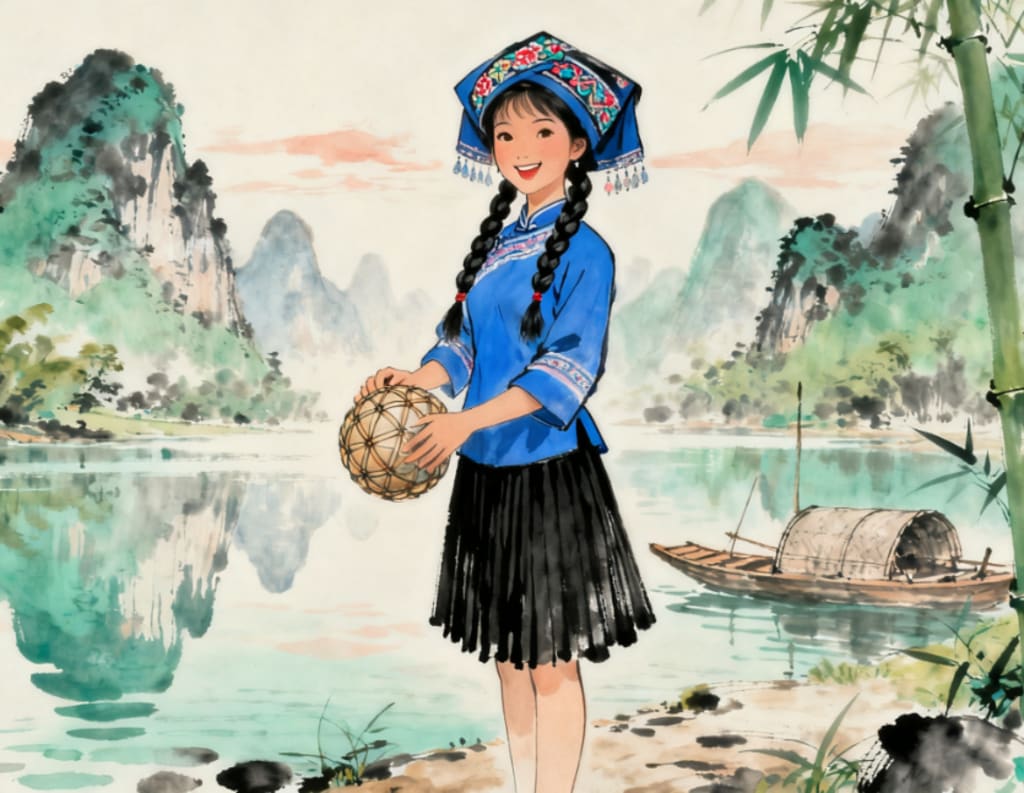
In the mist-shrouded mountains of Guangxi, where the Li River winds like a jade ribbon through emerald peaks, there lived a legendary folk singer named Liu Sanjie—Third Sister Liu. Her voice, clearer than morning dew and more piercing than a kingfisher’s cry, carried across terraced fields and bamboo groves, echoing the joys and sorrows of the Zhuang people.
It was said that Sanjie could weave the very essence of life into her songs: the blush of peach blossoms in spring, the shimmer of summer lotus leaves, the golden harvest moons of autumn, and the quiet resilience of winter bamboo. Her ballads spoke of love that outlasted stone mountains and justice that flowed as relentlessly as the rivers. Yet her gift drew both admiration and envy.

One day, a wealthy landowner named Mo Huairen—whose name meant "Seeker of Benevolence" but whose heart was barren of it—came to hear her sing. He had amassed fortunes by seizing lands and taxing the poor, and when he saw Sanjie’s influence over the common folk, he grew fearful. Determined to silence her, he devised a cruel plan.
Mo announced a public song duel: if Sanjie could defeat him and his hired scholars in improvisational singing, he would cease his tyranny. But if she lost, she must vow never to sing again. The villagers trembled—how could one woman, however gifted, overcome the cunning of educated men? Yet Sanjie only smiled, her eyes reflecting the steadfastness of the karst mountains.
On the day of the contest, the banks of the Li River swelled with people. Mo’s scholars, draped in silk robes, began with intricate verses praising wealth and power. Sanjie responded with a melody about the cicada—a tiny creature whose song could drown out the noise of the whole forest. The crowd erupted in cheers.
For three days, the duel raged. The scholars sang of greed and dominance; Sanjie answered with themes of nature, community, and love. With each exchange, Mo’s men grew more desperate, their verses twisting into hollow boasts, while Sanjie’s voice soared, drawing power from the wind, the water, and the hearts of her listeners.
On the final day, as the sun dipped behind the peaks, Mo hurled his last challenge—a verse mocking the foolishness of the poor. Sanjie gazed at the suffering faces around her and sang a reply so piercing that the very heavens seemed to pause:
“Your greed casts shadows over the land,
But mountains stand firm, and rivers expand.
Your words may twist like vines in the night,
Yet the morning sun will bring the light.”
A silence fell. Then, as if awakened by her voice, the crowd burst into applause—a roar that shook the earth. Defeated and humiliated, Mo Huairen slunk away, his schemes shattered.
But Sanjie knew the powerful seldom yield gracefully. To protect her people from further strife, she chose to depart. With a final song of farewell—a promise that her spirit would always linger in the landscape—she stepped onto a bamboo raft and drifted down the Li River, vanishing into the mist where sky and water merge.
To this day, travelers in Guangxi swear they sometimes hear her voice carried on the breeze—a melody woven into the rhythm of paddles dipping into water, the rustle of bamboo forests, and the songs of the Zhuang people. For Liu Sanjie became more than a woman; she became a symbol of resilience, a harmony between humanity and nature, and an eternal note in the symphony of Chinese folklore.
About the Creator
David cen
Share Chinese Sory,which you never heard before.China has 5000 years history and it is A kingdom of artifacts.Such as Chinese Kongfu,Qigong etc.
'Till Death We Do Art
There would be nothing divine in this world without art. Nature may surpass the divine to all intents and purposes, but like everything it absorbs and is absorbed by, it remains here, stuck on the surface of this world, ever-present, physically bound to the universe.
By Avocado Nunzella BSc (Psych) -- M.A.P 25 days ago in Art
Rewire Your Mind for Success
brilliant inventor and worked day and night in her small lab, filled with glowing screens and strange gadgets. Despite her talent, she struggled to find success. Her inventions were often overlooked, and her ideas remained trapped in her mind.
By Hamad Afridi 3 days ago in Art



Comments
There are no comments for this story
Be the first to respond and start the conversation.