
“The Last Canvas”
“A story of love, loss, and the healing power of art.”
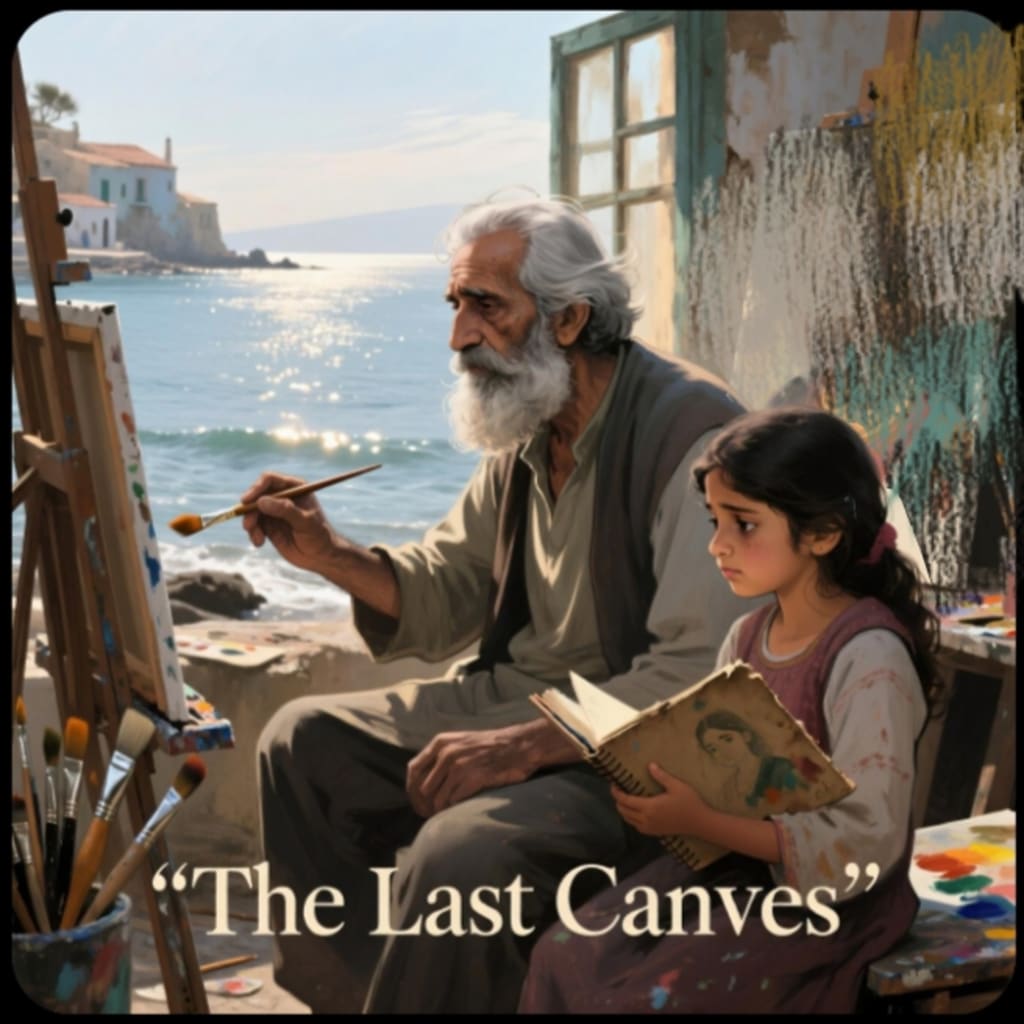
On the edge of a quiet coastal village, where the sea whispered against the rocks and the air always carried a hint of salt and jasmine, lived an old man named Rahim. Once, his name had been spoken with reverence—“Rahim the Painter,” they called him, the man who could make waves dance on canvas and sunsets breathe.
But that was long ago.
After Safiya, his wife of fifty years, passed quietly in her sleep, Rahim stopped painting. He covered his canvases, wrapped his brushes in cloth, and locked the door to his studio. The house grew still. Only the wind and the distant cry of gulls broke the silence.
People said he had lost his hand. But those who knew him understood—he had simply lost his reason.
Every morning, a girl named Zara walked past his house on her way to school. Seventeen, with paint-stained fingers and a sketchbook always tucked under her arm, she dreamed of creating something that would make people feel. She had seen photos of Rahim’s old work in a tattered art magazine—seascapes so alive you could hear the tide, portraits so tender they seemed to blink.
One humid afternoon, heart pounding, she knocked on his door, clutching a small canvas she’d spent weeks on—a portrait of her grandmother, painted from memory.
The door creaked open. Rahim stood there, thinner than she expected, his beard silver like sea foam, his eyes distant but not unkind.
“Yes?” he asked, voice soft like tide retreating.
Zara held out the painting. “I… I was wondering if you could tell me what’s wrong with it.”
He took it gently, studied it for a long moment. The brushwork was uneven. The colors clashed in places. But there was something beneath it—something raw, honest.
“You’re not trying to impress,” he said finally. “That’s good. Most beginners do. But you’re trying to remember.”
Zara blinked. No one had ever seen that in her work before.
He stepped back. “Come in. Let’s talk.”
That day began something neither of them expected.
Week after week, Zara returned. Not for lessons in perspective or shading, but for something deeper. Rahim taught her to listen—to the silence between waves, to the weight of a glance, to the way light falls differently on a face when someone is about to cry.
“Painting isn’t about copying what you see,” he said one evening, watching her struggle with a sky. “It’s about showing what you feel.”
Slowly, the house came alive again. Laughter returned. The smell of turpentine and linseed oil drifted from the studio. Rahim began to touch his old brushes, turning them in his hands like forgotten friends.
Then one rainy afternoon, while waiting for him to return from the market, Zara peeked into the studio.
In the corner, covered by a yellowed cloth, was a canvas.
Curious, she lifted the fabric.
And froze.
It was a portrait of Safiya.
Only half-finished. The eyes were complete—deep, warm, full of quiet love—and they seemed to look straight at her, as if asking, Will you help him finish me?
When Rahim came home and found her there, he didn’t scold her. He just stood beside her, staring at the face he hadn’t seen in years.
“I started it the week after she passed,” he said, voice barely above a whisper. “But I couldn’t finish. I thought… if I let her live on the canvas, I’d have to let her go in my heart.”
Zara looked at him. “Or maybe,” she said gently, “finishing her is how you keep her.”
That night, Rahim sat before the canvas for hours. The rain tapped on the roof like a patient hand.
And the next morning, he picked up his brush.
Stroke by stroke, memory by memory, Safiya returned—not as a ghost, but as a presence. Her smile, the way her scarf caught the wind, the golden light of evening wrapping around her like an embrace.
Sometimes his hand shook. Sometimes tears fell onto the canvas and blurred the paint. But he kept going.
When it was done, he stepped back. The room felt different. Lighter.
“It’s not perfect,” he said, smiling faintly. “But it’s true.”
Zara asked if he’d paint again.
He shook his head. “This was my last canvas. Not because I can’t. But because I’ve said what I needed to say.”
A month later, the village held its annual art exhibition.
In the center of the hall hung “Safiya in Sunset”—a woman standing by the shore, her face turned toward the light, love and loss woven into every stroke.
And beside it, a smaller painting: “Rahim”, by Zara. An old man sitting by the sea, brush in hand, a faint smile on his lips, the wind in his beard.
No grand titles. No awards. Just two paintings, side by side—connected not by style, but by soul.
People stopped. Looked. Stayed.
Because art, at its core, is not about beauty.
It’s about memory.
It’s about love that refuses to fade.
And sometimes, it’s the quietest brushstroke that speaks the loudest.
About the Creator
meerjanan
A curious storyteller with a passion for turning simple moments into meaningful words. Writing about life, purpose, and the quiet strength we often overlook. Follow for stories that inspire, heal, and empower.
Reader insights
Nice work
Very well written. Keep up the good work!
Top insights
Compelling and original writing
Creative use of language & vocab
Easy to read and follow
Well-structured & engaging content
Excellent storytelling
Original narrative & well developed characters
Expert insights and opinions
Arguments were carefully researched and presented
Eye opening
Niche topic & fresh perspectives
Heartfelt and relatable
The story invoked strong personal emotions
Masterful proofreading
Zero grammar & spelling mistakes
On-point and relevant
Writing reflected the title & theme
'Till Death We Do Art
There would be nothing divine in this world without art. Nature may surpass the divine to all intents and purposes, but like everything it absorbs and is absorbed by, it remains here, stuck on the surface of this world, ever-present, physically bound to the universe.
By Avocado Nunzella BSc (Psych) -- M.A.P 21 days ago in Art
Things to do in Casablanca:
Casablanca is one of lovely destinations around Morocco. Casablanca is considered the largest city in Morocco. It's famously known for its historic attractions, cultural sites and natural landscapes. Additionally, the city is well- known for its clean beaches offering visitors a lifetime experience. This blog cover the top things to do in Casablanca:
By Othmane Anaam7 days ago in Art



Comments (1)
Good