
The History of Art: From the Renaissance to Modern Avant-Gardes
Exploring the Evolution of Western Art: From Classical Revival to Revolutionary Breakthroughs

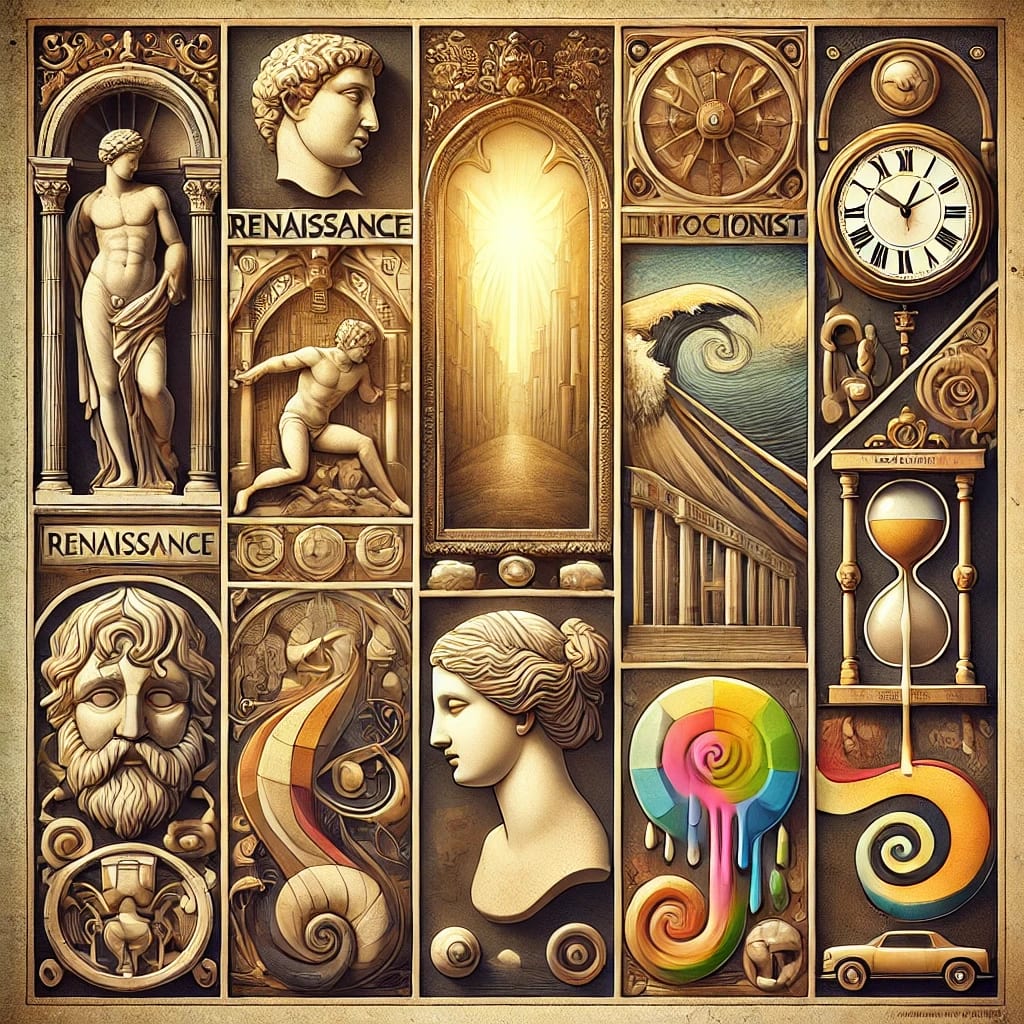
Summary:
The history of art is a fascinating journey through centuries, reflecting the cultural, social, and technological changes of society. From the rebirth of classical antiquity in the Renaissance, through the exploration of light and color in Impressionism, to the radical breaks of the Modern Avant-Gardes, each era has left an indelible mark on the history of art. This article explores the major artistic movements from the Renaissance to the Modern Avant-Gardes, analyzing the most representative works and the historical context in which they were born.
1. The Renaissance: The Rebirth of Antiquity
1.1. Rediscovering the Ancient World
The Renaissance, born in Italy in the 14th century, represents a rebirth of the arts and sciences. After the Middle Ages, characterized by predominantly religious and symbolic art, Renaissance artists were inspired by classical Greek and Roman models. This return to antiquity was not just a matter of style but also implied a new worldview, centered on humanity and its ability to know and represent reality.
The revival of the ancient world was evident not only in the visual arts but also in other disciplines such as architecture, literature, and philosophy. The rediscovery of classical texts, thanks to humanists like Petrarch and Lorenzo Valla, helped shape a new way of thinking. This quest for knowledge was reflected in the attention to detail and proportion in artworks, as seen in the balanced compositions and idealized figures.
1.2. Masters of the Renaissance
Leonardo da Vinci, Michelangelo Buonarroti, and Raphael Sanzio are the principal exponents of the Italian Renaissance. Their works not only profoundly influenced European art but also defined aesthetic canons for centuries. Leonardo’s “Mona Lisa,” with its enigmatic smile and innovative sfumato technique, and Michelangelo’s “David,” a symbol of human perfection, are just two examples of the extraordinary artistic achievements of this period.
These artists were not only painters or sculptors but also true intellectuals involved in various disciplines. Leonardo, for example, was also an engineer, anatomist, and inventor. Michelangelo, besides being a sculptor, was also an architect and poet. This versatility is a distinctive feature of the Renaissance, an era when art and science were not separated but nourished each other.
1.3. The Renaissance in Northern Europe
While Italy was the pulsating center of the Renaissance, the influence of this movement also extended to Northern Europe. Artists like Albrecht Dürer and Jan van Eyck carried forward the Renaissance tradition with a focus on detail and realism that differed from the Italian idealism. The technique of oil painting, perfected during this period, allowed for a more precise representation of textures and light.
The Northern Renaissance is characterized by a more realistic and sometimes more intimate interpretation of reality compared to the idealized classicism of Italy. Nature, landscapes, and daily life became subjects of great relevance in art. Van Eyck’s meticulous detail and Dürer’s technical mastery testify to a commitment to direct observation and the exploration of the visible world.
2. The Baroque: Drama and Movement
2.1. Reaction to Classicism
The Baroque, emerging in the 17th century, is a reaction to the rigor and symmetry of the Renaissance. Unlike the calm harmony of the Renaissance, Baroque art is dynamic, emotional, and often theatrical. This style reflects the religious and political tensions of the time, including the Counter-Reformation and religious wars.
The Catholic Church, in response to the Protestant Reformation, promoted an art that had to be not only beautiful but also didactic and engaging, capable of inspiring faith and devotion. This impulse is evident in the works full of pathos and movement by Bernini and Rubens, where the boundaries between art and reality seem to dissolve.
2.2. Caravaggio and Dramatic Realism
Michelangelo Merisi da Caravaggio is one of the most influential artists of the Baroque. His chiaroscuro technique, which uses strong contrasts of light and shadow to create a dramatic effect, revolutionized painting. His works, such as “The Calling of Saint Matthew,” are characterized by a raw realism that brings the viewer closer to the depicted scene.
Caravaggio not only innovated technically but also changed the way religious subjects were represented. His saints and martyrs are human figures, with faces marked by fatigue and pain, making sacred stories more accessible and moving for the viewer. This emotional intensity is one of the elements that make the Baroque such a powerful movement.
2.3. The Baroque in Europe
The Baroque quickly spread throughout Europe, assuming different characteristics depending on the local context. In Spain, Diego Velázquez combined realism with a touch of psychology in his portraits, such as in the famous “Las Meninas.” In the Netherlands, the Baroque manifested in more intimate and everyday painting, with artists like Rembrandt and Vermeer exploring light and emotion with unprecedented depth.
In France, the Baroque merged with classical style, giving rise to the so-called Classical Baroque or French Baroque, characterized by a balance between decoration and formal rigor, as seen in the Palace of Versailles. In Germany and Austria, the Baroque reached its peak in churches and palaces, where opulence and decorative complexity reflect the power and spirituality of the time.
3. The Rococo: Elegance and Refinement
3.1. A Light and Decorative Art
The Rococo, which emerged in France in the early 18th century, is a style that emphasizes grace, lightness, and ornamentation. Unlike the drama of the Baroque, Rococo is characterized by sinuous lines, pastel colors, and an atmosphere of frivolous elegance.
Rococo reflects the tastes of an aristocratic society that favored pleasure, intimacy, and entertainment. This style developed in a context of stability and economic prosperity, and its decorative lightness reflects a certain carefree attitude of the time, which would soon be replaced by pre-revolutionary tensions.
3.2. Masters of Rococo
Antoine Watteau and François Boucher are among the leading exponents of this style. Their works, often depicting scenes of gallant and mythological life, embody the Rococo aesthetic. Watteau’s “The Embarkation for Cythera” is a classic example of this trend, with its idyllic atmosphere and attention to decorative details.
Boucher’s works, such as his famous depictions of gods and nymphs, embody a sensuality and lightness that are typical of Rococo. Rococo also finds expression in the decorative arts, such as the creation of furniture, porcelain, and luxurious interiors that enriched the salons and palaces of the European aristocracy.
3.3. Rococo in Europe
Although Rococo was born in France, it quickly spread throughout Europe, influencing architecture, painting, and the decorative arts. In Germany and Austria, for example, the Rococo style is expressed in sumptuous churches and palaces, such as the Würzburg Residence, where ornamentation and the use of light reach spectacular levels.
In Italy, Rococo manifests mainly in architecture and the decorative arts, with an emphasis on elegance and ornamental richness, as seen in Venetian churches and the palaces of Turin and Naples. The style also spread to Spain and Portugal, where it was adopted in the decorations of churches and royal palaces.
4. Romanticism: Emotion and Individuality
4.1. Revolt Against Reason
Romanticism, which developed at the end of the 18th century, is a reaction against the rationalism of the Enlightenment and Classicism. Romantic artists prioritized emotion, individuality, and wild nature over rationality and order. This movement reflects a profound change in the perception of man and his relationship with the world.
Romanticism embraces the idea that truth is not only a matter of reason but also of feeling and intuition. This shift in perspective is manifested in an art that explores the irrational, the mysterious, and the sublime, seeking to capture the complexity and depth of human experience.
4.2. Romantic Painting and Literature
Eugène Delacroix, with his fiery canvases full of passion and color, is one of the greatest representatives of Romantic painting. Similarly, in literature, authors like Lord Byron and Johann Wolfgang von Goethe express the intensity of feelings and rebellion against social conventions. Delacroix’s work “Liberty Leading the People,” for example, is a powerful symbol of the aspiration for freedom and self-determination.
Romantic painting does not merely depict external reality but focuses on the subjectivity and emotions of the artist. The landscapes of Caspar David Friedrich, for example, are not just natural views but reflect an inner state of mind, a sense of solitude and reflection on the human condition.
4.3. Romanticism in Architecture and Music
Romanticism is not limited to painting and literature but also permeates architecture and music. Gothic Revival architecture, with its references to the Middle Ages, and the symphonies of Ludwig van Beethoven, which explore the depths of the human soul, are expressions of Romantic fervor.
In architecture, the Gothic Revival developed as a reaction against neoclassical rigor, drawing inspiration from medieval castles and Gothic cathedrals. In music, composers like Beethoven and Richard Wagner sought to express the ineffable through complex and innovative musical forms, giving voice to the deepest emotions and aspirations of the individual.
5. Impressionism: Light and the Moment
5.1. The Revolution of Light
Impressionism, born in France in the second half of the 19th century, represents a radical break with previous artistic traditions. Impressionists, including Claude Monet, Pierre-Auguste Renoir, and Edgar Degas, focused on capturing the fleeting moment and representing light and color innovatively. Their quick brushstrokes and vivid colors gave rise to a new vision of reality.
Impressionists challenged academic conventions not only in their subjects, often drawn from modern life, but also in their technique. They abandoned studio painting to work en plein air, capturing natural light and its changes throughout the day. This focus on light and color revolutionized the way of seeing and representing the world.
5.2. Impressionist Exhibitions
Impressionists, initially rejected by official salons, organized independent exhibitions that elicited mixed reactions from the public and critics. However, these exhibitions marked the beginning of a new era in art, where originality and experimentation were valued. Monet’s “Impression, Sunrise,” which gave the movement its name, is a manifesto of this new aesthetic.
Despite initial criticism, accusing the Impressionists of being amateurs incapable of painting, the movement soon gained great influence, inspiring a new generation of artists. The Impressionist exhibitions were not just an opportunity to see new works but also a forum for passionate debates on art and its future.
5.3. The Legacy of Impressionism
Impressionism not only revolutionized painting but also paved the way for numerous subsequent movements, such as Post-Impressionism and Fauvism. The innovative approach to light, color, and composition would profoundly influence artists like Vincent van Gogh and Henri Matisse, who would continue experimentation in new and unexpected directions.
Impressionism also contributed to a change in the perception of art and the role of the artist. Impressionists established themselves as pioneers of an art that no longer had to conform to academic canons but was free to explore the subjective reality and personal vision of the artist. This creative freedom would be the foundation of the Modern Avant-Gardes.
6. Modern Avant-Gardes: Breaking with the Past
6.1. Cubism and the Deconstruction of Reality
The Modern Avant-Gardes, which developed in the early 20th century, are characterized by a desire to break with all previous artistic conventions. Cubism, with Pablo Picasso and Georges Braque, deconstructs reality into geometric forms, offering new perspectives and a fragmented representation of the world. Picasso’s famous painting “Les Demoiselles d’Avignon” marks the beginning of this artistic revolution.
Cubism is not just a pictorial movement but a new way of seeing and interpreting reality. Cubist artists challenged the idea of linear perspective and naturalistic representation, instead exploring the multiple facets of reality simultaneously. This fragmentation and recomposition of space and time would profoundly influence the art, literature, and even the science of the 20th century.
6.2. Abstract Art and the Search for Essence
Another highly relevant movement is Abstract Art, with artists like Wassily Kandinsky and Piet Mondrian seeking to represent the essence of art through pure forms and colors, completely detaching themselves from figurative representation. Kandinsky, in particular, saw art as a means to express interiority and spirituality, as demonstrated in his work “Composition VII.”
Abstract Art is a response to the need to go beyond visible appearance, seeking to express the ineffable and the universal. Mondrian, with his rigorous geometric style, explores balance and harmony through the use of lines and primary colors. Abstract Art thus emerges as a movement aimed at a deeper and more spiritual understanding of the world, far from recognizable forms.
6.3. Surrealism and the Unconscious
Surrealism, led by André Breton and Salvador Dalí, explores the world of the unconscious and dreams, seeking to liberate art from the constraints of logic and rationality. Surrealist works are often characterized by dreamlike and disorienting images, as seen in Dalí’s famous painting “The Persistence of Memory,” where melting clocks defy the laws of physics and time.
Surrealism is not just an artistic movement but a way of thinking that embraces the irrational and the fantastical as paths to deeper truth. Surrealist techniques, such as automatism and automatic writing, seek to bypass the conscious control of the artist, allowing the unconscious to emerge. This approach would influence not only the visual arts but also literature, cinema, and psychoanalysis.
7. Expressionism: The Cry of the Soul
7.1. The Roots of Expressionism
Expressionism emerged in the early 20th century as a response to modernity and its alienations. This movement developed mainly in Germany, with artists like Edvard Munch, Ernst Ludwig Kirchner, and Egon Schiele seeking to express the deepest and most turbulent emotions of the human soul. Expressionist art is not concerned with external beauty but with inner truth, often anguished and distorted.
The roots of Expressionism lie in Symbolism and Post-Impressionism, but it stands out for its emotional intensity and willingness to explore the anguish and loneliness of modern man. Munch’s works, such as “The Scream,” are emblematic of this desire to express existential pain and fear of the unknown.
7.2. Expressionist Groups: Die Brücke and Der Blaue Reiter
Two of the main Expressionist groups are Die Brücke (The Bridge) and Der Blaue Reiter (The Blue Rider). Die Brücke, founded in Dresden in 1905, promoted spontaneous and instinctive art influenced by primitive cultures and folk art. Der Blaue Reiter, on the other hand, was more oriented towards abstract and mystical spirituality, with artists like Kandinsky and Franz Marc seeking to transcend visible reality.
Die Brücke focuses on the immediacy of experience, with vivid colors and aggressive brushstrokes that reflect emotional urgency. Der Blaue Reiter, on the other hand, explores the possibilities of art as a means of spiritual elevation, seeking to express harmony and connection between man and the cosmos. However, both groups share a rejection of traditional artistic conventions and a desire to explore new expressive avenues.
7.3. Expressionism in Mass Culture
The influence of Expressionism extends beyond the visual arts, influencing cinema, literature, and theater. German Expressionist cinema, with films like “The Cabinet of Dr. Caligari” and “Nosferatu,” uses dramatic lights and shadows to create unsettling and surreal atmospheres, reflecting the anxieties and fears of society at the time.
In literature, Expressionism manifests through fragmented prose and charged emotional tension, as in the works of Franz Kafka and Georg Trakl. Expressionist theater, with authors like Bertolt Brecht and Georg Kaiser, also challenges traditional narrative conventions, experimenting with form and content to express the crises of the individual and society.
Conclusion
The history of art, from the Renaissance to the Modern Avant-Gardes, is a story of evolution, innovation, and revolution. Each period has brought new ideas, techniques, and perspectives that have enriched the cultural heritage of humanity. From the rebirth of the ancient world to the deconstruction of reality, artists have always sought to explore and represent the complexity of human experience through their work. This exploration continues, demonstrating that art is a vital force in constant transformation, capable of reflecting and influencing the world we live in.
About the Creator
Fabio Smiraglia
I am a passionate content writer with extensive experience in crafting engaging texts for blogs, websites, and social media. I love telling stories, informing, and connecting with audiences, always with creativity and precision.
Keep reading
More stories from Fabio Smiraglia and writers in Art and other communities.
The Neuroscience of Memory: How It Works and How to Improve It
Introduction to Memory and Its Neuroscientific Foundations Memory is one of the most fascinating and complex cognitive functions of the human brain. It encompasses the ability to acquire, store, and retrieve information, a function essential for our survival and daily functioning. From remembering the name of an old friend to recalling important dates, memory influences every aspect of our lives. However, despite its crucial importance, memory remains one of the most mysterious and least understood functions of the human mind.
By Fabio Smiragliaabout a year ago in Humans




Comments (3)
So so amazing .i love your content and subscribed. Kindly reciprocate by subscribing to me also . thank you and keep it up
Excellent history
What a great summary of art history. You gave me a quick review of what I had in my Western Civilization courses (Humanities) in college.