
The Golden Embrace: A Love Immortalized in Klimt’s ‘The Kiss’
How a stolen kiss became one of art history’s most iconic embraces

**The Golden Embrace: The Story Behind Klimt’s *The Kiss*
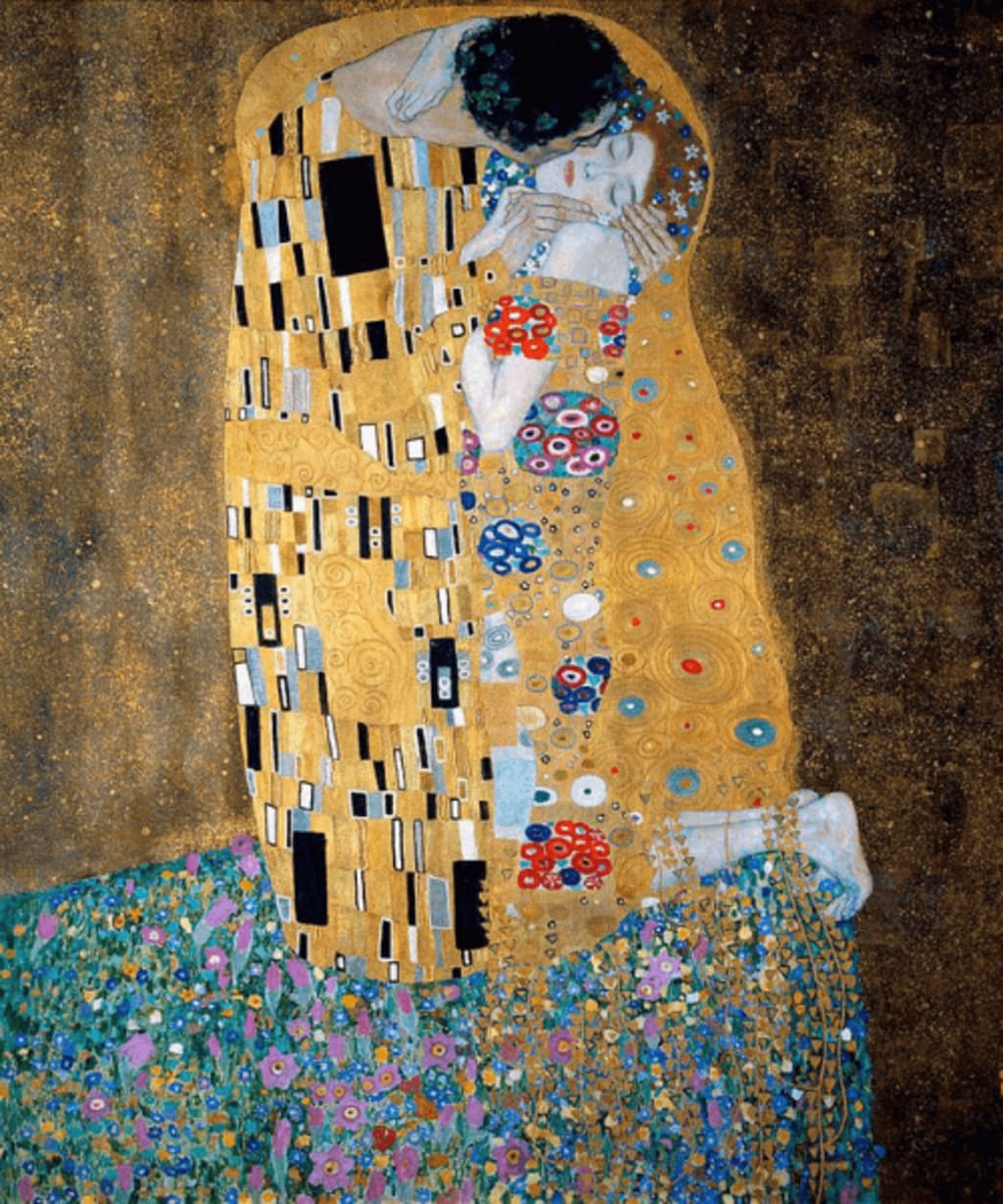
In the heart of Vienna, amidst the opulence of the early 20th century, Gustav Klimt stood at the pinnacle of his artistic career. The year was 1907, and the whispers of modernism were reshaping the world of art. Klimt, already a controversial and celebrated figure, was about to create a masterpiece that would transcend time—*The Kiss*.
**A Love Woven in Gold**
Klimt’s studio was a sanctuary of creativity, filled with sketches, fabrics, and the shimmer of gold leaf. He had long been fascinated by Byzantine mosaics, their intricate patterns and luminous surfaces inspiring his *Golden Phase*. But *The Kiss* was different—it was not just an artistic experiment; it was a whisper of passion, an ode to love itself.
The painting depicted a man and a woman locked in an intimate embrace, their bodies entwined amidst a sea of gold. The man’s cloak, adorned with bold black rectangles, contrasted with the woman’s flowing dress, decorated with delicate floral patterns. Their faces were serene, lost in the ecstasy of the moment, as if the world around them had dissolved into nothingness.
**The Muse Behind the Masterpiece**
Though Klimt never confirmed the identities of the lovers, many believed the woman was Emilie Flöge, his lifelong companion and muse. Emilie was a fashion designer, a woman of grace and independence, and their relationship was one of deep affection, though shrouded in mystery. Some speculated their bond was platonic, others romantic—but in *The Kiss*, Klimt immortalized a love that defied definition.
Others whispered that the painting was inspired by Klimt’s own fleeting affairs, a reflection of his belief that love was both sacred and transient. The man, kneeling in devotion, could be Klimt himself, surrendering to the intoxicating power of desire.
**A Controversial Masterpiece**
When *The Kiss* was first exhibited in 1908, it was met with both awe and scandal. Critics were divided—some hailed it as a revolutionary work, while others condemned its sensuality. The Austrian government, hesitant at first, eventually acquired the painting, recognizing its brilliance despite the controversy.
Klimt’s use of gold was not merely decorative; it was symbolic. Gold, the color of divinity and decadence, elevated the lovers into a realm beyond the mortal. Their embrace was not just physical—it was spiritual, a merging of souls. The patterns on their robes hinted at the duality of love: the masculine geometric shapes clashing yet harmonizing with the feminine swirls of flowers and circles.
**The Legacy of *The Kiss***
Over a century later, *The Kiss* remains one of the most celebrated paintings in history. It has been reproduced, parodied, and revered, a testament to its universal appeal. But beyond its beauty lies a deeper truth—that love, in all its forms, is the most profound force in existence.
Klimt once said, *"All art is erotic."* In *The Kiss*, he captured the very essence of that belief. The painting is not just a depiction of two people; it is a moment frozen in time, a golden dream of passion and tenderness.
**A Whisper Across Time**
As you stand before *The Kiss* today, in the halls of the Österreichische Galerie Belvedere, you can almost hear the rustle of golden robes, the soft sigh of the lovers. Klimt’s masterpiece is more than paint and gold—it is a love letter to the world, a reminder that even in the darkest times, beauty and passion endure.
And perhaps, if you look closely, you’ll see your own reflection in the gilded patterns—because love, after all, is a story that belongs to everyone.
Because *The Kiss* isn’t just a painting.
**It’s a love letter to the world.**
The End
About the Creator
Soul Drafts
Storyteller of quiet moments and deep emotions. I write to explore love, loss, memory, and the magic hidden in everyday lives. ✉️
Reader insights
Nice work
Very well written. Keep up the good work!
Top insight
Heartfelt and relatable
The story invoked strong personal emotions
Keep reading
More stories from Soul Drafts and writers in Art and other communities.
"The Starry Night: A Masterpiece Born from Madness"
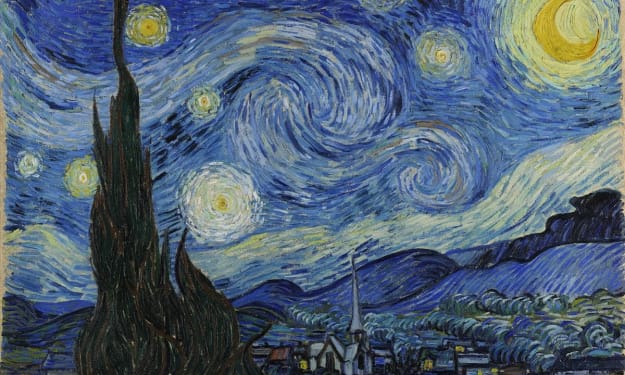
The Starry Night: A Symphony of Silence and Madness In the hush of a Saint-Rémy night, the stars whispered. It was 1889, and Vincent van Gogh sat behind the iron bars of the asylum window, his breath fogging the glass as the wind stirred the cypress trees beyond. The room behind him was still—too still. Silence had always been his shadow, but now it had teeth. Every ticking second scraped at his thoughts.
By Soul Drafts7 months ago in Art
How Tattoo Parlours in Cape Town Help Clients Feel Comfortable and Informed
Walking into a tattoo parlour in cape town for the first time can feel strange. You are trusting someone with your skin, your story, and a design you might wear for life. It is normal to feel excited and scared at the same time.
By Tools of Trade Studios3 days ago in Art
What Voice Cloning Technology Means for Creators and Digital Identity
The rise of artificial intelligence has reshaped the creative landscape in countless ways, from AI-generated visual art to automated music composition, and one of the most intriguing frontiers today is voice cloning. With tools that let users clone your voice using only a short sample of speech, creators and digital communicators are discovering new ways to produce audio content that feels natural and expressive.
By aliyashahzadi8 days ago in Art



Comments
There are no comments for this story
Be the first to respond and start the conversation.