
The Gashapon Chronicles
Where Every Toy Holds a Memory
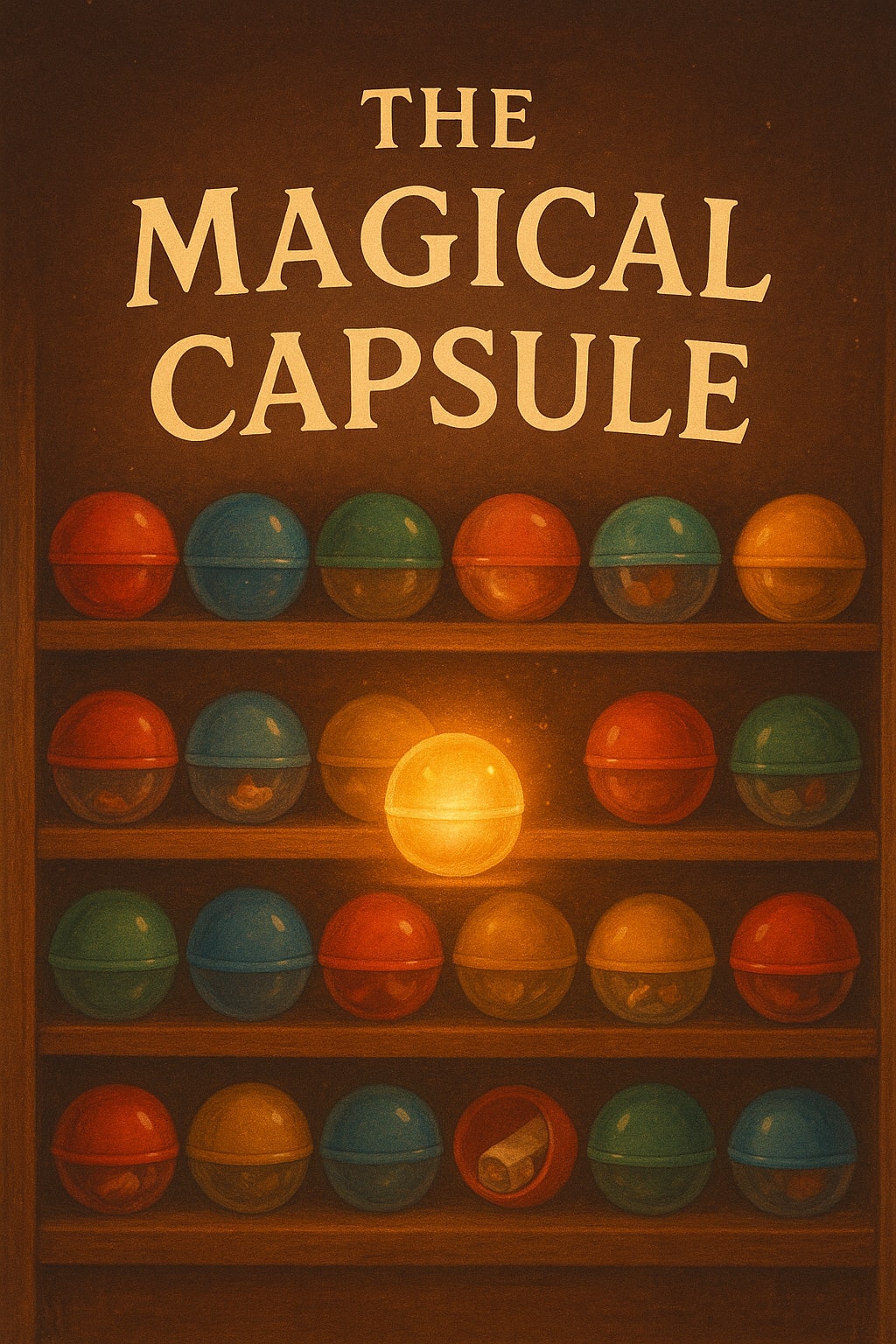
The Gashapon Shelf
by [ikram ullah]
The shelf was older than the shop itself. At least, that’s what Mr. Kato claimed whenever customers asked about it. Standing proudly behind the counter, it was a tall, narrow display with seven uneven tiers, each crammed with plastic capsules — reds, blues, greens, and yellows — stacked precariously like colorful bubbles.
Most people thought it was just an odd little collection, some old hobby the shopkeeper couldn’t part with. But I knew better.
I first stumbled into Kato’s Collectibles when I was twelve, hiding from the rain. My shoes squeaked on the wooden floor as I wandered between narrow aisles stacked with comic books, trading cards, and model kits. That was when I saw it — the shelf.
The capsules were mismatched, some cloudy with age, others so shiny they must have been brand new. The toys inside were stranger than the usual gashapon prizes you’d get from a vending machine: a tiny porcelain teacup no bigger than my fingernail, a folded paper crane, a silver key with no teeth, a miniature shoe made of glass.
I asked Mr. Kato how much one cost. He just smiled, his eyes creasing at the corners. “Not for sale like normal toys. You don’t pay with money. You pay with a memory.”
I laughed, thinking it was a joke. But he just pointed to a small notebook resting on the shelf. “Write something that happened to you. Doesn’t matter if it’s happy or sad, but it must be true. Then you can pick one capsule.”
That first time, I wrote about the time my best friend dared me to jump into the river in winter. My hands shook as I wrote — not from cold, but from the feeling that this was something important. I picked a pale blue capsule. Inside was a tiny plastic compass.
It didn’t point north.
I didn’t go back for months. But when I did, I saw something strange: the capsule I’d taken had been replaced by another entirely different one, as if the shelf never wanted to look empty.
Over the years, I became a regular. I’d trade a memory for a capsule whenever something meaningful happened — my first heartbreak, the day my father left, the afternoon I learned to ride a bike without training wheels. Each time, the toy inside was unexpected, sometimes confusing. A single button. A marble carved with a spiral. A scrap of fabric that smelled faintly of vanilla.
One evening, during my last year of high school, I stayed after closing to help Mr. Kato organize his stock. As I dusted the shelf, I noticed something. Some of the capsules were gone.
“You’ve been selling them?” I asked.
He shook his head. “No. Sometimes, when a person needs something, the shelf chooses for them. And sometimes, a toy will find its way back to the person who gave the memory in the first place.”
That night, I opened a yellow capsule from the top tier — one I swear I’d never seen before. Inside was the plastic compass I’d gotten the very first time. It was scuffed, as if it had been on a long journey. I looked at Mr. Kato, but he only smiled and said, “Guess it’s yours again.”
Years passed. I left town for university, then for work in the city. The shelf faded into the background of my mind, the way childhood things often do. I kept the compass in a drawer, though, for reasons I couldn’t explain.
Then came the phone call.
It was Mr. Kato’s niece. The shop had closed. He’d passed away quietly in his sleep. She was clearing out the store and wondered if I wanted anything as a keepsake.
Two days later, I stood in the dusty, quiet shop, the air smelling faintly of old paper and cedar. The shelves were mostly bare. But the Gashapon Shelf was still there, every tier filled with capsules as if nothing had changed.
His niece said, “He left this for you. Said you’d know what to do with it.”
I didn’t. Not right away. But I took it home.
At first, I kept it in my living room, just as it had been in the shop. Friends would ask about it, and I’d smile vaguely, the way Mr. Kato used to. One day, a neighbor’s kid came over during a rainstorm. His eyes went wide at the sight of the capsules.
“What’s in them?” he asked.
I heard myself say, “They’re not for sale like normal toys. You pay with a memory.”
He grinned, ran to my desk, and scribbled down a story about the time he won a school race. I let him pick a capsule. Inside was a tiny plastic shoe — the same one I remembered seeing on the shelf when I was twelve.
That’s when I understood. The shelf wasn’t meant to be mine to keep. It was meant to keep giving.
Now, years later, it stands by the window in a little secondhand bookshop I run. The capsules still change, appearing and disappearing in ways I can’t explain. Some children leave laughing, clutching their prize. Some adults walk away quietly, holding something small but precious in their hands, their eyes shining with the glimmer of a forgotten past.
And sometimes, on quiet nights, I take down the compass from the top shelf. It still doesn’t point north. But somehow, it always seems to point me back here — to the place where small wonders wait for those willing to trade a piece of their story.
About the Creator
Keep reading
More stories from Ikram Ullah and writers in Art and other communities.
Leave the Light On
I’ll Leave the Light On by [Ikram Ullah] The storm had rolled in hours ago, turning the quiet coastal town into a blurred watercolor of rain, wind, and shadows. It rattled the shutters, hissed through the cracks in the old house, and painted the windows with streaks of water that distorted the view of the street below.
By Ikram Ullah7 months ago in Blush
'Till Death We Do Art
There would be nothing divine in this world without art. Nature may surpass the divine to all intents and purposes, but like everything it absorbs and is absorbed by, it remains here, stuck on the surface of this world, ever-present, physically bound to the universe.
By Avocado Nunzella BSc (Psych) -- M.A.P 18 days ago in Art
Sahara Desert of Merzouga: The Complete Travel Blog Guide
Sahara Desert of Merzouga is one of the top places, you should not miss when visiting Morocco. It's place where golden dunes stretch endlessly, camels walk across the horizon, and nights sparkle with a sky full of stars. Located near the Algerian border, Merzouga is the gateway to the spectacular Erg Chebbi dunes, the most lovely sand dunes in Morocco. Merzouga desert is highly recommended among travelers due to its lovely high, clean and golden dunes offering visitors the chance to enjoy their vacation. Morocco Tours Company
By Othmane Anaam5 days ago in Art



Comments
There are no comments for this story
Be the first to respond and start the conversation.