
The Ferocious Taotie in "Shanhaijing"
Record of Strange Beasts in the Classic of Mountains and Seas

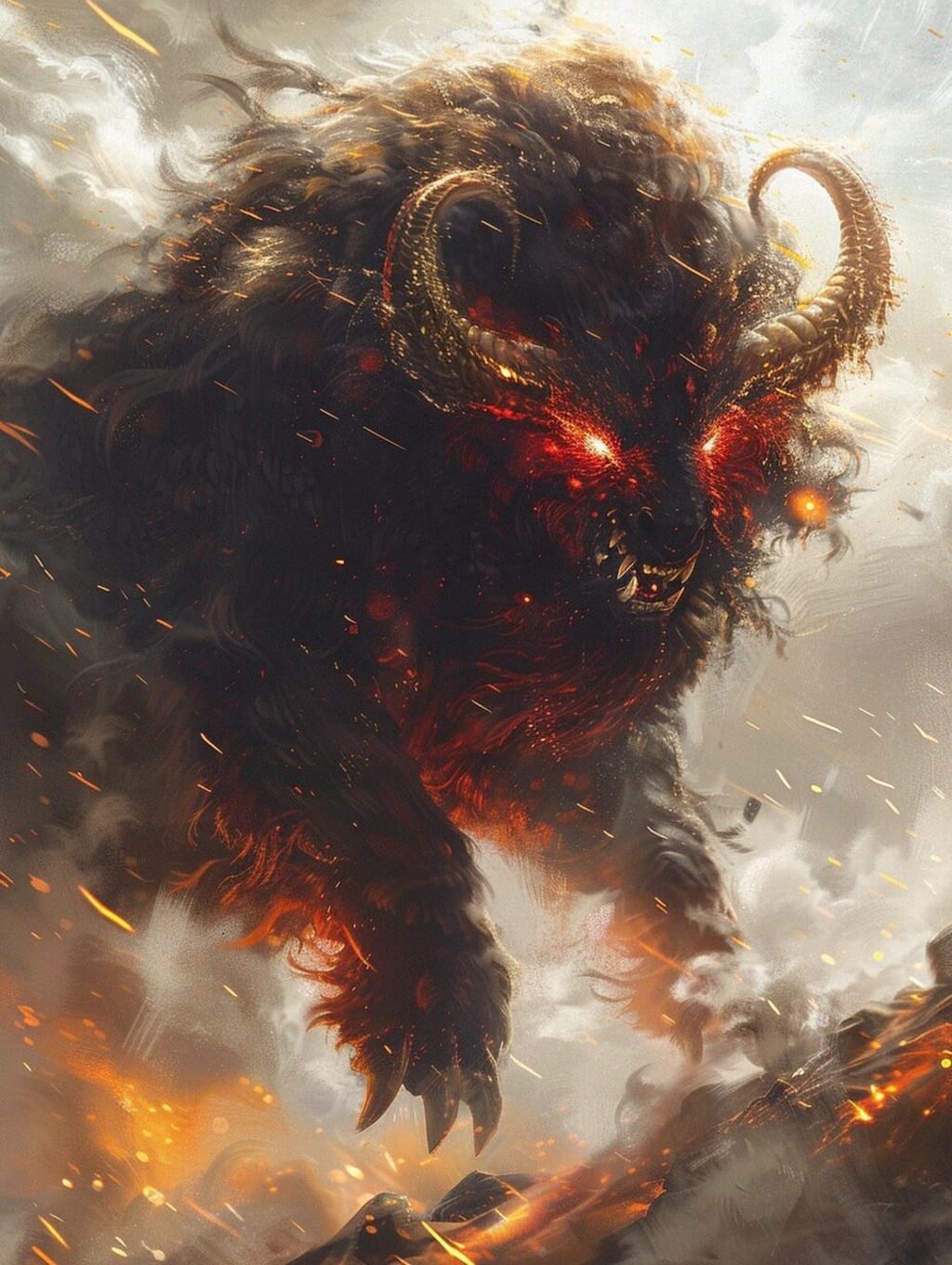
In the intricate tapestry of Chinese mythology woven by the "Shanhaijing," Taotie emerges as a menacing and unforgettable creature. This mythical being is renowned for its gluttonous nature and has left an indelible mark on Chinese cultural and historical narratives.
Appearance and Physical Features
Taotie is depicted in a rather grotesque and fearsome manner. It has a large, round head with a disproportionately wide mouth that seems to stretch to an impossible extent. Its jaws are lined with sharp, jagged teeth, ready to devour any prey that comes within its reach. The creature's eyes are small yet filled with a fierce and insatiable hunger, often described as glowing with a malevolent light.
Taotie typically lacks a distinct body in the traditional sense. Its head seems to merge directly into a mass of shaggy, coarse fur that covers its form. Some accounts suggest that it has short, stubby legs, which are surprisingly powerful, allowing it to move with a lumbering yet determined gait. Its overall appearance is designed to strike fear into the hearts of those who encounter it.
Gluttonous Behavior and Habits
The most defining characteristic of Taotie is its insatiable appetite. It is said to be constantly hungry and will consume anything and everything in its path. There is no limit to its gluttony; it will eat animals, plants, and even inanimate objects if it can get them into its mouth. Taotie's hunger is so intense that it has been known to devour itself in a never - ending attempt to satisfy its cravings, leaving only its head and a gaping maw as a symbol of its insatiable nature.
This gluttonous behavior has made Taotie a symbol of excess and greed in Chinese culture. It serves as a cautionary tale, warning people against the dangers of uncontrolled desires. The creature's insatiable appetite is not just a physical trait but also a metaphor for the human vices of overindulgence and avarice.
Mythological Stories
In one well - known mythological story, Taotie was once a powerful and proud figure. However, due to its extreme gluttony and arrogance, it incurred the wrath of the gods. As a punishment, it was transformed into the monstrous creature we know today. The gods cursed it to be constantly hungry, never able to satisfy its appetite no matter how much it ate. This story shows how Taotie's downfall was a result of its own vices, and it serves as a moral lesson about the consequences of giving in to excessive desires.
Another story tells of Taotie's rampage in the human world. It would descend upon villages and towns, devouring crops, livestock, and even people. The local communities were helpless against this ferocious creature until a hero emerged. The hero, armed with courage and a plan, managed to outwit Taotie and drive it away. This tale showcases Taotie as a threat to humanity and the importance of heroism in the face of overwhelming odds.
Cultural Significance
Taotie holds a significant place in Chinese culture as a symbol of negative qualities. It represents the dangers of greed, gluttony, and overindulgence. In ancient Chinese society, the image of Taotie was used to caution people against these vices. It was often depicted on bronze vessels during the Shang and Zhou dynasties. These vessels were used in religious ceremonies and feasts, and the presence of Taotie served as a reminder to those using the vessels to practice moderation and avoid excessive consumption.
In modern Chinese culture, Taotie still serves as a powerful symbol. It is used in various forms of art, literature, and media to represent the darker aspects of human nature. It also appears in idiomatic expressions and proverbs, further ingraining its significance in the Chinese language and cultural consciousness.
Influence on Art and Literature
Taotie's image has had a profound influence on Chinese art. In traditional Chinese bronzeware, Taotie patterns are some of the most iconic and recognizable. These patterns are highly detailed, with the creature's fierce features and menacing presence captured in the intricate designs. In paintings, Taotie is often depicted in a more dynamic and terrifying manner, either in the act of devouring or lurking in the shadows, waiting for its next meal.
In literature, Taotie appears in many ancient texts, where it is described in vivid detail. Poets and storytellers have used Taotie to create dramatic and cautionary tales. In modern literature, especially in fantasy and horror genres, Taotie continues to be a popular subject. It is often reimagined and adapted to fit new narratives, introducing this ancient and fearsome creature to a wider audience.
In conclusion, Taotie in the "Shanhaijing" is a creature that has fascinated and terrified people for centuries. Its unique appearance, gluttonous behavior, and the stories associated with it have made it an integral part of Chinese mythology and culture. Whether as a symbol of vice, a subject of art, or a character in literature, Taotie continues to play a significant role in shaping our understanding of Chinese heritage.
About the Creator
hello-word
As a Chinese person, love for the culture of my own country. Nowadays, the global exchange of information is becoming increasingly rapid. I also hope that more people can gain a deeper and more detailed understanding of Chinese culture.
Keep reading
More stories from hello-word and writers in Art and other communities.
The Mysterious White Ze in "Shanhaijing"
In the rich and diverse world of Chinese mythology as presented in the "Shanhaijing," the White Ze stands out as an enigmatic and highly revered creature. This mythical being holds a special place in the pantheon of ancient Chinese legends, embodying wisdom, knowledge, and auspiciousness.
By hello-wordabout a year ago in Art
'Till Death We Do Art
There would be nothing divine in this world without art. Nature may surpass the divine to all intents and purposes, but like everything it absorbs and is absorbed by, it remains here, stuck on the surface of this world, ever-present, physically bound to the universe.
By Avocado Nunzella BSc (Psych) -- M.A.P 26 days ago in Art
The Front Seat
I found myself waking up in the front seat of the bus. My eyes were filled with the early morning darkness. I had been asleep, but I wasn’t sure for how long. I tried to wake up my body, but my head felt heavy, as though I had been sleeping for an eternity, although I couldn’t pinpoint how much time had passed.
By Aunty Sada2 days ago in Art



Comments
There are no comments for this story
Be the first to respond and start the conversation.