
“The Equation of Her Eyes”
A Genius, a Violinist, and the Formula for Love”

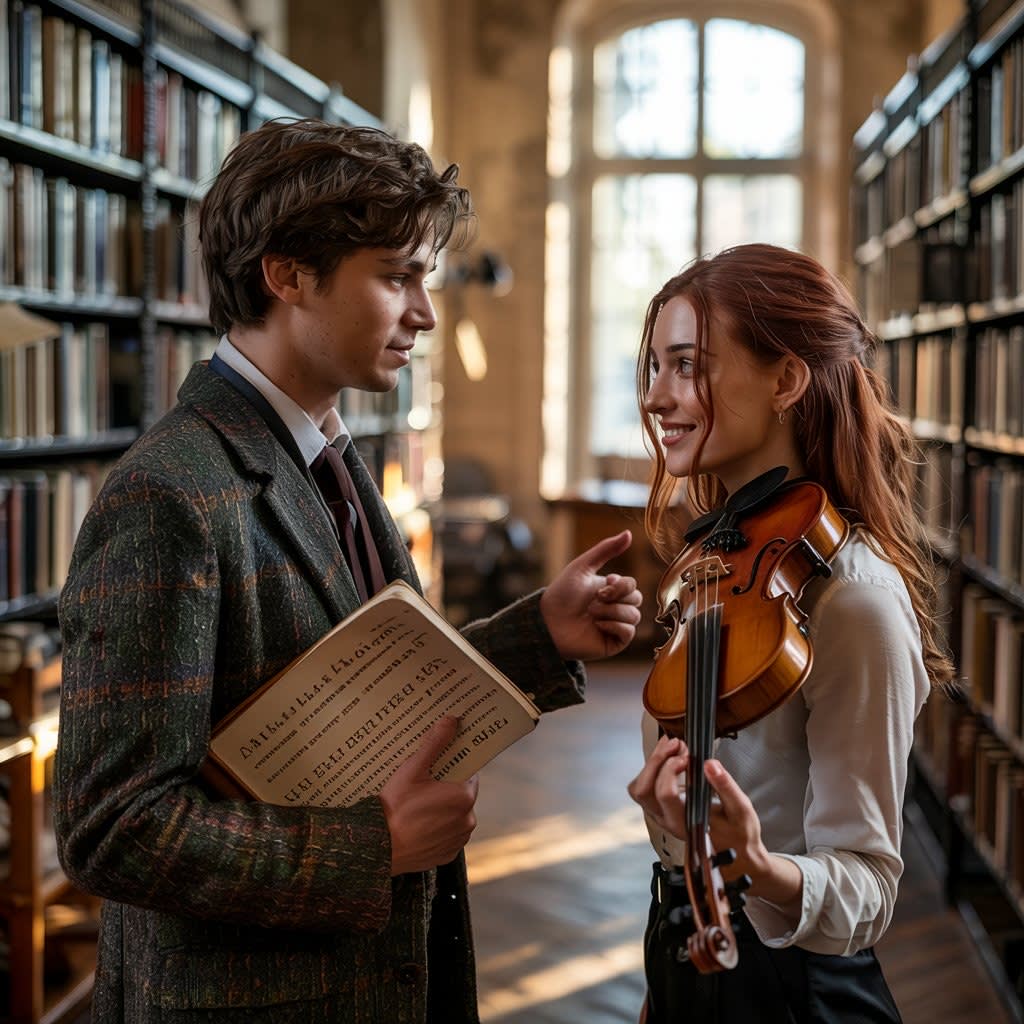
They called him The Prodigy of Prague. At just 17, Aleksander Varga had solved equations professors had battled for decades. He read quantum mechanics the way other boys read comic books. He was sharp, methodical, and somewhat cold—a mind that moved faster than emotion. Love, for him, was just a chemical illusion, a reaction of dopamine and oxytocin he could define but never feel.
Until he met her.
Her name was Lila Moreau. She wasn’t a mathematician or a scientist. She was a violinist. A transfer student from Paris with soft brown eyes that held symphonies in silence. When she played, time itself seemed to fold—Aleksander, who had always believed music was just organized sound waves, began to feel… something.
It started simply. She sat beside him in chemistry, tapping her pencil in rhythm, her notebook filled with doodles instead of formulas. Aleksander, irritated at first, tried to ignore her. But one day, she leaned over and asked, “Why do molecules fall in love?”
He looked at her, puzzled. “They don’t. Molecules react. Love is a human construct.”
She smiled. “Maybe. But reactions can be beautiful too.”
That night, he couldn’t sleep. He didn’t like that. His brain was always in control—until Lila entered it.
Over the months, they began talking more. She would invite him to her recitals, and though he didn’t understand why the way she played made his chest tighten, he kept showing up. In return, he showed her equations—taught her how to find beauty in symmetry and logic.

One evening, in the old library, she asked, “Do you ever think love is like math? Predictable, with rules and formulas?”
He replied, “No. Love is like quantum mechanics—uncertain, entangled, and impossible to observe without changing the outcome.”
She laughed. “So you admit love exists?”
“I admit… something exists. When I’m around you, I can’t calculate things like before.”
They fell in love in slow, secret layers. It wasn’t passionate like the books she read, or chaotic like the stories he avoided. It was like a sonata—structured but emotional, complex but flowing.
Then came the scholarship.
MIT. Full ride. Prestigious. Life-changing.
“I’ll be gone in three months,” he told her quietly, afraid of what her reaction might be.
She blinked, pain briefly flickering in her eyes. “That’s amazing. You deserve it.”
“You’ll still be here,” he said.
“I know.”
They sat in silence, the weight of unspoken decisions hanging between them.
The day before his flight, she took him to the old observatory on the hill. It was cloudy, the stars hidden, but she brought her violin.
“I wrote this for you,” she said.
And she played.
It wasn’t perfect—it was raw and trembling. But Aleksander, the boy who once believed music was noise, now understood it was everything. Every note carried memories, laughter, arguments about physics, soft hands in dark theaters, and kisses between textbooks.

As she finished, he whispered, “What if I stayed?”
She looked at him fiercely. “Don’t you dare. You’re going to be one of the greatest minds in the world.”
“But what if—”
“I’ll wait,” she said, her voice barely above the wind. “If it’s real, we’ll find our way back. Love doesn’t vanish. It transforms. Like energy.”
He left the next morning. She cried. He didn’t—until the plane took off and he realized the seat beside him would always feel empty.
Years passed. They wrote letters, then emails, then long video calls. Time zones were cruel. So were deadlines. But she got into Juilliard, and he got published in Nature before 21.
On the day he defended his doctoral thesis, he quoted something Lila once said: “Reactions can be beautiful.” His professors didn’t understand the context, but they nodded thoughtfully.
He returned to Prague five years later, walking up that same observatory hill, heart racing like he was 17 again.
She was there.
Waiting.
Still with the same soft brown eyes, though now they carried even more stories.
Neither of them spoke at first. She stepped forward, reached into her coat, and pulled out a folded paper.
It was an old sketch from chemistry class. Two molecules, holding hands.
“I kept it,” she said.
He smiled, eyes stinging. “I kept everything.”
And as the first snow began to fall, the boy who once believed in logic over love kissed the girl who taught him otherwise—proving, once and for all, that even geniuses don’t always need to solve everything.
Some things are meant to be felt.
About the Creator
Najibullah
I’m Najibullah — a journalist dedicated to amplifying the voices of the oppressed and sharing reliable, useful information to inform and inspire.
Keep reading
More stories from Najibullah and writers in Art and other communities.
A Prince Among the Stars
The Little Prince By Antoine de Saint-Exupéry (Narrated and Retold) Once upon a time, a pilot crashed his plane in the middle of the Sahara Desert. With only enough water to last a few days, he was trying to repair his engine when he heard a small, curious voice.
By Najibullah10 months ago in Art
'Till Death We Do Art
There would be nothing divine in this world without art. Nature may surpass the divine to all intents and purposes, but like everything it absorbs and is absorbed by, it remains here, stuck on the surface of this world, ever-present, physically bound to the universe.
By Avocado Nunzella BSc (Psych) -- M.A.P 23 days ago in Art
Heavenly Harmonies and Heavy Criticisms: The Complex Rise of Bethel Music
Heavenly Harmonies and Heavy Criticisms: The Complex Rise of Bethel Music Walk into almost any contemporary Christian church on a Sunday morning—whether in London, Lagos, or Los Angeles—and you are almost guaranteed to hear their music.
By Nivard Anna3 days ago in Art


Comments (4)
Asalam Aleekum Najibullah Bhai sanga yee kha yee .margaree da kom zee yee ta .yaar zama ba lag help wa na ky. khabara my kawala chee ta ma support kawa za ba ta support kom o brother
Good story
good
Good