
The Echo of Kindness
The Echo of Kindness: How a Lost Song Found Its Way Home
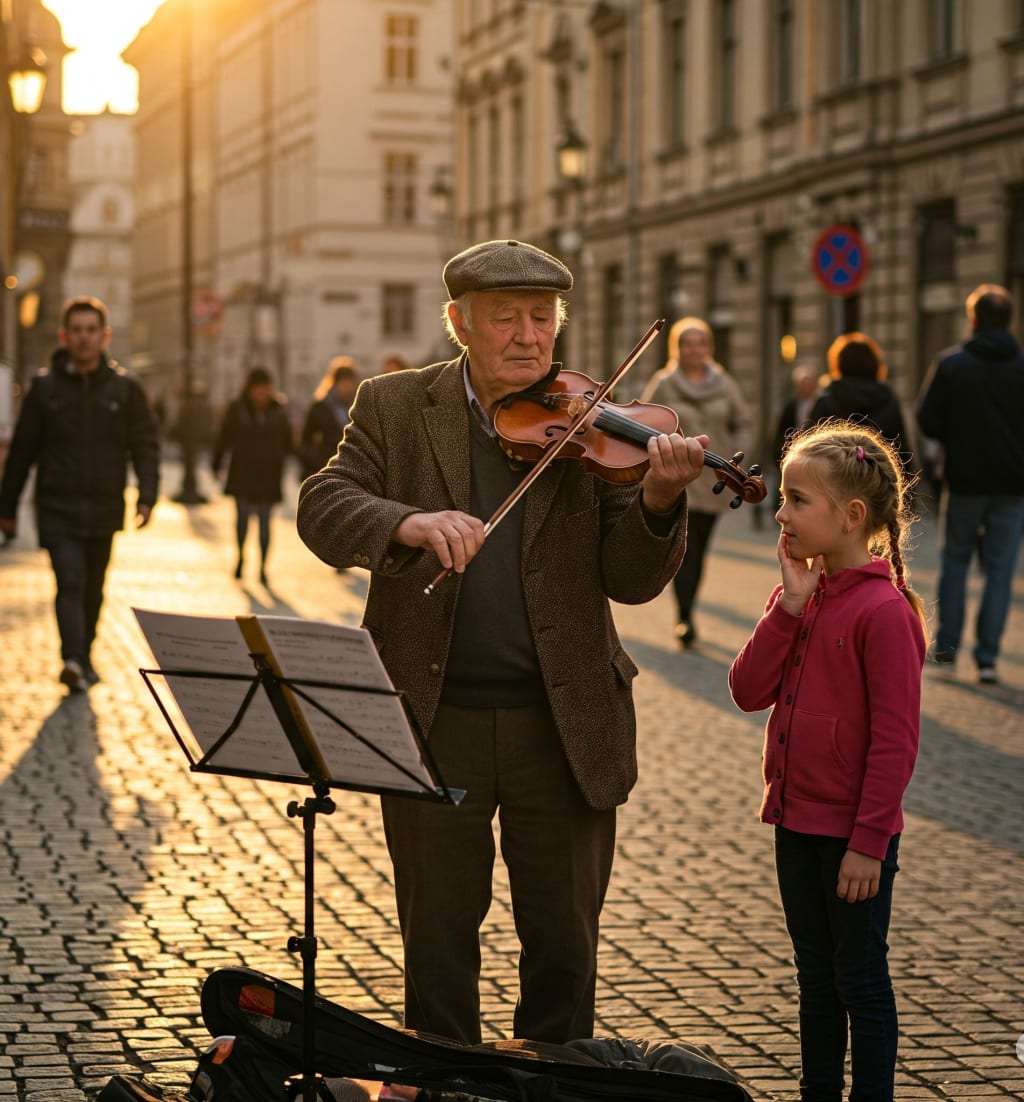
The city breathed in its usual rhythm - a symphony of honking taxis, chattering crowds, and hurried footsteps that never seemed to slow. Neon signs flickered to life as evening fell, painting the sidewalks in pools of electric color. Ten-year-old Mia clutched her father's hand tighter as they navigated the bustling streets, her small fingers nearly lost in his warm grip.
Then, cutting through the urban cacophony like a knife through smoke, came a sound that made Mia stop dead in her tracks.
A violin's mournful cry rose above the noise, so full of sorrow and beauty that it seemed to silence the world around it. Mia tugged her father's arm insistently until he relented, allowing her to lead them toward the source of the music.
There, tucked between a flickering lamppost and the grimy wall of a convenience store, sat an old man on a rickety wooden stool. His clothes hung loose on his thin frame, worn thin by time and weather. The violin in his hands looked nearly as ancient as he did - its wood scarred but polished with care, its strings gleaming under the streetlights.
Most people walked past without a glance, though a few tossed coins into the battered hat at his feet without breaking stride. But Mia stood transfixed, her school backpack forgotten as it slid down one shoulder. When the song ended with a trembling high note that hung in the air like a question, she dug through her pockets until she found a single, crumpled dollar bill.
The old man's eyes crinkled as she carefully placed it in his hat. "Thank you, little nightingale," he said, his voice like dry leaves rustling.
Mia hesitated. "That song... it made my heart hurt. But in a good way."
The musician chuckled, a sound as warm as the tea Mia's grandmother used to brew. "That is how you know real music, child. It should always speak true."
"What's it called?"
The old man's gnarled fingers tightened slightly on his bow. "In my homeland, we called it 'The Orphan's Lament.' But that was... many lifetimes ago."
Something in the way he said it made Mia sit right there on the concrete, heedless of her school uniform. "Will you play it again?"
The musician - Elias, as Mia would later learn - seemed surprised, then delighted. This time when he played, he closed his eyes, letting the bow dance across the strings with a skill that belied his ragged appearance. The notes swirled around Mia like living things, and suddenly she was back in her grandmother's kitchen, safe in the circle of Teta's arms as she sang that strange, sweet lullaby from the Old Country.
When the last note faded, Mia realized tears were streaming down her face.
"You know this song?" Elias asked softly, his own eyes suspiciously bright.
"My grandmother... she sang something like it. Before..." Mia trailed off, suddenly aware of how many people had left her life.
Elias nodded slowly. "Your Teta was from Alveria?"
Mia's head snapped up. "How did you know?"
The old man's smile was bittersweet. "Because only an Alverian would know this melody. It's about..." He paused, searching for words. "It's about how love outlasts even the longest goodbye."
Mia's father, who had been waiting patiently, finally crouched beside them. "We should get home, solnyshko," he murmured, but his journalist's eyes were fixed on Elias with new interest.
"Will you be here tomorrow?" Mia asked as her father helped her up.
Elias spread his hands. "If the city permits it."
That night, Mia lay awake staring at the glow-in-the-dark stars on her ceiling, hearing that haunting melody replay in her mind. Down the hall, she could hear her father typing furiously on his laptop, pausing only to dig through his box of old press badges from his war correspondent days.
The next evening, they returned with a thermos of sweet mint tea and a paper bag still warm with fresh burek from the Balkan bakery across town. Elias accepted them with hands that shook slightly, his eyes widening at the familiar aroma of the flaky pastry.
"You remembered," he said quietly.
Mia's father sat beside him on the sidewalk, heedless of his dress slacks. "Tell me," he said simply, pulling out his recorder. "Tell me everything." painting the streets in gold, Elias did. He spoke of concert halls now reduced to rubble, of compositions lost to bomb blasts, of how he'd once played for kings and now played for pennies. But most of all, he spoke of music's stubborn persistence - how a single melody could survive wars, oceans, and decades to find its way home again in this quiet corner of the rushing city, three hearts beat a little closer together. And that, perhaps, was enough.
About the Creator
Keep reading
More stories from Umar Farooq and writers in Art and other communities.
The Case of the Missing Mango Lassi
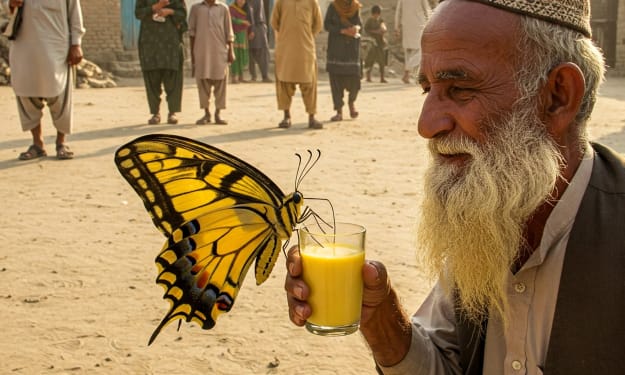
The late afternoon sun cast long, comical shadows across the dusty lanes of Baidara. A gentle breeze, carrying the scent of woodsmoke and something vaguely floral (perhaps a particularly enthusiastic goat had been nibbling on jasmine again), rustled the leaves of the ancient banyan tree in the village square. Underneath its sprawling branches, old Sardar Khan, a man whose beard seemed to have a wisdom all its own, was enjoying his daily ritual: a tall, frosty glass of mango lassi. Now, Sardar Khan’s mango lassi wasn't just any mango lassi. It was a concoction of legendary proportions, lovingly prepared by his wife, the formidable but secretly sweet Bibi Gul. It was thick, creamy, intensely mango-y, and possessed the uncanny ability to soothe even the most cantankerous soul. For Sardar Khan, it was the elixir of life, the fuel that powered his afternoon naps and his insightful (and often loudly proclaimed) opinions on local politics. Today, however, tragedy had struck. The lassi was gone. Vanished. Poof! One moment it was there, condensation beading on the glass, a tantalizing swirl of saffron on top. The next, only a damp ring remained on the small wooden table beside him. Sardar Khan’s eyes, usually twinkling with amusement, widened in disbelief. He patted his pockets, as if the lassi might have somehow migrated into his shalwar kameez. He peered under the table, half expecting to see it hiding shyly amongst the dust bunnies. Nothing. “Bibi Gul!” he bellowed, his voice echoing through the quiet square, startling a flock of pigeons into flight. “My lassi! It has… it has absconded!” Bibi Gul emerged from their small mud-brick house, wiping her hands on her dupatta, a look of mild irritation on her face. “Absconded? Sardar Khan, are you feeling alright? Lassies don’t simply walk away.” “But it’s gone, woman!” Sardar Khan insisted, gesturing dramatically at the empty spot. “One minute I was contemplating the profound mysteries of why the neighbor’s chickens always seemed to end up in my vegetable patch, the next… wham! Lassi-less!” Bibi Gul sighed, a sound that could curdle milk at twenty paces. “Perhaps you drank it and forgot?” Sardar Khan clutched his chest in mock offense. “Forget my mango lassi? Bibi Gul, that’s like suggesting I might forget my own name! This is a grave matter, a culinary crime!” News of the missing lassi spread through Baidara like wildfire. It was, after all, a slow news day. The tailor, Masterji Rahim, paused his meticulous stitching. The chai-wallah, young Imran, stopped pouring his steaming brew. Even the aforementioned chicken-rustling neighbor, old Karim, leaned in with a curious frown. A small crowd gathered around Sardar Khan, their faces a mixture of concern and morbid curiosity. “Did you see anything, Sardar Khan?” Masterji Rahim asked, adjusting his spectacles. “Only the fleeting joy of its presence,” Sardar Khan lamented, his voice thick with emotion. “And then… emptiness. A void where creamy mango goodness once resided.” Imran, ever the pragmatist, suggested, “Maybe a dog? They’re partial to sweet things.” Sardar Khan scoffed. “A dog with the dexterity to lift a full glass without spilling a drop? Preposterous! This was the work of a cunning… a lassi-napper!” Theories abounded. Perhaps a mischievous jinni had taken a fancy to it. Maybe a passing tourist, desperate for refreshment, had made a daring grab-and-run. Old Karim even suggested that the mango lassi had simply evaporated due to the sheer intensity of its deliciousness. Suddenly, young little Fatima, Karim’s granddaughter, piped up, her eyes wide. “I saw something!” A hush fell over the crowd. “What did you see, child?” Sardar Khan asked, his hopes soaring. Fatima pointed a small finger towards the banyan tree. “A big, yellow butterfly… it was… sipping!” A collective gasp rippled through the onlookers. A butterfly? Sipping? It sounded utterly ridiculous, yet Fatima’s earnestness was undeniable. Sardar Khan cautiously approached the tree, peering at its thick trunk. And then he saw it. A large, bright yellow butterfly, its wings slowly fluttering, perched precariously on a low branch. And clinging to its proboscis, a tiny, sticky droplet of… mango lassi. The crowd erupted in laughter. Sardar Khan stared, his mouth agape. The great mango lassi mystery, solved by a sticky-winged culprit. Bibi Gul, shaking her head but with a smile playing on her lips, retrieved a fresh glass of lassi from the house. As Sardar Khan finally took a long, satisfying sip, he couldn’t help but chuckle. “Well,” he declared, wiping a smudge of lassi from his mustache, “it seems even the smallest creatures appreciate Bibi Gul’s magnificent mango lassi. Though,” he added with a twinkle in his eye, “next time, I’m assigning a guard.” And so, the case of the missing mango lassi became a beloved, and slightly sticky, tale in the annals of Baidara, a reminder that even the most serious of situations can sometimes have the most unexpectedly hilarious of explanations. And the yellow butterfly? It became a local legend, forever known as the Mango Marauder.
By Umar Farooq9 months ago in Humor
Impressive Artwork by Odilon Redon
French symbolist artist Odilon Redon was famous for his drawings in the 1880s. The artist’s artworks were mentioned in the popular 1884 novel “A Rebours,” or “Against the Grain,” by Joris-Karl Hysmans. His later artworks were created in oils and pastels. He developed an interest in Hinduism and Buddhism, and this interest in mysticism is reflected in his works of art.
By Rasma Raisters5 days ago in Art
What Is A5 Service on Mercedes and When Do You Need It?
If you’re a Mercedes‑Benz owner, you’ve likely seen a maintenance message pop up on your dashboard — perhaps showing something like “Service A5 due”. But what exactly is a5 service on Mercedes, why it matters, what it includes, and how much it costs? This complete, easy‑to‑understand guide answers all those questions so you can keep your luxury vehicle running smoothly and avoid costly repairs down the road.
By Vincent Otiri7 days ago in Art
Wild Card Weekend Recap: What Happens Now?
I think I figured out why I love Wild Card Weekend so much. It's because it's the first playoff anything of the calendar year. The NFL season starts in the fall, and once upon a time, the champion was crowned either on or slightly before New Year's. The evolution of the NFL schedule has resulted in the playoffs starting just into the New Year, and currently, the final week of the season falls on the first weekend of the New Year, with Wild Card Weekend coming a week after that. So yes, chronologically, the NFL's Wild Card Weekend serves as the first playoff anything of the calendar year.
By Clyde E. Dawkins6 days ago in Unbalanced



Comments
There are no comments for this story
Be the first to respond and start the conversation.