
THE DA VINCI CODE IN THE PAINTING OF THE LADY AND THE ERMINE
THE PAINTING OF THE LADY AND THE ERMINE

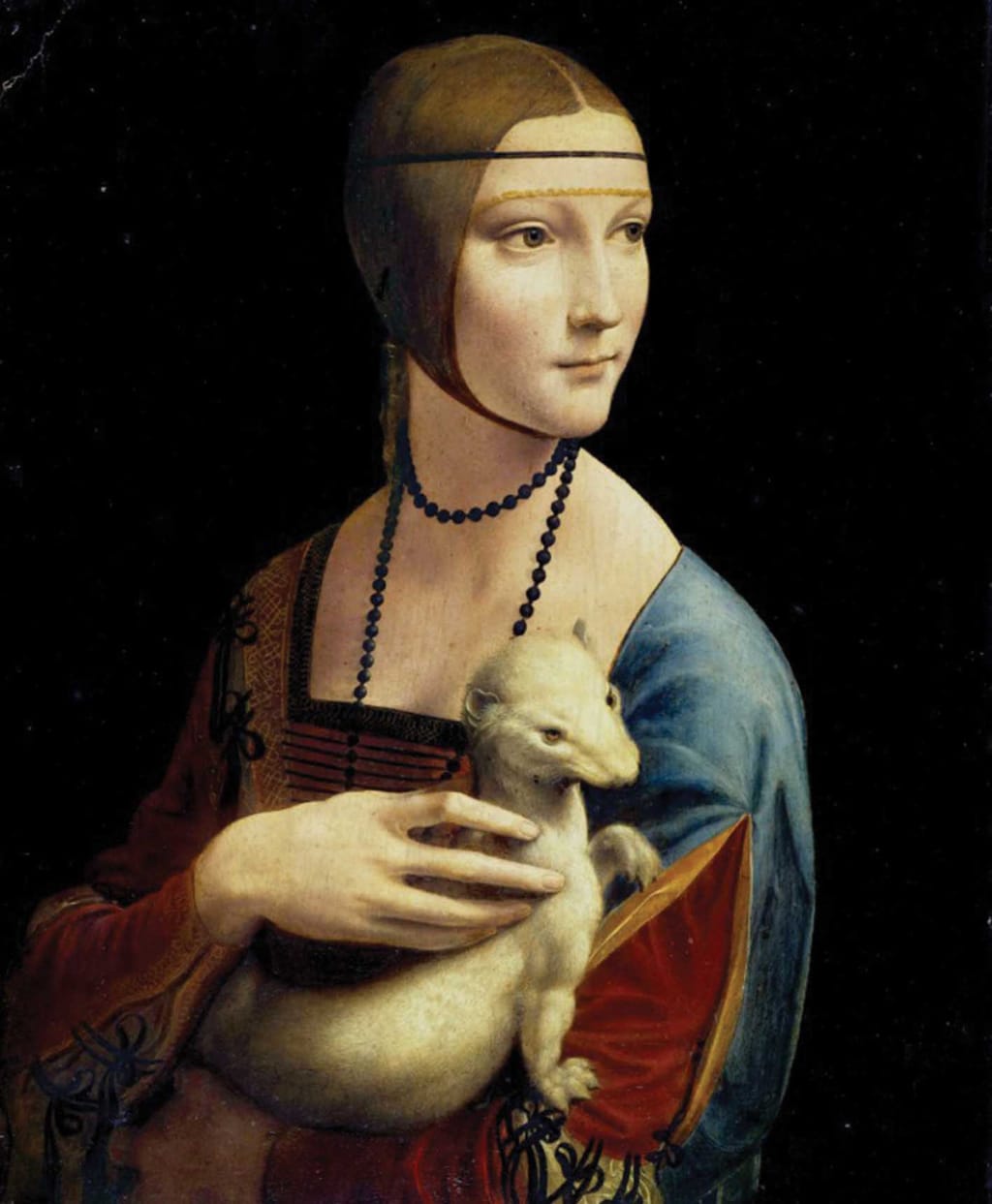
Like all works by the Italian painter Leonardo da Vinci, the painting "Lady with Ermine" contains many secrets and is considered the first modern portrait. It is one of four portraits of women painted by Leonardo that have survived to this day.
The other three are the famous "Mona Lisa," the portrait of Ginevra de' Benci (both on display at the Louvre Museum), and the portrait of "La belle ferronnière" (currently at the National Gallery of Art in Washington, DC, USA).
"Lady with Ermine" was painted around 1489-1490, more than 10 years before the "Mona Lisa." The painting (54.8cm x 40.3cm) is also known as the Portrait of Cecilia Gallerani.
The artwork depicts a beautiful woman from Siena with porcelain-like skin, simple attire, and an air of sophistication. She wears a blue sbernia cloak over a red dress, a dark silk ribbon around her head, and holds a delicate veil with a golden edge, along with a string of black beads, adding an aura of modesty to her character.
Cecilia's posture in the painting is distinct from the typical poses seen in portraits of that era. She is seated with a slight tilt to the right, her face turned to the left, her eyes not directed toward the viewer in the conventional manner but rather focused on some "third party" outside the frame on the right side. This posture represents a breakthrough in Leonardo's technique compared to contemporary portraiture, which usually featured direct frontal poses. Italian poet Bernardo Bellincioni (1452-1492) suggested that Cecilia adopt this seated position, as if she were listening to someone speak.
The enigmatic smile on Cecilia's lips always leaves viewers with a sense of hidden or guarded emotions. The white ermine she holds in her hand shares many similarities with its owner - white fur, dark eyes, and also looking to the right - all with subtle symbolism.
With extraordinary craftsmanship, Leonardo depicted Cecilia's hand placed on the ermine with lifelike details, from the long fingernails to the skin folds around the knuckles, and even the veins running along a curved finger.
The light entering from the left side of Cecilia is delicately portrayed on her face, her fingers, on the folds of her sbernia cloak, and on the soft white fur of the ermine, creating a three-dimensional effect and bringing the artwork to life.
Using the relatively new oil painting technique introduced in Italy in the 1470s on a panel of poplar wood, the Italian master created an image with movement, conveying both the character and the psychology of the subject through posture and gestures.
A portrait that John Pope-Hennessy, a renowned art historian, considered revolutionary in terms of imagery and posing, calling it the "first modern portrait."
The Code in the White Ermine
Subsequent technical analysis revealed that beneath the portrait of Lady with Ermine, there are two other paintings that Leonardo created of Cecilia in the same pose: one without the ermine and the other with a dazzling red outfit not concealed by the blue cloak.
It appears that the portrait was altered, likely at the request of the person who commissioned Leonardo to paint it, Ludovico Maria Sforza, the Duke of Milan, who had a deep appreciation for art and later commissioned Leonardo to paint "The Last Supper."
The Duke of Milan was also the person who saw the beauty of Cecilia Gallerani (1473-1536) and was captivated by her talent. As the daughter of an educated middle-class family, with a diplomat father and a law professor mother, Cecilia was skilled in poetry, public speaking, Latin writing, and became the lover of the Duke at the age of 16.
Cradling the white ermine in her arms, Cecilia was not just holding a common pet among the aristocracy but rather harboring many secrets of herself and her lover within it.
With its white fur, the ermine in the painting symbolizes purity, echoing the lady's grace. Leonardo himself later explained in his handwritten notes that the white ermine kept itself clean by saying, "It would be better to be caught by the hunter than to hide in dirty burrows."
When painting a somewhat subdued portrait of the noblewoman from Florence, Ginevra de' Benci, around 1474-1478, Leonardo included a juniper bush in the background to conceal the subject's name within it.
Ten years later, a similar technique was used when painting Cecilia Gallerani's portrait, but with more vivid and subtle use of color and light. Ultimately, the ermine in Cecilia's arms could also carry another layer of meaning: it is a symbol of pregnancy in Italian Renaissance culture. With its masculine-looking raised leg muscles, it may hide another story that the portrait was completed in 1490, and Cecilia gave birth to the Duke's son in 1491, when she was just 18 years old.
About the Creator
Keep reading
More stories from Diana Rose and writers in Art and other communities.
'Till Death We Do Art
There would be nothing divine in this world without art. Nature may surpass the divine to all intents and purposes, but like everything it absorbs and is absorbed by, it remains here, stuck on the surface of this world, ever-present, physically bound to the universe.
By Avocado Nunzella BSc (Psych) -- M.A.P 27 days ago in Art
Rewire Your Mind for Success
brilliant inventor and worked day and night in her small lab, filled with glowing screens and strange gadgets. Despite her talent, she struggled to find success. Her inventions were often overlooked, and her ideas remained trapped in her mind.
By Hamad Afridi 6 days ago in Art
Pandora’s Burden
“My brother warned me to not accept gifts from the one who commissioned you,” said Epimetheus to the woman clad in silvery raiments standing at the entrance to the temple. Her silver tiara and the silver rings on her fingers and toes glinted in the firelight cast by torches set on either side of the doorway. Lingering in the shadows, beyond the reach of the flames as she was, he could not tell what she held in her hands. At first what appeared to be a box was perhaps a funerary urn, or maybe merely an apple.
By J. Otis Haas3 days ago in Fiction




Comments
There are no comments for this story
Be the first to respond and start the conversation.