
The Cursed Filmmaker
Nicolás Guillén

Nicolás Guillén Landrián (1938–2003) created a body of work as intense as his life. When one ventures into it, one cannot help but be surprised by such profound genius—rediscovered again after so much time. Writing this homage to his figure caught me off guard, becoming a challenge to highlight such a sincere and sensitive aesthetic in so few lines. What was Landrián beyond a creator? Time has proven that the simplicity of his work was the foundation for shaping a deeper sense of Cuban identity within the artistic spectrum.
Misunderstood in his time—in an era of decisions more impulsive than mistaken—the work of Nicolasito (as his closest colleagues called him) vanished from the national spotlight. He was not the one who lost the most, but rather Cuban culture and the country itself. It is essential to analyze every step of action taken by this man—perhaps the greatest artistic talent ever born in Cuba. His film work, entirely documentary, but no less captivating for it, is a perfect harmony of anthological cultural expressions, the visible dramatic stories of the country, and the process of forming Cuban nationality.

As viewers engage with his filmography, they sense the genuine emotion radiating from Landrián. The Revolution was, for him, a beacon of personal and artistic self-realization. Working with Solás and Santiago Álvarez served as a formative experience, yet the most distinctive touches of the era emerge from his own trail. Music and culture play supporting roles in his creations, just as his portrayal of a new society’s evolution finds in him the greatest driver of emotion. His work is beautiful because it is real.
The transformation he aims to highlight is raw and singular. Landrián was acutely aware of the social context in which he lived, and he traveled across the country in search of stories to tell. Poetry and romanticism accompany his vision, but they are not its essence. What was needed was a way to show how a country is born—and Nicolás became the most capable of giving power to that portrayal. Coffea Arábiga and Los del baile (perhaps the most misunderstood, due to its resemblance to PM) represent the summit of his filmmaking—always precise. His ability to move between the visual arts and cinema made Landrián the principal artist capable of expressing his ideas spontaneously, without sacrificing authenticity. It is unjust that Cuban culture was unable to enjoy more of his presence beyond his exile. His life, sadly, was a drama; censorship, his greatest punishment, was something he could never recover from. Perhaps an apology was missing—some sign of respect and love for his work. Perhaps he never felt valued enough to accept it. It has been a privilege for this writer to attempt to grasp the legacy of, in my view, the most important documentarian in Cuba and one of its most representative filmmakers.

—This text was originally written by Carlos Javier Valle Díaz and is published with his express permission.—
About the Creator
Keep reading
More stories from Cesar Alejandro Mursuli Abreu and writers in Art and other communities.
1917: From Dream to Greatness
War conflicts in cinema have been portrayed in a wide variety of ways over the years. Some stories have been more moving than others, endowed with greater quality. We can find films of this type with adventurous tones; some are purely documentaries, others depict genuine romances, and several have been created in which comedy serves as the main attraction. Militarism has undergone a remarkable evolution in terms of the message it seeks to convey. Today, while some productions attempt to denounce the crimes committed in war and the urgent need to end all existing conflicts, others aim to highlight the supposed heroism of victorious powers and discredit their enemies—and even some allies.
By Cesar Alejandro Mursuli Abreu8 months ago in Critique
'Till Death We Do Art
There would be nothing divine in this world without art. Nature may surpass the divine to all intents and purposes, but like everything it absorbs and is absorbed by, it remains here, stuck on the surface of this world, ever-present, physically bound to the universe.
By Avocado Nunzella BSc (Psych) -- M.A.P 16 days ago in Art
The Dress That Broke the Internet Was Gold and Nobody Could Agree on Why
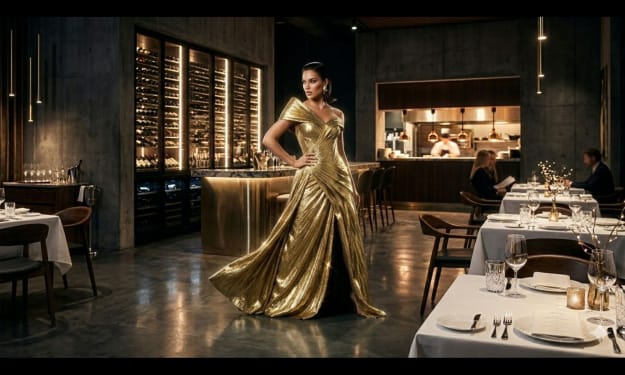
She walked into the room and everything stopped. Not because of her confidence or music that was playing, though there was plenty of that. Everything stopped because of the dress. Floor-length, liquid, blazing gold, it caught every light in the room and threw it straight back.
By CurlsAndCommasabout 8 hours ago in Art



Comments
There are no comments for this story
Be the first to respond and start the conversation.