
The Creative Mind Unveiled
Exploring the Psychology Behind Artistic Brilliance and Emotional Expression
The Creative Mind Unveiled
Exploring the Psychology Behind Artistic Brilliance and Emotional Expression
When Ava was eight years old, she sketched her first portrait—not from sight, but from memory. It was of her grandmother, whom she hadn’t seen in two years. The lines were uneven, the nose a bit too long, but somehow, the drawing captured her grandmother’s warmth in a way no photograph ever had. That moment was the beginning of her life as an artist—and unknowingly, a journey into the mysterious landscape of the creative mind.
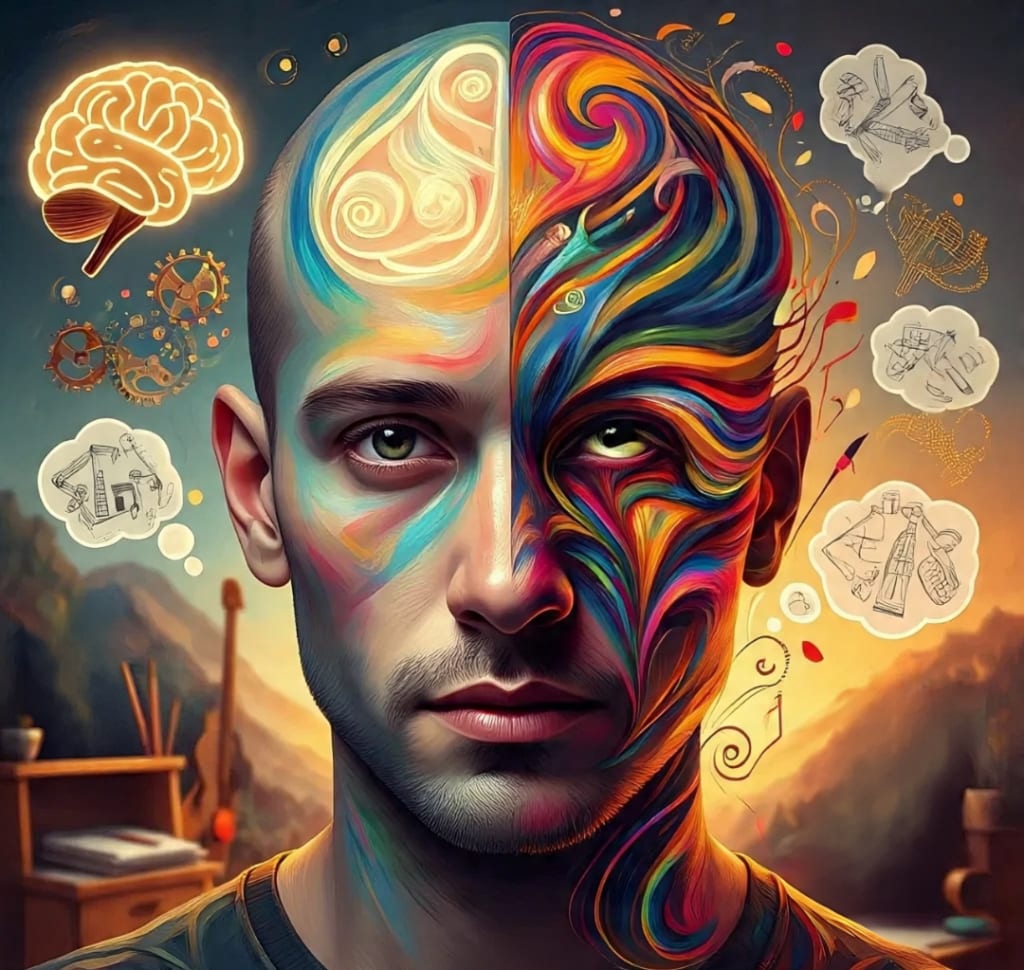
Artists like Ava have long fascinated psychologists, neuroscientists, and philosophers alike. What is it that fuels artistic talent? Why do some individuals feel a constant need to create, express, and explore emotions through paint, music, dance, or words? The psychology of artists is a field as layered as a complex oil painting, and recent studies have begun to shed light on how their minds work.
One of the most consistent findings in the psychology of creativity is that artists often show higher levels of openness to experience—a personality trait linked to imagination, curiosity, and sensitivity to beauty and emotion. This trait helps explain why artists can take a fleeting moment, like the play of light through leaves, and turn it into a visual or emotional experience that resonates deeply with others.
Ava, for example, found that certain colors could capture emotions that words couldn’t. Red wasn’t just red—it was rage, passion, sometimes love, depending on how it was used. Her mind didn’t just see the world; it interpreted it through layers of emotional meaning. This emotional intensity, however, can also come with its challenges.
Many artists experience emotional vulnerability more intensely than the general population. It’s not uncommon for artists to struggle with anxiety, depression, or mood swings. But psychologists argue that this isn’t a flaw—it’s part of the same sensitivity that allows them to create. According to Dr. James Kaufman, a leading researcher in the psychology of creativity, “Artists don’t just feel emotions—they feel compelled to understand and express them.”
Another fascinating aspect of artist psychology is the phenomenon of flow state—a mental state where time seems to disappear, and the artist becomes fully immersed in the act of creation. Ava described it as being “swept away by something bigger,” where hours passed like minutes, and she only resurfaced when the painting felt complete. This state is associated with heightened focus, reduced self-consciousness, and a deep sense of satisfaction—conditions that boost both mental well-being and creative performance.
Yet, the artist’s brain is not just emotional—it’s also highly problem-solving-oriented. Contrary to the stereotype of the “scattered creative,” many artists engage in complex cognitive planning, constantly revising their work, evaluating new ideas, and testing boundaries. The process of creation involves both divergent thinking (generating many ideas) and convergent thinking (choosing the best one), showing that artistry requires a balance of freedom and discipline.
In Ava’s case, her creative routine included bursts of spontaneous sketching followed by hours of careful refinement. “It’s like dreaming and engineering at the same time,” she often said.
Psychologists also explore how identity and self-expression play roles in an artist’s mind. For many, art isn’t just something they do—it’s who they are. Their creations become extensions of themselves, making public reception—whether praise or criticism—deeply personal. This vulnerability, while daunting, also fosters authenticity, which audiences often recognize and appreciate.
Interestingly, neurological studies have shown that artists tend to have stronger connections between the default mode network (linked to imagination and introspection) and the executive control network (responsible for planning and focus). This unique brain connectivity might help explain their ability to think creatively while also bringing their visions to life with intention.
As Ava grew older, her art evolved, reflecting changes in her inner world. Her early works were raw and emotional, while later pieces became layered with symbolism and subtlety. Through every life transition—love, grief, change—she turned inward and created, not just to express, but to process and understand.
The psychology of artists, then, isn’t about labeling them as “tortured geniuses” or “eccentric minds.” It’s about recognizing a unique way of perceiving, feeling, and translating the world. Artists serve as emotional historians, visionaries, and mirrors, often saying what others cannot through their chosen medium.
For Ava, and countless artists like her, creativity is more than talent—it’s a way of being. The canvas, the melody, the poem—they are all doors to a deeper understanding of what it means to be human.
About the Creator
Keep reading
More stories from Muhammad Saad and writers in Art and other communities.
The Colors of Creativity
In a sunlit studio tucked away in a quiet neighborhood, a young artist named Leila dipped her brush into a pot of cerulean blue. The canvas before her was blank, but in her mind, it danced with colors and movement. For Leila, art wasn’t just a pastime—it was a way of life, a language she used to express emotions that words couldn’t capture. Leila’s journey into the world of art began when she was a child. Her parents, immigrants who worked tirelessly to provide for their family, didn’t have the means to buy expensive art supplies. But they brought home scraps of paper, old pencils, and leftover paint from hardware stores. With these humble tools, Leila turned her tiny bedroom into a gallery of imagination. What started as a childhood escape quickly grew into a passion. In high school, a teacher noticed Leila’s talent and encouraged her to apply for a local art mentorship program. There, she was introduced to different styles—abstract, impressionist, surrealist—and mediums like clay, charcoal, and digital illustration. Each form opened a new door to understanding the world and herself. But Leila’s story isn’t just personal—it reflects the powerful role art plays in communities around the globe. Art has always been a mirror of society. From prehistoric cave paintings in Lascaux to the murals of modern-day cities, humans have used visual expression to record history, challenge injustice, and celebrate life. During the Renaissance, artists like Leonardo da Vinci and Michelangelo blended science and creativity to capture the beauty of the human form. In the 20th century, artists such as Frida Kahlo and Jean-Michel Basquiat used their work to confront cultural identity and political inequality. More than just decoration, art is a form of communication. It crosses language barriers, connects cultures, and bridges generations. A single painting can evoke empathy, provoke thought, or spark conversation across continents. Leila learned this firsthand when she volunteered to lead a mural project at a local community center. The center, located in a once-neglected part of the city, had recently been revived thanks to neighborhood efforts. The organizers believed that a large, colorful mural could symbolize the area's rebirth. Working with kids, seniors, and other local artists, Leila guided the creation of a massive artwork that spanned an entire wall. It depicted the past, present, and future of the neighborhood—from its historical roots to the dreams of its youngest residents. People who had never held a brush before came to help, adding their own touches and stories. When it was finished, the mural wasn’t just a work of art—it was a symbol of hope, resilience, and pride. Science, too, has begun to understand the profound impact of art. Studies show that creating or even viewing art can reduce stress, improve mental health, and increase cognitive function. Schools that integrate the arts into their curriculum often report better academic outcomes, particularly among students who struggle in traditional learning environments. Leila eventually opened her own art studio, where she teaches children and adults alike. Her classes are less about technical perfection and more about exploration and expression. “Art isn’t about being ‘good’ at drawing,” she often tells her students. “It’s about discovering how you see the world—and learning to share that with others.” One of her students, a retired engineer named Jorge, had never painted before. He came to the studio to honor his late wife, who had loved to paint. At first, Jorge was hesitant. But over time, he began to find peace in the quiet rhythm of the brush. Now, he paints landscapes inspired by the parks they used to walk in together. For Leila, these stories are what make art magical. Not the galleries or fame, but the everyday transformations—the way it can connect strangers, heal wounds, and give people a voice. As she finishes the last stroke on her new canvas—a swirl of blues and golds that suggests a sunrise—Leila steps back and smiles. In that moment, she knows the painting will speak to someone, even if she never hears the words. Because art, in all its forms, is a universal reminder: we are all creators. And in every brushstroke, sculpture, sketch, or melody, we leave a piece of ourselves behind—for others to find, to feel, and to understand.
By Muhammad Saad 7 months ago in Art
'Till Death We Do Art
There would be nothing divine in this world without art. Nature may surpass the divine to all intents and purposes, but like everything it absorbs and is absorbed by, it remains here, stuck on the surface of this world, ever-present, physically bound to the universe.
By Avocado Nunzella BSc (Psych) -- M.A.P 20 days ago in Art
Ida Shaghoian: Painting Memory and Emotion Through Contemporary Landscape
Innovation in art often grows from conversations that cross disciplines. Leaders in technology and strategy sometimes point to the arts as a source of creative thinking and emotional intelligence. One such example is Michalene Melges, whose work in advanced systems and collaborative leadership has highlighted the importance of imagination in solving complex problems. Her perspective reflects a broader cultural truth. Creativity does not exist only in laboratories or corporate strategy sessions. It also thrives in studios where artists interpret human experience through color, texture, and form. Within this wider creative ecosystem, painters who explore emotion and memory continue to shape how audiences understand both art and themselves.
By Ida Shaghoian3 days ago in Art




Comments
There are no comments for this story
Be the first to respond and start the conversation.