
*The Color She Couldn’t Name*
A forgotten brush. A blank canvas. A journey back to herself.


In a narrow lane where the scent of warm bread curled through the morning air and the tailor’s sewing machine clicked like a steady heartbeat, there stood a quiet little studio with peeling paint and a rusted door handle. Its sign, once bold in cursive—Meher Art Studio—had faded into near silence, as if the building itself had learned to whisper.
Inside, time had paused.
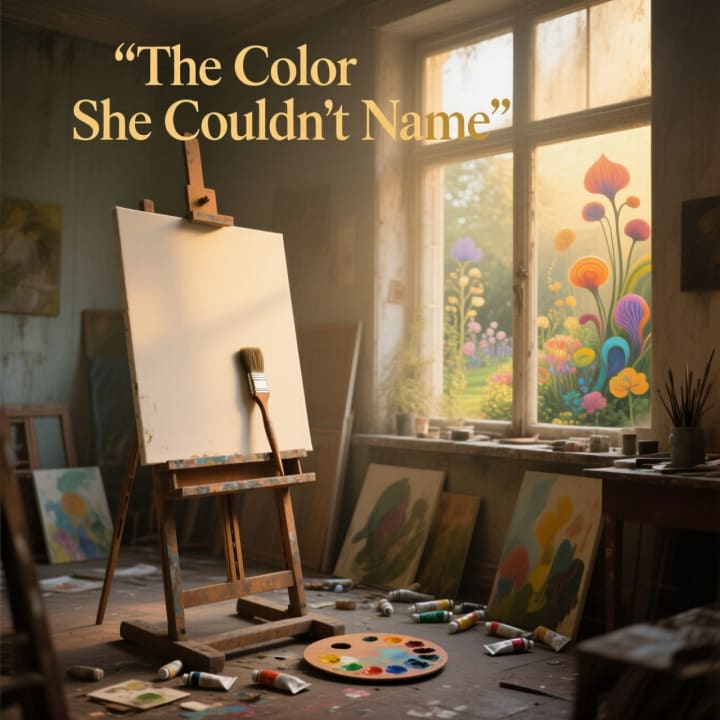
Dust lay gently over the tables. Canvases leaned against the wall like old friends too shy to speak. And in the corner, an easel stood frozen, holding a blank canvas that had waited five years for one thing: a single stroke.
The woman who finally returned was not the same one who had left.
Meher had once painted with a kind of fearless honesty—her art wasn’t just seen, it was felt. Critics called her work “a conversation between memory and emotion.” People said her colors made them remember things they’d forgotten: a grandmother’s lullaby, the smell of rain on hot earth, the quiet comfort of being truly known.
But then, one day, she stopped.
No farewell exhibition. No final piece. Just silence.
Some said it was grief—her mother’s passing had come swiftly, quietly, leaving a space no words could fill. Others thought it was love lost, or inspiration gone dry. Meher never explained. She simply locked the door, tucked the key into her pocket, and walked away from the only language she’d ever known.
Until last night.
She dreamt of her mother.
Not in a house, not in a photo, but in a garden—vast and glowing, where flowers bloomed in colors that didn’t have names. Her mother stood beneath a sky that shifted from deep indigo to soft gold, not speaking, just smiling. She placed a hand over her heart, then pointed to Meher, then to an empty canvas that appeared between them like a gift.
Meher woke with tears on her cheeks. Not from sorrow. From recognition. For the first time in years, she felt color again—like a pulse beneath her skin.
So she went back.
The key turned with a groan. The door creaked open. The air inside was still, heavy with memory, but not unwelcoming. It was waiting.
She walked to the easel. Her fingers brushed the dusty surface of the canvas. There, beside it, lay a single brush—her favorite, the one with the chipped handle and the soft bristles she’d used since art school.
She dipped it in water. Her hand shook.
She picked up a tube of cobalt blue. The cap came off with a soft pop. The smell—sharp, familiar, alive—flooded her senses. It was like hearing a song from childhood.
She hesitated.
Then, slowly, she touched the brush to the canvas.
One stroke.
Then another.
And another.
She didn’t plan. She didn’t sketch. She let her hand move as if guided by something deeper than thought. Crimson swirled into ochre. Gold bled into violet. Shapes emerged—not of objects, but of feelings: longing, warmth, the ache of missing someone, and beneath it all, a quiet kind of peace.
Hours slipped away. The light changed. The city outside hummed, but inside, there was only the whisper of bristles on canvas.
When she finally stepped back, her clothes stained, her hair loose, she saw it.
It wasn’t perfect. It wasn’t polished. But it was true.

In the center stood a woman—her mother—surrounded by flowers made of light, music, and fragments of old conversations. Her eyes were closed, but her smile was full of knowing. And in her chest, where her heart would be, pulsed a single patch of color—unlike any on the palette. A shade Meher had no name for, but recognized instantly.
She titled it, simply: The Color I Forgot to Remember.
That night, she uploaded the painting online. No caption. No artist statement. Just the image.
She didn’t expect anything.
But by morning, her phone wouldn’t stop.
“I don’t know what this is,” wrote one woman, “but I cried. It felt like coming home.”
“I saw my father in it,” said another. “He’s gone ten years. I didn’t think I could miss him this much.”
One message read: “You painted the color of my grief. And somehow, it made it beautiful.”
Meher sat by the window, tea cooling in her hands, and smiled.
The next morning, she returned to the studio.
This time, she opened every window. Sunlight poured in, dancing across the floor, waking the dust, touching the forgotten tubes of paint.
She set up five blank canvases.
The colors waited.
And so did the world.
Because art was never about getting it right.
It was about showing up.
About remembering who you were—
one stroke, one feeling, one unnamed color at a time.
About the Creator
meerjanan
A curious storyteller with a passion for turning simple moments into meaningful words. Writing about life, purpose, and the quiet strength we often overlook. Follow for stories that inspire, heal, and empower.
Reader insights
Outstanding
Excellent work. Looking forward to reading more!
Top insights
Compelling and original writing
Creative use of language & vocab
Easy to read and follow
Well-structured & engaging content
Excellent storytelling
Original narrative & well developed characters
Expert insights and opinions
Arguments were carefully researched and presented
Eye opening
Niche topic & fresh perspectives
Heartfelt and relatable
The story invoked strong personal emotions
Masterful proofreading
Zero grammar & spelling mistakes
On-point and relevant
Writing reflected the title & theme
'Till Death We Do Art
There would be nothing divine in this world without art. Nature may surpass the divine to all intents and purposes, but like everything it absorbs and is absorbed by, it remains here, stuck on the surface of this world, ever-present, physically bound to the universe.
By Avocado Nunzella BSc (Psych) -- M.A.P 21 days ago in Art
Leadership Behind the Experience: The Role of Brandon Cody Verran at Big Sky
In the world of hospitality and resort management, great guest experiences rarely happen by accident. Behind every smooth operation, welcoming atmosphere, and memorable stay is a team of dedicated professionals working together. At Big Sky Resort, one of the most renowned mountain destinations in North America, leadership plays a key role in ensuring that guests receive the level of service they expect. Among those helping guide operations is Brandon Cody Verran, who serves as an assistant general manager within the larger organization of Boyne Resorts.
By ORM_Specialista day ago in Art




Comments (1)
Good