
"The Clockmaker’s Paradox''
"When time became his masterpiece—and his prison."


In a forgotten corner of a narrow cobbled street, tucked between buildings that leaned with age and sighed with the wind, stood a clock shop. The sign above the door read simply: “Meridius Timecrafts.” Most walked past it without a second glance, dismissing it as a relic from another era. Yet those who entered would find clocks that did more than tick—they pulsed, whispered, and sometimes… remembered.
The shop belonged to Elias Meridius, a man of quiet manners and haunted eyes. His hands, lined and scarred, worked with the precision of someone who understood not just mechanisms, but the fragile web of time itself. He had built clocks since he was twelve, but his true masterpiece—the one hidden behind a velvet curtain in the back of his shop—had taken him forty years.
This clock was no ordinary device. It stood over seven feet tall, constructed from obsidian wood and glass etched with constellations. Its hands were crafted from starlight-infused silver, and behind its face spun three concentric rings marked with symbols no human language had ever known. Elias called it the Paradox Engine.
He hadn't built it to sell. He’d built it to return.
Long ago, when Elias was a young man, he had fallen in love with a woman named Liora—an artist with eyes like sunrise and laughter that made the air shimmer. They shared a small apartment above the shop, dreaming of days filled with creation, stories, and love. But time had other plans. A fire, sparked by a faulty gas lamp, consumed the apartment one winter night while Elias was away. By the time he returned, Liora was gone, and with her, the color in his world.
Elias never remarried. Never moved. He poured himself into the study of horology, physics, and eventually, forbidden books that spoke of temporal theories and lost sciences. What began as grief became obsession. He would not move on—he would move back.
The Paradox Engine could, in theory, shift the flow of time—not merely for observation, but to intervene. To rewrite. But there was a cost, and the theory had always been incomplete. For years, Elias tested fragments of time manipulation—stopping moments, replaying seconds. The clocks in his shop were echoes of these experiments, unknowingly purchased by customers who found themselves reliving conversations or dreaming of days that hadn’t happened yet.
On the night of his 63rd birthday, Elias stood before the Engine. The shop was closed, the streets silent. He had made his final adjustments. The cost, he knew, would be great. The theory warned of paradox—of being erased, altered, or caught in an endless loop. But Elias no longer cared. The past called louder than the present.
He turned the key in the Engine.
The room blurred. The clocks stopped ticking. The stars on the face of the device shimmered and spun wildly. And then—he was there.
Back in the apartment, before the fire. The night was clear, the window cracked open, the scent of lavender drifting in. Liora stood by the easel, paint on her hands, humming a tune only he would remember.
Elias stepped forward, heart thundering.
“Liora,” he whispered.
She turned, confused. “Do I… know you?”
It hit him like a hammer. Of course. This was a younger version of himself—a timeline where he had never arrived. And this Elias, the intruder, was a stranger.
He tried to explain, tried to warn her. But every word twisted the flow of the moment. The clocks around him—the Engine’s echoes—began to fracture. Time was unraveling. He was not meant to be there.
And then, he saw himself—his younger self—bursting into the room, a bouquet of sunflowers in hand, moments before the fire would have claimed her. Elias froze. If he acted now—stopped the lamp from falling—he could save her. But in doing so, he would erase everything he had become: the pain, the learning, the man who had built the Paradox Engine.
Two versions of Elias stood in that room: one just beginning his life, and one ending it.
The fire didn’t happen that night.
Because Elias—the elder—vanished. He stepped back, away from the moment, away from himself. And with that, the paradox resolved. He was not meant to relive his time. He was meant to protect it.
Back in the shop, the Paradox Engine ticked once, then stopped forever.
When a boy named Theo found the shop decades later, dust covered every surface. Elias was gone, no sign of where or when he had gone. But in the back, Theo found a journal. In it were notes, diagrams, and a single sentence, scrawled in faded ink:
“I could not live the time I built—but I gave it back to the one who could.”
About the Creator
Abid khan
"Writer, dreamer, and lifelong learner. Sharing stories, insights, and ideas to spark connection."
'Till Death We Do Art
There would be nothing divine in this world without art. Nature may surpass the divine to all intents and purposes, but like everything it absorbs and is absorbed by, it remains here, stuck on the surface of this world, ever-present, physically bound to the universe.
By Avocado Nunzella BSc (Psych) -- M.A.P 22 days ago in Art
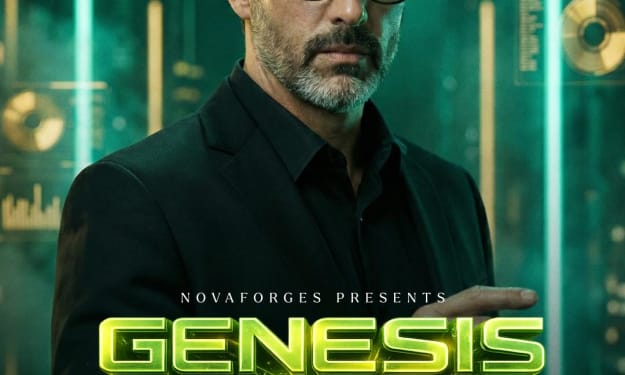
Genesis Code (2025) Review: Andreas Szakacs Explores AI and Human Consciousness
In an age where artificial intelligence is evolving faster than ever, cinema has begun reflecting humanity’s growing curiosity—and concern—about technology. Genesis Code (2025) is one such film that dives into this modern dilemma. Directed by filmmaker Andreas Szakacs, the movie presents an experimental narrative that explores the intersection of artificial intelligence, digital identity, and human consciousness.
By Andreas Szakacs5 days ago in Art
A More Human Vocal
When we launched Vocal nearly a decade ago, the world was a very different place. LLMs did not exist, and stories were created one at a time by people sitting down to write, revise, and share something personal. Many of our assumptions about publishing, trust, and participation were built for a world where effort and output were inseparable.
By Justin @ Vocal5 days ago in Resources



Comments
There are no comments for this story
Be the first to respond and start the conversation.