
The Clock That Only Ticked at Midnight
The town waited. The clock ticked. Or did it?

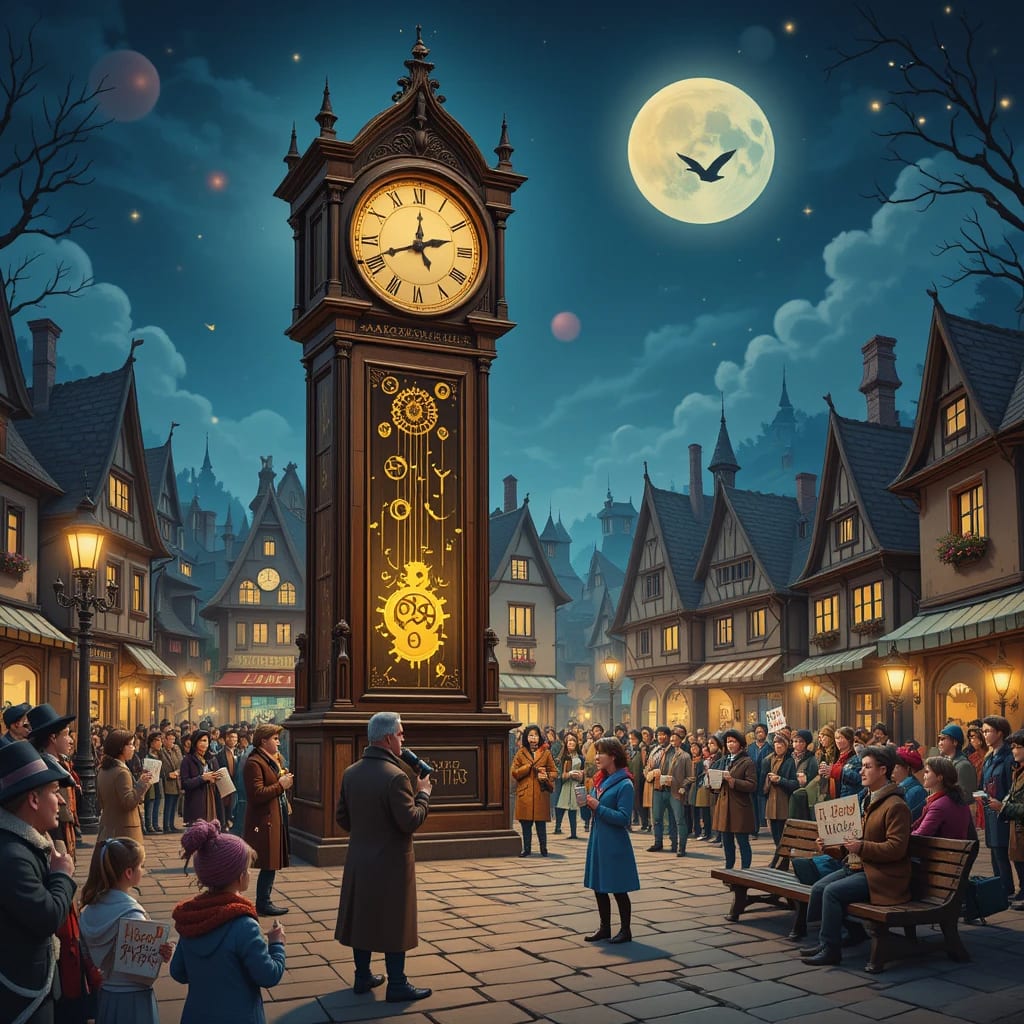
In the otherwise unremarkable town of Wiggleshire (population: confused), there stood a very large, very old, very intimidating grandfather clock in the middle of Main Street. It was not in anyone’s house. It was not in the museum. It was simply… there. Erected like a Victorian skyscraper in the middle of the crosswalk.
No one remembered when it arrived. No one remembered asking for it. But it was always there, standing over twelve feet tall, carved from dark walnut and humming faintly like it had secrets. Some said it was built by monks. Others blamed aliens. One man swore he saw it fly in on a Tuesday.
But the strangest thing about the clock? It only ticked at midnight. One tick. Then silence. Every day. Without fail.
For years, the townsfolk of Wiggleshire ignored it. At first, they complained:
“It’s blocking traffic!”
“It’s haunted.”
“It made eye contact with my dog.”
But after a while, they simply walked around it. That’s what people do with weird things. They accept them and move on.
Until one day.
-
That day was Thursday. A peculiar day already, because nothing good ever happens on a Thursday. It’s the midlife crisis of the week.
The Mayor—Bartholomew Crankle, age 59, height 4’11, moustache like a broom left in the rain—stood in the town square with a megaphone and a very serious face.
“People of Wiggleshire!” he bellowed. “This clock is no longer just a nuisance. It’s a phenomenon. We’ve had scientists. We’ve had mystics. We even had a TikTok psychic named Derek. No one knows why it ticks only at midnight.”
The crowd murmured.
Bartholomew continued, “But as of tonight, I am announcing the First Annual Grand Midnight Tick Celebration!”
Everyone clapped. Not because they cared about the clock, but because Thursdays were boring.
-
At 11:45 PM that night, the entire town gathered around the clock.
Old Mrs. Wimpole brought folding chairs and a thermos of regret (and tea).
Teenagers took selfies while pretending not to care.
The church choir hummed ominous tones just for ambiance.
People speculated wildly.
“I heard if you hear the tick, your sins are erased.”
“I heard it grants a wish if you hum ‘Bohemian Rhapsody’ in reverse.”
“I heard it’s a cosmic reset button. Like Ctrl + Alt + God.”
At 11:59, the mayor climbed atop a bench, raised his arms, and shouted, “Let us welcome the midnight tick!”
The whole town leaned in.
Silence.
Closer silence.
Silence that felt louder than normal.
Then…
TICK.
Just one. Deep and resonant, like the sound of history clearing its throat.
The crowd erupted.
They cheered. They clapped. They cried. One man proposed marriage to a woman he had just met (she politely declined). Someone released three doves that immediately flew into a tree and fell asleep.
“Truly,” said Mayor Crankle, “we have witnessed greatness.”
The next morning, the newspaper headline read:
“TICK HEARD ROUND THE WORLD”
Suddenly, people were talking. Wiggleshire wasn’t just a town anymore. It was a destination. Tourists arrived with fanny packs and portable stools. A documentary crew from Belgium asked, “Does ze clock speak?”
Merchandise appeared:
“I ❤️ Midnight Tick” mugs
Plush clocks that said “tick!” when squeezed
Shirts that read: “I waited ‘til midnight and all I got was this stupid tick.”
Mayor Crankle was invited to speak on daytime TV.
“I believe,” he said with a completely serious face, “that this clock is humanity’s metaphorical metronome. We tick. Therefore, we are.”
Applause.
Soon, the town was booming.
Wiggleshire opened its first espresso bar (called "Tick Tock Coffee") and its second bookstore (called “Tick Lit”). Real estate prices soared. A man sold air in jars labeled “Midnight Breath.”
Then came the investors.
A billionaire named Chase Quantum offered to build a glass dome over the clock and charge $22 admission. “This will preserve its tickiness,” he claimed.
The town was divided.
Some said, “Let the tick be free!”
Others said, “If we can tax the tick, we can pave the east lot.”
Meanwhile, scientists studied it. They measured vibrations, interviewed pigeons, and even installed sensors inside the clock.
At the next midnight, they waited.
Nothing.
No tick.
Just silence.
-
Panic ensued.
The mayor had to release a statement:
“We are investigating the disappearance of the tick. We believe it may have been spooked.”
The town spiraled into existential confusion.
“Was the tick ever real?”
“Have we angered it?”
“Is this a metaphor for late-stage capitalism?”
TikTokers demanded answers.
The town therapist was booked solid for weeks.
People stared at the clock in silence. It stared back.
Then, seven days later, just as the mayor was preparing a “Farewell to the Tick” eulogy…
TICK.
It came without warning.
Louder than before. Bolder. Brazen.
The town lost its mind.
They hugged strangers. Cried into churros. Someone fainted into a popcorn stand.
And that was when the mayor, trembling with joy, received a fax (yes, fax) from a university in Norway.
The letter read:
> “We have concluded that the clock ticks exactly once every seven days. Specifically, on Thursdays. It is not a daily midnight tick, but a weekly tick. An incredibly boring phenomenon.”
There was a long pause.
Then someone shouted:
“So we get Thursdays off now, right?”
Everyone cheered again.
Moral of the Story:
People will believe almost anything if it's mysterious enough, happens at midnight, or gives them a day off work.
Especially on Thursdays
About the Creator
GoldenTone
GoldenTone is a creative vocal media platform where storytelling and vocal education come together. We explore the power of the human voice — from singing and speaking to expression and technique.
Keep reading
More stories from GoldenTone and writers in Art and other communities.
The Presented World
In a time when screens mediate more of our experiences than ever before, the idea of a "presented world" takes on an urgent new relevance. Every image, news headline, video snippet, and algorithmic suggestion forms a mosaic—not of objective truth, but of a curated reality shaped to meet psychological, commercial, or political ends. The "presented world" is not simply what we see; it is what we are meant to see. And what we are meant to see often becomes what we believe is real.
By GoldenTone7 months ago in Art
The River and the Drops
High in the mountains, where no one watched and no one applauded, tiny drops of water slipped from melting snow. Each drop was small, almost invisible, and carried a quiet fear within itself. They began their journey without knowing where they were going, only knowing that they were moving away from where they began.
By Sudais Zakwan4 days ago in Art



Comments
There are no comments for this story
Be the first to respond and start the conversation.