
The Child Who Painted Time
When a young orphan’s art began to predict the future, the world celebrated her gift until her final painting foretold its end.

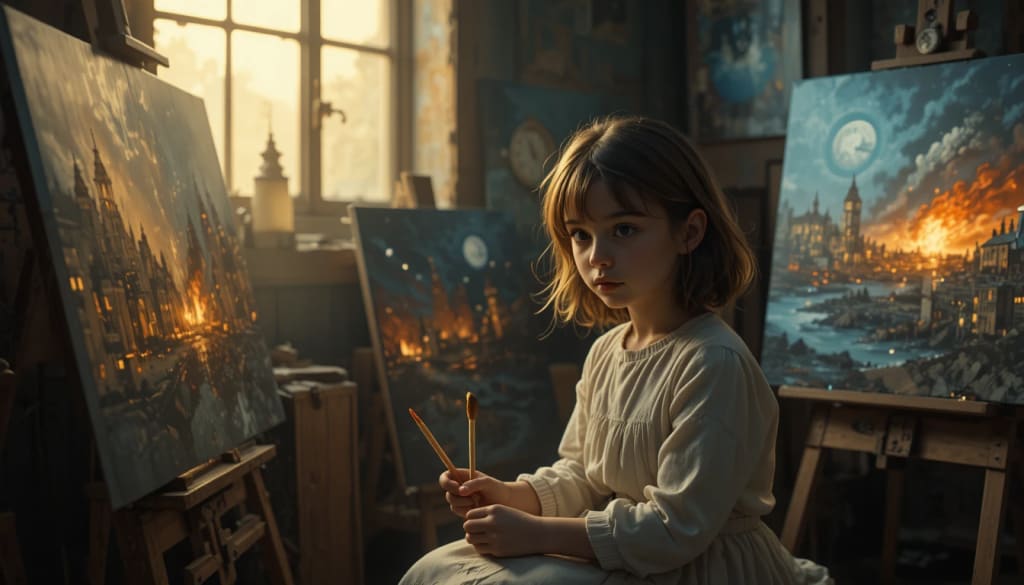
In a forgotten corner of an aging orphanage near Prague, a quiet ten-year-old girl named Elara Vance spent her days painting. She spoke little, but her art spoke for her vibrant, surreal, and hauntingly precise. The caretakers thought her gift was simply the result of too many nights spent alone with her imagination. That was until one morning, she painted a fire that hadn’t yet happened.
Three days later, the orphanage’s west wing burned down exactly as depicted the same flames, the same collapsing beam, even the same sparrow she’d painted escaping through the smoke.
At first, the staff dismissed it as coincidence. But when her next painting showed a nearby bridge collapsing and it did whispers of the Prophet Painter began to spread.
The Rise of a Miracle
Enter Vincent Moreau, an ambitious Parisian art dealer whose career had been stagnating. When he heard rumors of a child prodigy painting the future, he traveled to Prague immediately. What he found stunned him not just the accuracy of Elara’s visions, but the emotion embedded in every brushstroke.
Moreau adopted her under the guise of mentorship. He brought her to Paris, dressed her in velvet, and introduced her to the world as The Child Who Painted Time. Within weeks, her work was exhibited in the Louvre. Journalists called her the miracle of the millennium. Billionaires competed for her canvases, paying millions for glimpses into tomorrow.
Elara, however, grew quieter with each painting. She painted earthquakes, riots, the fall of governments each followed by headlines that mirrored her art. She never smiled during interviews. Her eyes, dark and distant, seemed older than her years.
She doesn’t paint to create, her caretaker once said. She paints because she must.
The Exploitation of a Gift
Moreau built an empire around Elara’s abilities. He founded The Time Studio, where live audiences could watch her paint under glass walls, her small hands trembling as if guided by something unseen. The media turned her into an icon. Documentaries, fashion lines, NFTs her face was everywhere.
But behind the fame, Elara was breaking. She began waking at night, screaming that her colors were bleeding. Her visions became darker, her canvases filled with storm clouds, faces screaming, and clocks melting into the earth.
One morning, she painted a scene unlike any before a massive wave swallowing entire cities, skies burning crimson, and a clock tower crumbling into dust. She titled it The Final Hour.
And then she stopped.
The Painting She Refused to Finish
When Moreau saw the unfinished canvas, he demanded she complete it. The world wants to see, he said. But Elara refused, hiding the painting away and locking her studio door.
The end doesn’t need witnesses, she whispered.
Furious, Moreau threatened to cut her off no more fame, no more comfort. In response, Elara vanished. The next morning, her studio was empty except for the unfinished painting, the brushes still wet, and a single line written in chalk on the floor:
You cannot frame time.
News outlets exploded with speculation. Some claimed she’d gone mad. Others insisted she’d seen something humanity was not meant to see.
Weeks later, art restorers analyzed The Final Hour and discovered something chilling the brushstrokes changed under light. When exposed to ultraviolet rays, faint outlines of continents appeared, submerged beneath rising seas.
Then, as if timed by fate, seismic activity around the world began to spike. Floods swept across coastlines eerily similar to those in Elara’s painting. The public turned from awe to fear.
Legacy of the Girl Who Knew Tomorrow
Vincent Moreau disappeared shortly after. Some say he took the painting with him. Others claim Elara returned for it. No one ever saw either of them again.
Today, The Final Hour is whispered about like a myth a cursed masterpiece, capable of revealing what’s next. Conspiracy theorists claim fragments of it exist online, each showing different futures. Art historians, however, call it the most significant lost work of the 21st century.
And somewhere, perhaps in a quiet attic, a girl who once painted time still watches the world unfold brush in hand, waiting for the right moment to begin again.
About the Creator
Farooq Hashmi
Thanks for reading! Subscribe to my newsletters.
- Storyteller, Love/Romance, Dark, Surrealism, Psychological, Nature, Mythical, Whimsical
Keep reading
More stories from Farooq Hashmi and writers in Art and other communities.
Over the Counter Nasal Spray Shows Promising Results Against COVID-19 and Cold Infections
A new phase 2 clinical trial suggests that a widely available over-the-counter nasal spray typically used for allergies could offer a meaningful reduction in infection risk for both COVID-19 and other respiratory viruses. The antihistamine nasal spray azelastine demonstrated a significantly lower incidence of PCR-confirmed SARS-CoV-2 infections (the virus responsible for COVID-19), as well as fewer cases of common-cold-causing rhinovirus, compared with placebo.
By Farooq Hashmi4 months ago in Lifehack
'Till Death We Do Art
There would be nothing divine in this world without art. Nature may surpass the divine to all intents and purposes, but like everything it absorbs and is absorbed by, it remains here, stuck on the surface of this world, ever-present, physically bound to the universe.
By Avocado Nunzella BSc (Psych) -- M.A.P 12 days ago in Art
David Bowie: Identity as Art and Philosophy
David Bowie didn’t just make music. He made selves. Each era of his career arrived with a new face, a new voice, a new story about who he was allowed to be. Ziggy Stardust fell from the stars to preach doomed glamour. The Thin White Duke stalked across the stage with ice-cold elegance. Then there were the quieter, searching versions—Bowie as wanderer, as witness, as man growing older without pretending to stay young. This wasn’t costume for costume’s sake. It was a living philosophy: identity is not discovered; it’s created.
By Fred Bradford5 days ago in Art



Comments
There are no comments for this story
Be the first to respond and start the conversation.