
Schopenhauer's Philosophy and Its Influence on Contemporary Music
Looking at examples of contemporary music through Schopenhauer's framework

Introduction
In the realm of philosophy and music, few figures stand as intriguing as Arthur Schopenhauer, the 19th-century German philosopher known for his distinctive views on the human will and existence. This article delves into the intricate relationship between Schopenhauer's philosophy and contemporary music, elucidating how his ideas continue to resonate with modern artists.
Understanding Schopenhauer's Philosophy
Before we explore the connection between Schopenhauer and contemporary music, it's essential to grasp the core tenets of his philosophy. Schopenhauer built upon the groundwork laid by Immanuel Kant, who distinguished between the world of phenomena, or the world of appearances, and the world of noumena, the world in itself. The former constitutes the world as we, as humans, experience it, while the latter exists beyond human consciousness, remaining elusive and unknowable.
Kant proposed that our consciousness filters sensory data through categories like space, time, and causality. Schopenhauer, however, condensed these categories into three, emphasizing their subjective nature. He asserted that these categories are not inherent features of the world but concepts imposed on our experiences by our consciousness.
Schopenhauer introduced a novel concept, the will, as the essence of the world. This will, he argued, transcends the confines of space, time, and causality, and it is characterized by endless striving. In every experience, an object appears for a subject, but Schopenhauer believed that this distinction between object and subject vanishes when we become aware of our own willing. Human beings, he contended, possess intentions, desires, and an innate drive to strive for something. When we are conscious of our own willing, it transforms from being an object for a subject to an intrinsic part of the subject itself.
Schopenhauer's pessimistic philosophy posits that because we are subject to the will, lasting happiness remains elusive. Fulfilling one's desires merely leads to the emergence of new ones, and if desires are exhausted, boredom sets in as another form of suffering. In Schopenhauer's view, the ceaseless striving of the will precludes any ultimate state of happiness.
Music as a Representation of the Will
Schopenhauer's unique take on music is particularly fascinating. He believed that music serves as a representation of the will, reflecting the essence of the world. According to Schopenhauer, music would exist even without human beings, as it is as real as our representation of the world.
Schopenhauer's Musical Analysis
Schopenhauer's ideas extend to the analysis of music itself. He suggested that different components of a musical composition correspond to various aspects of the will. For instance, base notes symbolize the lowest grades of the will, akin to crude, inanimate mass. Chords and intervals represent nature and wildlife. Leading notes, often associated with a human voice, mirror human life—the highest and most conscious manifestation of the will.
Schopenhauer also paid close attention to the speed, length, key, and repetition within a piece of music. He believed that a song ending by returning to its initial note signifies the will achieving a desire and returning to its starting point. This concept finds resonance in various contemporary songs.
Schopenhauer's Influence on Contemporary Music
The impact of Schopenhauer's philosophy on contemporary music is profound. Artists draw inspiration from his ideas, consciously or otherwise. For example, many songs within the minimal techno genre reflect the bleak, industrial aspects of life, mirroring Schopenhauer's view of the will and human existence.
Schopenhauer's theory also sheds light on key changes within songs. This, he argued, represents the death of an individual, while the will, the essence of the world, continues to manifest in others. When analyzing modern songs, the implications of key changes become particularly relevant.
Schopenhauer's influence extends to song structure and tempo. He associated quick, major passages with easily attained, common pleasures, while slower melodies with wide deviations conveyed a nobler effort toward a more distant goal.
Music and Lyrics
Schopenhauer's philosophy posits that music and lyrics do not necessarily need to align directly. Composing music to match specific lyrics, according to Schopenhauer, is an approach rooted in concepts rather than the genuine, inner essence of the world.
Conclusion
Schopenhauer's philosophical insights continue to permeate contemporary music, offering a unique lens through which to interpret its deeper meanings. From the portrayal of human existence and the ceaseless striving of the will to the intricate composition of songs, his ideas find resonance in countless modern melodies. Whether artists consciously incorporate Schopenhauer's philosophy or it permeates their work subconsciously, his enduring influence on contemporary music remains indisputable.
About the Creator
Keep reading
More stories from James Watson and writers in Art and other communities.
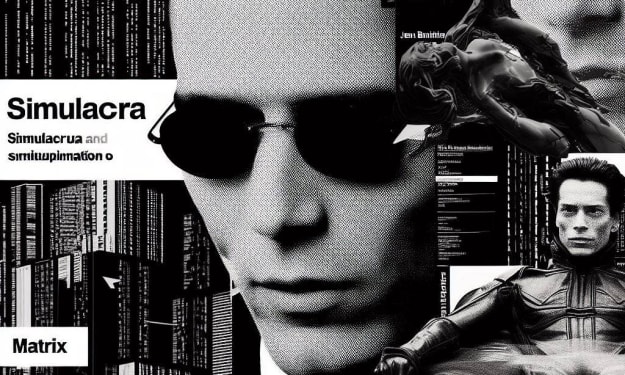
Jean Baudrillard And The Matrix
J'onn Booyah, a prominent intellectual of the late 20th century, is renowned for his challenging-to-pronounce name, a subject of enduring discussion. To facilitate clarity, we will hereafter refer to him by his first name, Sean. Beyond this, Sean is most notably recognized for his analysis of postmodern society. His works, characterized by their provocative and unyielding style, delve into mass media, communicative technologies, simulations, and pop culture, earning him the moniker of the high priest of post-modernism. However, Sean's most famous association with popular culture is undeniably the 1999 film "The Matrix." The film's profound influence on viewers is evident, not only because it explores themes aligned with Sean's work but also because his seminal book, "Simulacra and Simulation," is featured in the movie and even designated as required reading for the cast. The movie's unique engagement with Sean's ideas, which extensively scrutinized pop culture and mainstream media, provided a rare and invaluable object of analysis in the realm of Hollywood blockbusters.
By James Watson2 years ago in Art
“What If It Happens?”
Monday, 11 April 2022 Ishrat Jahan One of our friends, Mr. Farooq, is a middle-aged man, yet he has still not been able to free himself from his deeply suspicious and fearful nature. These days, I happened to have some free time, so I thought it would be a good idea to meet him and try to untangle the puzzle of his constant worries. By coincidence, he himself arrived at my humble home, jolting along in a rickshaw.
By Sudais Zakwan2 days ago in Art
Introduction to Organic Solutions
In the realm of fitness, the role of nutrition cannot be overstated, and organic supplements are increasingly recognised as essential components of a well-rounded training regime. Unlike their synthetic counterparts, organic supplements are derived from natural sources, ensuring that fitness trainers can provide their clients with products that are free from harmful additives and chemicals. This not only promotes better health but also supports the body’s natural processes, thereby enhancing overall performance and recovery.
By Organic Products 6 days ago in Art


Comments
There are no comments for this story
Be the first to respond and start the conversation.