
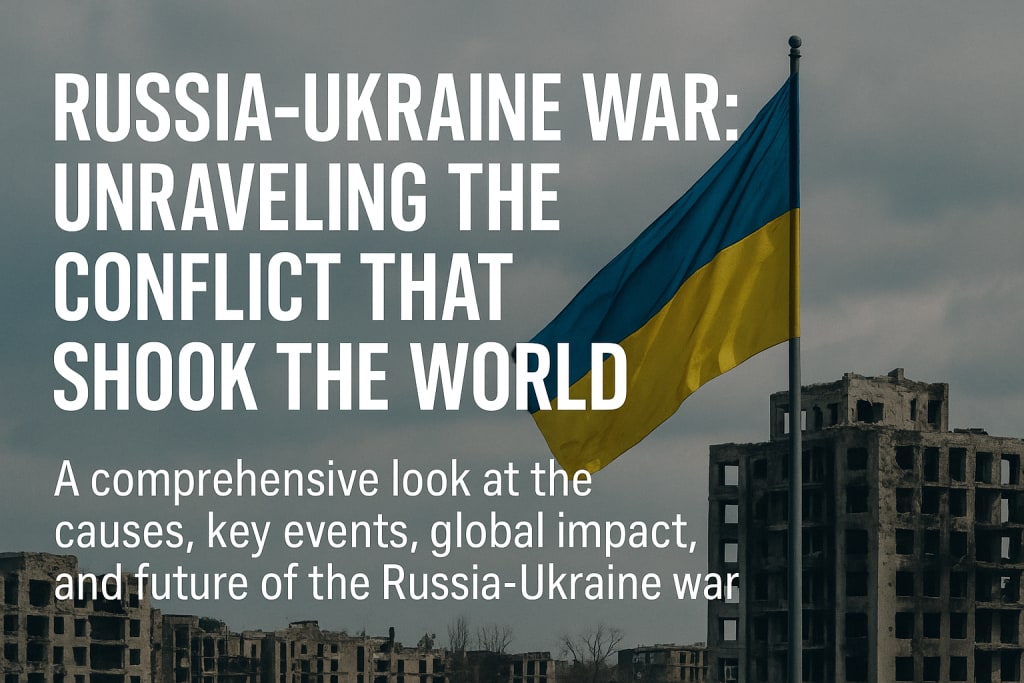
Russia-Ukraine War Unraveling the Conflict That Shook the World
A comprehensive look at the causes, key events, global impact, and future of the Russia-Ukraine war

Understanding the Russia-Ukraine Conflict: A Deep Dive into the Ongoing CrisisThe Russia-Ukraine conflict, which erupted into full-scale war in February 2022, has become one of the most significant geopolitical crises in recent history. It has affected not only the two nations involved but also the global economy, international relations, energy markets, and security dynamics across Europe and beyond. To understand the current situation, it’s essential to explore the historical background, the reasons behind the invasion, key events in the war, and its impact on the world.
Historical Background
The roots of the Russia-Ukraine conflict go back centuries, but more recently, tensions began building after the collapse of the Soviet Union in 1991. Ukraine, which had been a part of the USSR, became an independent country. However, Russia has often considered Ukraine part of its sphere of influence, particularly because of cultural, linguistic, and historical ties.In 2014, the situation escalated when Russia annexed Crimea following the Ukrainian Revolution that ousted pro-Russian President Viktor Yanukovych. This move was condemned by the West and led to sanctions against Russia. Around the same time, fighting broke out in eastern Ukraine between Ukrainian forces and Russian-backed separatists in the Donbas region. The conflict simmered for years, with intermittent ceasefires and ongoing clashes.
The 2022 Invasion
On February 24, 2022, Russian President Vladimir Putin launched a full-scale invasion of Ukraine, claiming the need to “demilitarize and denazify” the country — a rationale widely criticized and dismissed by international observers as baseless propaganda. The real motivations, analysts suggest, include Russia’s desire to prevent Ukraine from joining NATO, reassert dominance in the region, and undermine Western influence near its borders.
The invasion shocked the world and was met with swift condemnation. Western nations, including the United States, United Kingdom, and European Union, imposed severe economic sanctions on Russia. They also began supplying military aid to Ukraine, including weapons, intelligence, and humanitarian assistance.
Military Developments
Initially, Russian forces advanced rapidly, threatening major Ukrainian cities such as Kyiv and Kharkiv. However, the Ukrainian military, bolstered by civilian resistance and Western support, managed to repel many early offensives. By the end of 2022, Ukraine had regained significant territory, particularly in the north and northeast.The war then evolved into a grinding, attritional conflict, particularly focused on the Donbas region in eastern Ukraine and areas of southern Ukraine like Kherson and Zaporizhzhia. Russia declared the annexation of several occupied territories in late 2022, despite international condemnation and lack of control over the regions.As of 2025, the war continues, with frontlines shifting slowly and heavy casualties reported on both sides. Drone warfare, long-range artillery, and missile strikes have become a common part of the battlefield. Ukraine continues to demand the complete withdrawal of Russian forces, while Russia insists on retaining control of occupied territories.
International Response and Global Impact
The international community has played a critical role in supporting Ukraine. The United States has provided tens of billions of dollars in aid, while European countries have supplied tanks, air defense systems, and other advanced weaponry. NATO has strengthened its eastern flank, with countries like Finland and Sweden abandoning their traditional neutrality to apply for membership in the alliance.Economically, the war has had widespread consequences. Energy prices soared in 2022 due to disruptions in gas supplies from Russia, especially affecting European countries that had depended on Russian energy. Food prices also rose globally, as Ukraine and Russia are both major exporters of wheat, corn, and sunflower oil. The conflict has contributed to inflation and economic instability in many regions.
Humanitarian Crisis
The human toll of the war is staggering. Millions of Ukrainians have been displaced, either internally or as refugees in neighboring countries. Thousands of civilians have died, and infrastructure across Ukraine, including hospitals, schools, and power plants, has been severely damaged.The war has also had psychological and social consequences. Ukrainian society has shown remarkable resilience, but the trauma of war is profound. Russian citizens, too, have been affected, with many young men conscripted into the military and widespread censorship stifling dissent within Russia.
Future Outlook
The path to peace remains uncertain. Diplomatic efforts have been sporadic and largely unsuccessful, with both sides maintaining hardline positions. While some experts suggest a negotiated settlement may eventually occur, others warn that the conflict could continue for years, especially if neither side achieves a decisive military victory.There are also fears of escalation. With nuclear-armed powers involved, any miscalculation or provocation could lead to a broader conflict. The international community continues to call for de-escalation and a peaceful resolution, but so far, the war shows no signs of ending.
Conclusion
The Russia-Ukraine war has reshaped the modern geopolitical landscape. What began as a regional conflict has grown into a global issue with far-reaching implications. As the world watches and hopes for peace, one thing remains clear: the resilience of the Ukrainian people and the gravity of the conflict have left an indelible mark on history.
About the Creator
Samiullah
I am Dr.Samiullah from Pakistan and i am also a Professional Writter and Article Writter Hope u will like my article and stories thank u
Project Hail Mary
The anticipation for the Project Hail Mary film adaptation in 2026 is absolutely massive! Andy Weir’s story is a masterclass in 'competence porn,' and seeing Ryland Grace brought to life on the big screen is going to be a cinematic treat. Translating that level of scientific problem-solving to film is a highly strategic process—much like the focus and timing required in a top-tier ice fishing slot game in the UK—you have to get every detail right to make the 'catch' truly satisfying for the audience
By StanleyGreenabout 10 hours ago in Art
How, Too
Many people wonder how, too. You are not alone, and I am an expert. I will teach you how, too! First, you need to remit a small application fee and fill out an application describing the nature of your financial situation and how often payments will be made, as this will have great bearing on how well I teach you how, too.
By Harper Lewis7 days ago in Fiction



Comments
There are no comments for this story
Be the first to respond and start the conversation.