
Paradise Lost by John Milton
The Epic Tale of Man’s First Disobedience and the Fall from Grace
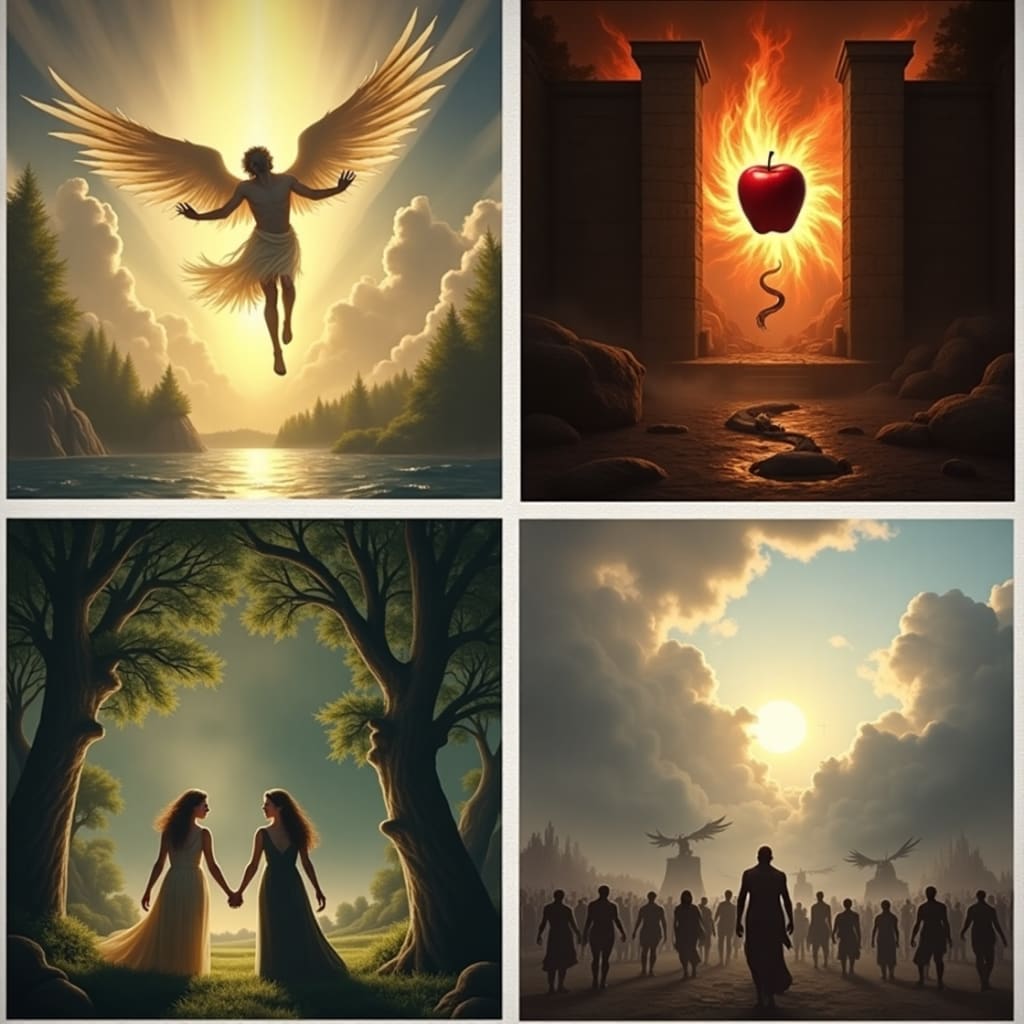
In the beginning, before time was counted in the hearts of men, there was light. Not the sun’s warmth, nor the stars’ flicker—but the light of Heaven, perfect and eternal. Here, among golden thrones and eternal songs, the angels soared, radiant and pure. And yet, even in that place of peace, pride found root.
Lucifer, the most resplendent of all the host, bearer of morning and brilliance unmatched, looked upon the throne of God and desired it for his own. “Why should one rule while others serve?” he whispered in silence. His voice, like fire, lit rebellion in the hearts of many, and soon a third of Heaven turned from harmony to defiance.
War came, not of mortal kind but of cosmic thunder. Heaven shook with the clash of divine and fallen, and Michael, Heaven’s captain, stood firm. With sword blazing like the dawn, he cast Lucifer and his legions from the high places into a prison of flame—a vast, burning abyss we now call Hell.
There in darkness, Lucifer rose. No longer Heaven’s brightest, he was now Satan—adversary, the Prince of Wrath. But his pride endured. “Better to reign in Hell than serve in Heaven,” he declared, forging his dominion in fire and shadow. From his molten throne, he conceived a plan not just of vengeance—but of corruption.
In another realm, Earth was born. A new creation, crafted by the Word, hung like a jewel in the void. And upon it walked Man—Adam and Eve—innocent, unspoiled, alive in a garden where no death yet grew. They loved in simplicity and were loved by their Maker, living beneath the boughs of Eden’s trees, near the river that glowed with living water.
But Satan, watching from afar, saw in them a chance to wound God’s joy.
Taking the form of a serpent—twisting beauty with guile—he slithered into Eden. There, under the boughs of the Tree of Knowledge, he found Eve alone. With a silver tongue and words veiled in sweet poison, he sowed doubt. “Did God truly say you must not eat? Can the Giver of all love truly forbid wisdom?” he hissed. The fruit shone like promise in her hand.
Eve tasted—and Adam, seeing her fallen, chose to fall beside her.
In that moment, the world changed. The skies dimmed, and the Earth trembled. The sun seemed less golden. Shame clothed them, and they hid their faces. Their hearts, once open, now knew fear. The harmony between Heaven and Earth was broken.
Yet in the courts above, God watched not with fury alone, but sorrow. Justice must be served, but mercy, too, was born. The Son, begotten not created, stood before His Father’s throne and offered Himself. He would descend, in time, take on flesh, and bear Man’s sin to redeem what was lost.
Until that day, Adam and Eve were sent forth—exiled, but not forsaken. Cherubim with flaming swords stood guard at Eden’s gate, and the garden faded behind them like a dream. Yet even as they walked into a world of thorns and labor, hope followed them like dawn after night.
This is the tale Paradise Lost tells—not only of rebellion and fall, but of the greatness of love, the cost of free will, and the promise of redemption.
Milton, blind yet visionary, wrote not merely to entertain, but to “justify the ways of God to men.” In thunderous verse and celestial imagery, he crafted an epic of cosmic scale, yet tender heart. Angels and demons, temptation and truth, fall and forgiveness—all are woven into a tapestry of eternal consequence.
For Paradise Lost is not just the story of what was lost, but of what may yet be found.
It is the journey of light through darkness, of man through suffering, of love through sin—and of the unbreakable bond between Creator and creation.
About the Creator
Keep reading
More stories from writers in Art and other communities.
'Till Death We Do Art
There would be nothing divine in this world without art. Nature may surpass the divine to all intents and purposes, but like everything it absorbs and is absorbed by, it remains here, stuck on the surface of this world, ever-present, physically bound to the universe.
By Avocado Nunzella BSc (Psych) -- M.A.P 14 days ago in Art
5 Ways to Trust Your Creative Ideas
When I go through creative dry spells, I tend to think that generating more ideas is what is going to get me through it. However, I've learned the hard way that this isn't the case. But, having more ideas doesn't make us more creative. In fact, it can have the opposite effect.
By Kathy Tsoukalas4 days ago in Art




Comments
There are no comments for this story
Be the first to respond and start the conversation.