
Multiplicity of Perception: A Journey Through the Eyes and Mouths of the Uncanny Self
Exploring Identity, Surveillance, and Expression in a Haunting Surrealist Portrait

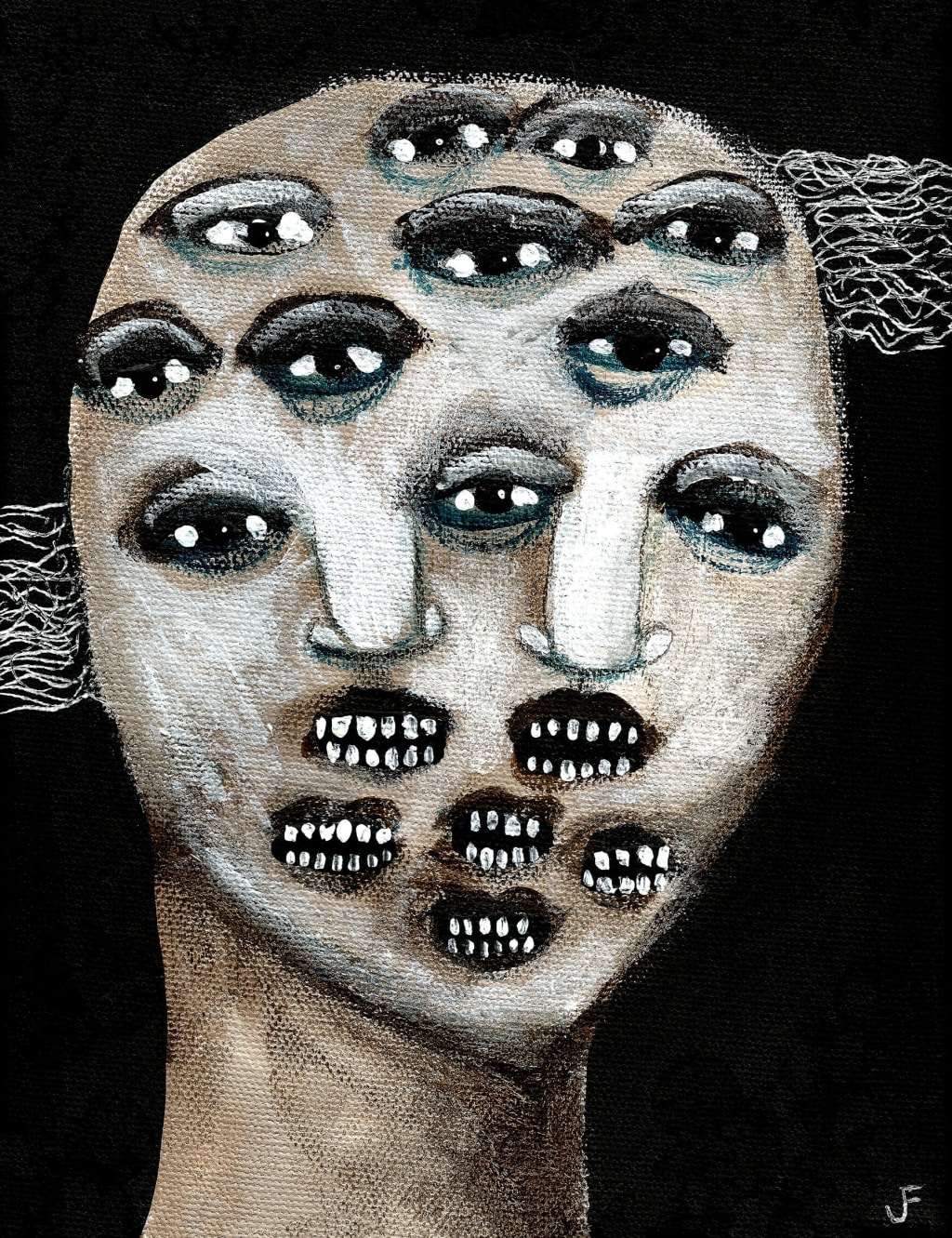
Art has long served as a mirror reflecting the myriad layers of human emotion, identity, and experience. Few works encapsulate the unease, multiplicity, and abstraction of contemporary inner life as powerfully as the surrealist painting presented here—a figure adorned with dozens of eyes and mouths, captured in a haunting, textured brushstroke style that provokes both curiosity and discomfort. This painting, with its eerie distortions and disorienting symmetry, invites viewers into a fractured but compelling psychological landscape. It is a place where perception is hyper-saturated, and expression is fragmented beyond comprehension.
At its core, this artwork grapples with themes of identity, surveillance, and the overwhelming noise of modern existence. The face is not singular, but many. It’s a head filled with seeing and speaking, yet devoid of conventional humanity. It evokes not just a single consciousness, but an amalgamation—perhaps a metaphor for the digital self, the internal cacophony of thought, or the fractured reality of those navigating trauma or overstimulation.
A Surrealist Descent into the Self
The painting owes much to the traditions of surrealism, with its focus on the unconscious, the dreamlike, and the grotesquely exaggerated. The multiple eyes and mouths on the head resemble the kind of imagery popularized by artists like Salvador Dalí and Max Ernst. Yet, unlike their often-symbolic representations of the subconscious, this painting leans into the psychological horror of perception itself. The face—if it can be called that—feels like a surveillance state embodied, a being that sees too much, speaks too often, and ultimately knows no peace.
Each eye is painted with stark white reflections, a detail that renders them hauntingly lifelike. They peer out in all directions, not with the intent of understanding, but with an intensity that feels accusatory. These eyes do not merely observe; they scrutinize. As viewers, we find ourselves being watched, even judged, by something that should be passive. The sheer number of them suggests hyperawareness—perhaps a state of anxiety, overstimulation, or the constant self-monitoring that comes with modern digital existence.
In contrast, the mouths below offer another type of discomfort. Open, filled with teeth, yet not clearly speaking or emoting, they seem frozen in a silent scream. There is something disturbingly disjointed about the fact that none of them appear to be forming words, and yet they all feel active. It evokes the overwhelming flood of communication we experience in today’s world—multiple voices, constant chatter, endless noise—and the artist’s decision to place these mouths where cheeks and chin would be suggests a distortion of natural expression. It’s not just about being heard; it’s about being unable to stop speaking, or feeling that one’s voice is diffused into fragments.
The Texture of Distortion
Beyond the unsettling anatomical arrangement, the medium and technique also contribute to the visceral effect of the painting. The thick brushstrokes and rough canvas texture lend a tactile sense of chaos. The painting feels raw, almost unfinished, which aligns with its thematic undercurrent of instability and unraveling. The use of neutral tones—grays, whites, muted browns—emphasizes the unnatural quality of the figure while also grounding it in a kind of ghostly realism. This is not a being from fantasy, but something that could exist just beyond the edge of our perception.
Hair, rendered as chaotic wire-like strands, further suggests disarray. It is less about beauty or identity, and more a symbol of unraveling thoughts or frayed connections. The facial form is elongated and lacking symmetry, drawing attention to the alien nature of the being depicted. The artist subtly denies the viewer any point of rest, offering no standard focal point or familiarity to cling to. This ambiguity forces viewers to confront the piece on emotional terms rather than logical ones.
Psychological and Cultural Interpretation
What might this creature represent in psychological or cultural terms? On a personal level, it could embody the inner life of someone living with dissociation or a fractured sense of self. The multiplicity of eyes and mouths might signify competing internal voices or an extreme sensitivity to one's environment—a person who sees and hears everything, yet can never silence the noise within.
On a societal level, the painting might reflect the alienation and overstimulation characteristic of modern life. In a world dominated by social media, 24-hour news cycles, and constant self-presentation, we are never fully alone and never fully ourselves. We observe others, are observed in return, and are expected to be “on” at all times. This creates a condition where perception becomes performance, and expression loses intimacy.
The artwork could also serve as a visual metaphor for surveillance capitalism, where every thought, action, and word is commodified. The many eyes symbolize the endless watching—by corporations, governments, or even our peers—while the mouths could represent the forced participation in a system that demands constant output, feedback, and consumption.
Beyond Horror: Empathy in the Grotesque
Despite its eerie aesthetic, the painting is not necessarily nihilistic. There is a strange kind of empathy evoked by the figure. One might imagine the burden of so many eyes and mouths—not as a power, but a curse. To see too much, to speak too often, yet to never be understood—this is not strength, but suffering. The figure’s silence is deafening, its gaze paralyzing, its expression void of peace. In this light, the painting becomes a meditation on the costs of overstimulation and the fragility of identity under pressure.
Perhaps the most human quality of the painting is its vulnerability. Beneath the horror is a question: what happens when we are pushed beyond the boundaries of what one mind can hold? What becomes of us when our selfhood fractures into so many pieces that the original is unrecognizable?
Conclusion: Art as a Mirror of Modern Existence
This painting, rich in surrealism, psychological depth, and socio-political allegory, offers more than shock value. It is a haunting exploration of identity, perception, and communication in the modern age. It challenges viewers not just to observe, but to reflect on their own inner multiplicity—the many voices, the many selves, the many ways we both see and are seen.
Art, at its best, allows us to access truths that words cannot fully capture. In the haunting eyes and silent mouths of this surrealist visage, we are given not answers, but necessary questions: Who am I when I am too many? Who sees when I am always seen? And in the clamor of so many mouths, how can I ever truly speak?
This is the brilliance and terror of the piece—it forces us not to look at it, but through it, into ourselves.
About the Creator
Fazal Malik
"Welcome ! We're dedicated to making learning fun and accessible. Subscribe for educational videos, tutorials, and resources to ignite your curiosity."
Keep reading
More stories from Fazal Malik and writers in Art and other communities.
Celestial Grace: The Ethereal Bond Between the Moon and the Divine Feminine
In the realm of myth, dreams, and timeless artistry, few images evoke such profound emotion and symbolism as that of a radiant woman bathed in lunar light. The image above—depicting an ethereal woman illuminated by the glow of a full moon—transcends the borders of fantasy and taps into something far deeper: humanity’s enduring connection with the cosmos, the divine feminine, and the mysteries of inner consciousness.
By Fazal Malik6 months ago in Art
If You Love Me, You'll Do It
I met Jason when I was five years old. I could say that I loved him from the moment I saw him. He was so handsome to me and I felt in awe by his presence. When they introduced him as the new kid in school, I wanted to be his friend right away. I remember it like it was yesterday. I remember his smile and how he didn't seem shy. He appeared confident and ready to learn. I waved at him and said "hello," before anyone else could even say a word. He sat next to me, and I asked him if he wanted to be friends. He looked so happy as he said, "Yes!"
By Sidney Smith (Sid Smith)6 days ago in Fiction




Comments
There are no comments for this story
Be the first to respond and start the conversation.