
More Than Pleasing: Art and Environment
What has been done and what needs to be


Let us begin with the premise that being environmentally conscious does not imply being flawless; rather, it means being mindful of what needs to be done to make our earth a better place for future generations.
Can art teach us how? Can it make us more aware of what’s going on with our planet?
A whole artistic movement has as its intrinsic goal just that. Environmental art, often known as Environmentalism-art or even Climate Change Art, is a set of artistic actions involving the representation and expression of ecological problems like global warming, pollution, and other themes concerning the deterioration of the environment’s health.
However, I would argue that even much of art outside of environmental art has held nature as its ultimate goal, the ultimate good, and may have the power to change our minds and behaviours when it comes to protecting the planet. That is, of course, relatively (it will not by itself save the planet).
Nature has been a subject of human artistic expression since the time of cave paintings. Moreover, some of the most beautiful pieces in art history are natural scenes. Think of the work of Monet, Van Gogh, Turner, and many of the most famous painters. Landscape paintings already created a connection between the artist and their surroundings, but also between the environment and the viewer.
But for our purpose today, we must focus on the effects of art created with an environmental conscience. Be it environmental art, activist art, or simply works made with the intention of reminding us of our planet and its changing atmosphere.
One of the examples I tend to use is that of Olafur Elliasson’s oeuvre.
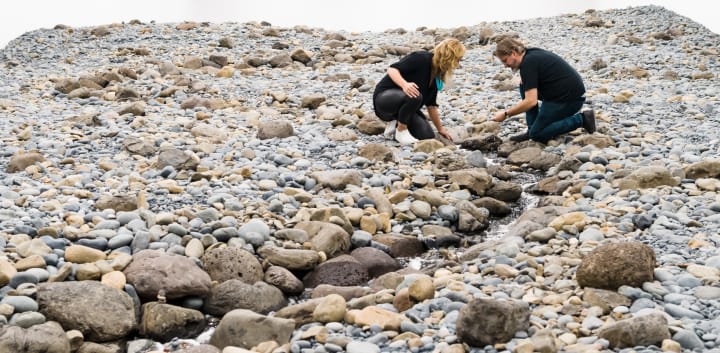
Famously, with Ice Watch, Eliasson (together with Minik Rosing, a geologist) moved chunks of Greenlandic ice to public spaces in Europe. In 2015 the melting ice blocks were brought to Paris, timing the installation with the UN conference on climate change.
Ice Watch creates climate change effects in hopes of making it visible and tangible to the human mundane experience. Of course, Ice Watch did not get around without criticism (e.g. the carbon emissions necessary to move and refrigerate blocks of ice). Still, the exhibitions created a real connection between the viewers and the art: people hugged, kissed, and listened to the ice blocks; many have posted about the installation on social media, spreading the word on climate change. If Ice Watch (or other installations such as The Weather Project) have created long-term behavioural change remains unfortunately unmeasured.
An informed guess would be that for many, it would have left a mark, but not translate to conscious behaviour, while for some it may have started or reinforced positive attitude and behavious towards the environment. But again, it is very hard to say, not having any data available.
Another artist famous for her environmental work is Diane Burko.
Like Eliasson, Diane Burko has collaborated with scientists to say something about our planet, in a way that can reach people in the most accurate of ways.
Burko is frequently invited to talk at symposiums and colloquia focused on how the arts may communicate scientific findings and occurrences.
And there it is, the intersection of science and art must be the way to reach people.
After all, statistics and facts alone may be emotionless, and emotions are what really stick with the audiences, to people’s consciences and memories.
Burko is an artist who has explored locations on the ground, underwater and in the air from open-door helicopters and planes with cameras, drones and sketchpads. Travelling from the temperate zones of America to Western Europe, from rainforests to glaciers, from active volcanoes to coral reefs below the equator, her art merges a vision that is at once panoramic, intimate and sometimes provocative. — Interalia Magazine
And again, that’s how you win people’s minds over. Behavioural change, in the form of influence, happens at its best when it leaves a mark. Now, just stats on the melting of the ice or the rising temperature may capture minds for a while, but it’s what captures the heart that stays with us the longest.
And I think that there is where art can really make a difference. Bigger scale and repeated messages would be needed (a once-off may not reach enough people to make any significant difference)
Through facts and images, I endeavour to make the invisible visual and visceral — Diane Burko
The tourism that art pieces can generate is another example of how fine arts can build up the potential for change. Because the more people see and interact with something, the bigger the impact.
In Art and sustainable ecology and economics, Vaughan Judge gives several examples of what art can do to aid sustainable behaviours, but I’d like to focus on those where tourism acts as a mediator. Because, especially in the times of Instagram and TikTok, sustainable tourism means also spreading awareness.
In the Caribbean Sea, there is an underwater sculpture park, the first of its kind. The Molinere Bay Underwater Sculpture Park is a group of ecological submerged modern art; it currently helps to ease tourist pressure on natural reefs. The sculptures were created to encourage coral growth by lowering the pH of the cement and giving a rough surface. This promotes coral polyps to cling to the surface, and the structure will eventually become a haven for little marine creatures. Taylor’s sculptures have already been shown to house a variety of aquatic species, including flounder, parrot fish, banded coral shrimp, and fire worms. Every year, a large number of tourists visit the area.
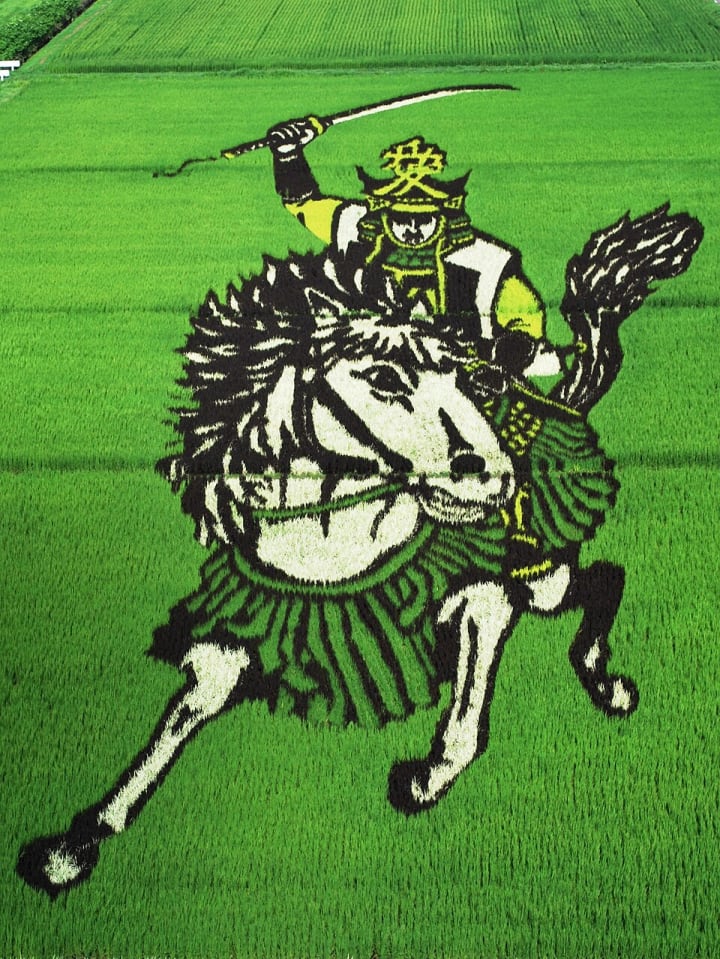
Another example of how art and art-tourism have been shown to have ecological (and economic) benefits is that of the Japanese rice paddy art. This art form has boosted tourism in the area and aided the continuation of fieldwork by increasing the base salary of workers.
Art can help us visualise the effects we as humans have on the planet. Creativity can ignite our imagination and form links with the reality we are living in. It is in many ways a matter of communication. Instead of using impersonal statistics and facts that may not stick in everyone’s minds, art can act as a moderator that is more personal, vivid, and tangible.
A lot of the art world understands the power of influence they hold, and a part of it is also interested in jumping on the green bandwagon. So artists are producing technological innovations, museums and galleries are dedicating whole exhibitions to climate change and ideas to revolutionise our approach to the topic.
So yes, I think art can be used as one of the tools to help save the planet. However, I believe academic research on art’s role in the battle is way too limited. What are the long-term effects of environmental exhibitions? Do they change people’s opinions, purchasing behaviours, recycling, and energy consumption? What happened to the people who hugged ice blocks in Paris?
Future research in behavioural psychology, art, anthropology, sociology (and more) may look at giving us some answers.
About the Creator
Avocado Nunzella BSc (Psych) -- M.A.P
Asterion, Jess, Avo, and all the other ghosts.
Keep reading
More stories from Avocado Nunzella BSc (Psych) -- M.A.P and writers in Art and other communities.
'Till Death We Do Art
There would be nothing divine in this world without art. Nature may surpass the divine to all intents and purposes, but like everything it absorbs and is absorbed by, it remains here, stuck on the surface of this world, ever-present, physically bound to the universe.
By Avocado Nunzella BSc (Psych) -- M.A.P 11 days ago in Art
Is Morocco Safe Country for Visitors:
Morocco is a country that is completely safe, with high security rates, particularly for tourists and visitors. Moreover, Morocco is a beautiful country located in the northern part of Africa. It is famously known for its natural landscapes, colourful souks, and historic monuments; it is one of the most popular travel destinations in North Africa. Additionally, Morocco offers a variety of unforgettable experiences, from the bustling streets of Marrakech to the blue-painted alleys of Chefchaouen and from the lovely Sahara Desert to the coastal charm of Casablanca, allowing visitors to enjoy a lifetime experience. Morocco Tours Company
By Othmane Anaam4 days ago in Art



Comments
There are no comments for this story
Be the first to respond and start the conversation.