
Mercy in the Shadows
Caravaggio’s The Seven Works of Mercy (1607)
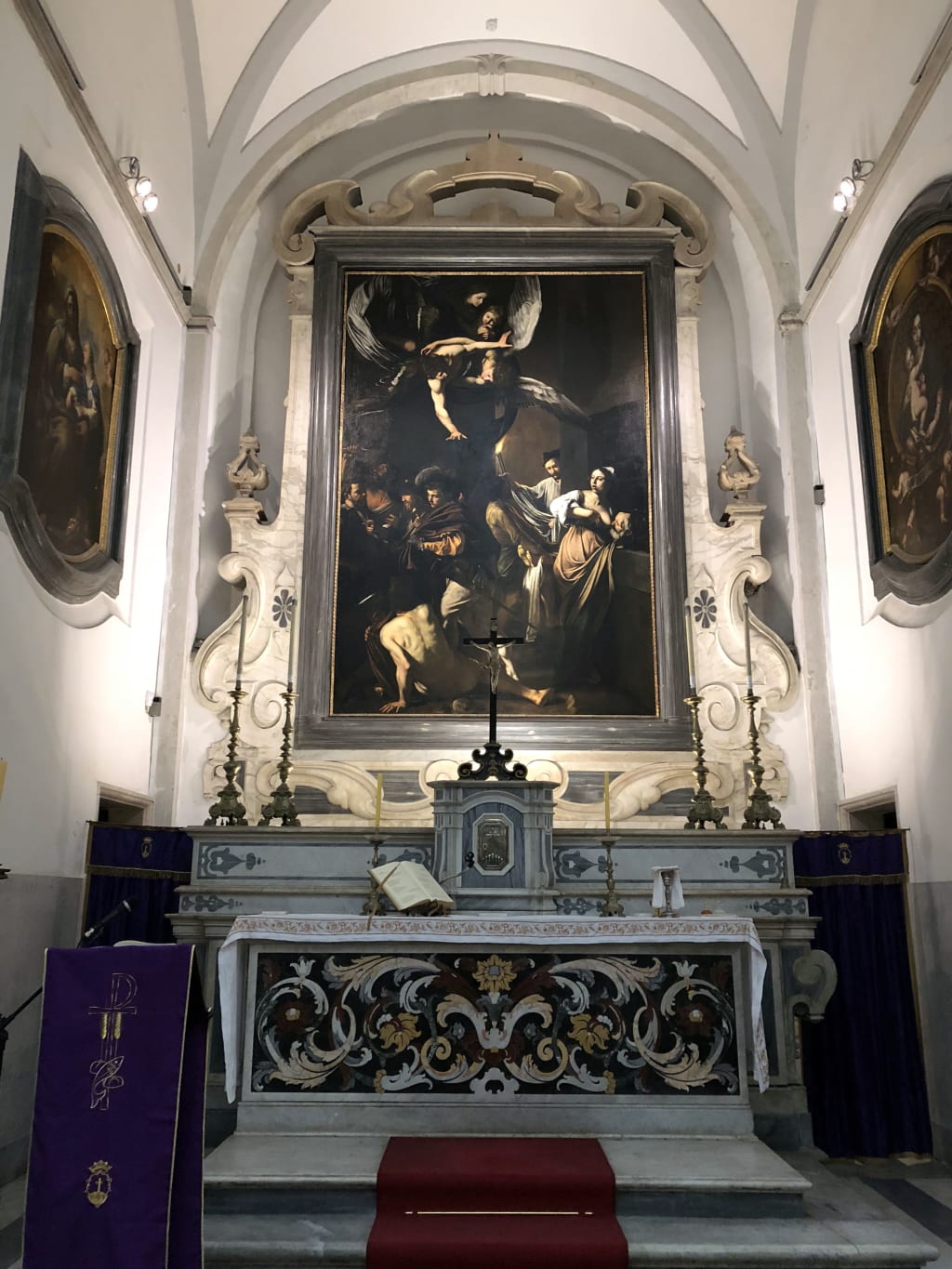
A work meant not to dazzle, but to ask:
What do we owe each other in a broken world?
II. Caravaggio Paints the Impossible
It’s 1607. Caravaggio is a fugitive.
He’s fled Rome after killing a man in a duel. His name is whispered across Italy — part genius, part menace. He’s wild. He’s revolutionary. He’s dangerous.
And now he’s in Naples, working for a charity order of noblemen who serve the poor.
They commission a painting to hang over their altar. It’s meant to depict le sette opere di misericordia corporale — the seven bodily acts of mercy from the Gospel.
Caravaggio agrees.
But what he paints isn’t seven separate scenes.
It’s one chaotic, almost impossible moment: a street of Naples where all seven mercies seem to erupt at once, stitched into a fever dream of grace and need.
The painting is a tangle of limbs, torches, faces, gestures — all happening in one cramped city night, like the whole weight of human compassion decided to show up at once.

III. What Are the Seven Works of Mercy?
Let’s begin here.
From the Gospel of Matthew and Catholic tradition, the seven acts are:
1. Feed the hungry
2. Give drink to the thirsty
3. Clothe the naked
4. Shelter the homeless
5. Visit the sick
6. Visit the imprisoned
7. Bury the dead
They’re simple.
And impossibly hard.
Not abstract love. Not general kindness.
This is sweat-and-blood mercy — the kind that requires touch, presence, inconvenience. The kind that makes you uncomfortable. That stains your hands.
IV. Mercy, in a Baroque Key
Caravaggio doesn’t give us a gentle morality tale.
His canvas is cluttered and on fire with humanity. It takes time — and courage — to see everything.
It’s not a sermon. It’s a street scene. And the people in it aren’t saints.
They’re us — desperate, tender, tired, lit by torchlight and grace.
V. Light That Cuts Like Mercy
In Caravaggio’s world, light doesn’t just illuminate. It wounds.
It slices through shadow like a judgment, like a miracle, like truth showing up where no one expected it.
In The Seven Works of Mercy, the light spills across bodies and brick walls, catching on a shoulder here, a gesture there. It’s theatrical, but not decorative.
This isn’t divine light from heaven.
It’s mercy appearing in the human world — messy, sudden, holy.
A hand outstretched in a crowd.
A cup of water.
A look.
No halos. No glory.
Just light, and what you do with it.
VI. The Myth of Roman Charity
The most unsettling act of mercy in the painting is the breast-feeding of the old man in prison — a real Roman myth of a daughter who secretly nursed her starving father to save his life.
In Caravaggio’s hands, this isn’t a shock-value moment.
It’s tenderness at the edge of desperation.
Mercy that violates taboo. That bends the rules of what is “proper” to save what is human.
It asks us:
How far would you go to keep someone alive?
What would you risk to offer kindness?
This is Caravaggio’s religion. Not a church of perfection — but of need.
VII. Painting the Unseen
Unlike Renaissance painters who idealized the world, Caravaggio painted what the world ignored.
He used real people — sex workers, beggars, drunks — as models. He didn’t polish them. He didn’t flatter the rich.
He made the sacred ordinary.
In The Seven Works of Mercy, the saints aren’t in gold robes. They’re barefoot. Dirty. Exhausted.
Because Caravaggio believed what Jesus said:
“When you care for the least of these, you care for me.”
He didn’t paint Christ on a throne.
He painted Christ in a gesture.
VIII. Mercy in the Time of Plague
Naples in 1607 was a city of extremes.
Glory and squalor. Gold altars and starving children. Disease. Corruption. Fear.
The Pio Monte della Misericordia wasn’t just a church — it was a lifeline: a lay order that fed the hungry and buried the dead when no one else would.
This painting wasn’t decoration. It was a mission statement.
A challenge.
A reminder to the men who prayed beneath it:
If you want to be holy, get your hands dirty.
If you want to be good, find the person everyone else avoids.
IX. When Art Refuses to Be Pretty
That’s what makes this painting still speak.
It’s not beautiful in the classical sense. It’s charged. Crowded. Grimy.
It makes you uncomfortable.
Because mercy isn’t tidy. And neither is love.
Caravaggio didn’t want his art to live in museums. He wanted it in the world — right in the mess of us.
So if you’re ever in Naples, find that little church. Walk in.
Stand beneath the painting.
And ask:
Where do I stand in this crowd?
X. From Naples to Now
Why does this matter today?
Because we’re still walking past the hungry.
Still scrolling past the suffering.
Still talking about kindness more than doing it.
Caravaggio’s painting is a reminder and a rebuke:
Mercy doesn’t wait until it’s convenient.
It shows up at night.
It spills through alleys.
It looks like an ordinary person offering water to a stranger who might be dangerous.
In 1607, he painted the world he saw.
It looks a lot like ours.
XI. Your Own Work of Mercy
This is not a guilt trip.
It’s an invitation.
To notice.
To offer.
To interrupt your routine with one small act of inconvenient kindness.
Because you — not just saints, not just orders, not just churches — carry the light Caravaggio painted.
And someone needs it today.
Maybe that’s the real point of the painting.
Not just to look.
But to do.
Final Thoughts:
Caravaggio’s The Seven Works of Mercy isn’t just a painting.
It’s a liturgy in oil. A street sermon. A confession.
It says:
“Don’t look for God in heaven.
Look for Him in the crowd.”
And when you leave the church and step back into the noise,
you might just see the whole world a little differently.
Because mercy — like light — leaves a mark.
And now, it’s your turn.
About the Creator
Zohre Hoseini
Freelance writer specializing in art analysis & design. Decoding the stories behind masterpieces & trends. Available for commissions.
Keep reading
More stories from Zohre Hoseini and writers in Art and other communities.
'Till Death We Do Art
There would be nothing divine in this world without art. Nature may surpass the divine to all intents and purposes, but like everything it absorbs and is absorbed by, it remains here, stuck on the surface of this world, ever-present, physically bound to the universe.
By Avocado Nunzella BSc (Psych) -- M.A.P 26 days ago in Art
The Rise of Decentralized Social Media and What It Means for Content Creators
For most of the past two decades, a small number of centralized platforms have dominated the social media landscape. Companies like Facebook, Instagram, X (formerly Twitter), and TikTok built massive ecosystems that attracted billions of users, but they did so under a model where the platform holds ultimate control over content, data, and revenue distribution. Creators who poured time and energy into building audiences on these platforms often found themselves at the mercy of opaque algorithms, sudden policy changes, and revenue-sharing structures that heavily favored the platform itself.
By Chaturbateme3 days ago in Art



Comments
There are no comments for this story
Be the first to respond and start the conversation.