
Marshall McLuhan: Philosopher of Media
Marshall McLuhan: Philosopher of Media

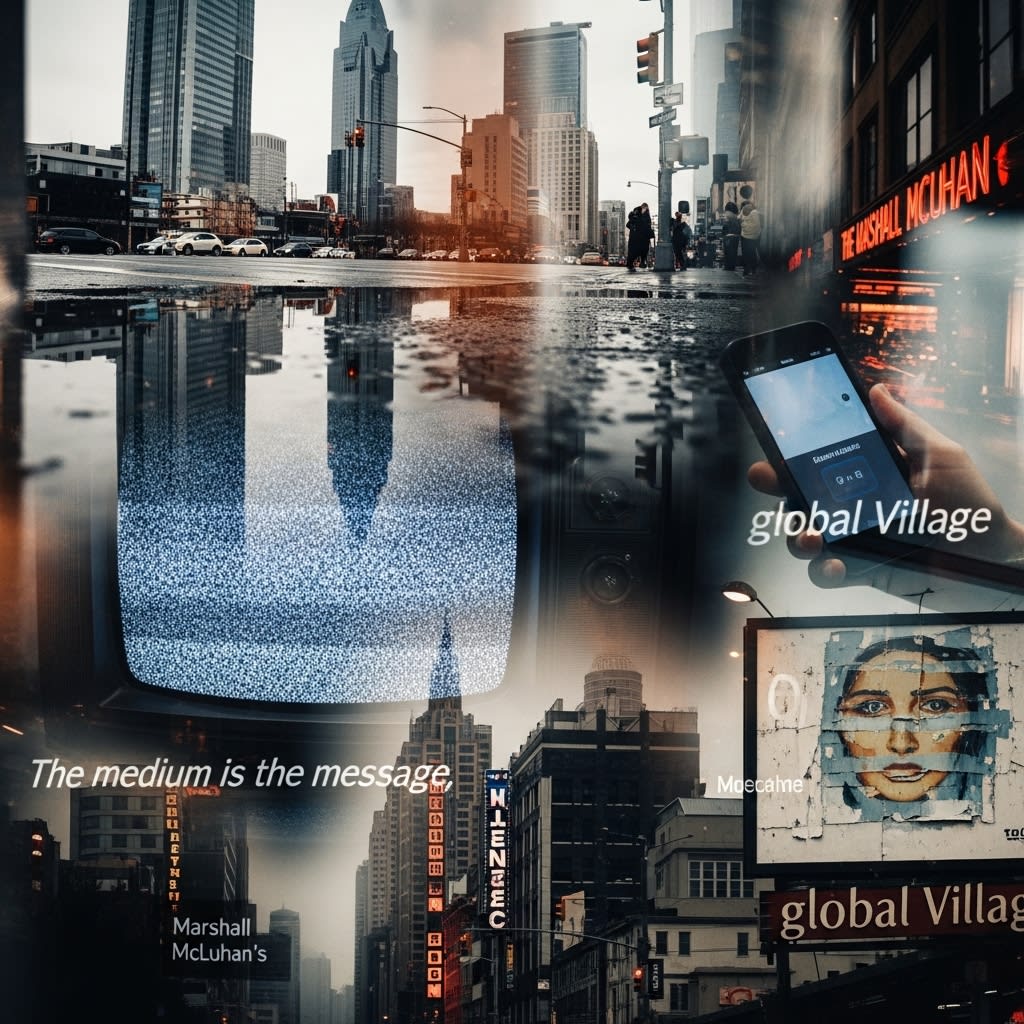
Marshall McLuhan did not study media to understand television or newspapers. He studied media to understand *us*. Long before smartphones, social media, or constant connectivity, this Canadian philosopher saw that technology does not merely deliver information—it reshapes perception, thought, and society itself. McLuhan’s ideas remain disturbingly relevant because he grasped a truth many still resist: the most powerful effects of media are invisible.
McLuhan was born in 1911 in Edmonton, Alberta, and trained in literature rather than philosophy or engineering. This outsider position proved to be his strength. Instead of analyzing media as tools, he approached them as environments. Just as fish do not notice water, humans rarely notice the media structures shaping their behavior. McLuhan set out to make those structures visible.
His most famous phrase, “the medium is the message,” is also his most misunderstood. McLuhan did not mean that content is irrelevant. He meant that the *form* of a medium changes society more profoundly than any individual message it carries. A book, a radio broadcast, a television screen, or a smartphone reorganizes human attention, social relationships, and cognitive habits regardless of what content flows through it.
For example, television did not just broadcast news—it changed politics, shortening attention spans, privileging image over argument, and rewarding charisma over substance. The internet did not simply accelerate communication—it dissolved boundaries between private and public life. These effects occur even when the content is trivial. The medium quietly rewires the mind.
McLuhan divided media into “hot” and “cool.” Hot media, like print, deliver high-definition information and require little audience participation. Cool media, like television or digital platforms, demand active involvement and interpretation. This distinction helped explain why different technologies create different kinds of cultures and personalities. Print culture fostered linear thinking, individualism, and nationalism. Electronic media revived tribalism, emotional immediacy, and collective identity.
This led to McLuhan’s prediction of the “global village.” As electronic media collapsed time and space, humanity would once again live in a shared sensory environment, resembling a village rather than a nation-state system. Today’s online outrage cycles, viral movements, and real-time global reactions confirm his insight. The village returned—but without elders or shared norms.
McLuhan was neither an optimist nor a pessimist. He refused moral panic and techno-utopianism alike. His goal was awareness. He believed that understanding media effects could grant a degree of freedom. Without awareness, societies become prisoners of technologies they mistake for neutral tools.
His style reflected his message. McLuhan wrote in fragments, aphorisms, and paradoxes. He rejected linear argument in favor of mosaic patterns, forcing readers to experience ideas rather than consume them passively. Critics accused him of obscurity. McLuhan replied that linear explanation belongs to print culture—and electronic culture requires a new form of thought.
This was philosophy performed, not just written.
McLuhan also challenged the assumption that progress equals improvement. Every new medium, he argued, amplifies some human capacity while amputating another. Writing extends memory but weakens oral tradition. Automobiles increase mobility but reshape cities around roads rather than people. Digital media enhances connection while eroding attention. There is no pure gain—only trade-offs.
His warning was subtle but severe: when a medium becomes invisible, it becomes total. When we no longer notice how technology shapes us, it controls us completely. Today’s algorithm-driven platforms, designed to capture attention and influence behavior, make McLuhan feel prophetic rather than theoretical.
Marshall McLuhan died in 1980, before the internet became a household reality. Yet few thinkers have anticipated the digital age more accurately. His work explains why debates about content moderation, misinformation, and screen addiction often miss the point. The deeper issue is not what we consume—but how consumption reshapes consciousness.
McLuhan was not a technologist, marketer, or futurist. He was a philosopher of perception. He taught that understanding media is not optional—it is a survival skill. In a world where technology evolves faster than ethics or wisdom, McLuhan remains essential.
He did not ask us to reject media. He asked us to see it.
About the Creator
Fred Bradford
Philosophy, for me, is not just an intellectual pursuit but a way to continuously grow, question, and connect with others on a deeper level. By reflecting on ideas we challenge how we see the world and our place in it.
Keep reading
More stories from Fred Bradford and writers in Art and other communities.
Metternich: The Architect of Stability
Klemens von Metternich stood almost alone in defending an unfashionable idea: stability. While others chased glory, ideology, or national destiny, Metternich pursued something far less dramatic but far more difficult—peace that lasts. He was not a conqueror, nor a visionary prophet. He was an architect, quietly designing a political structure strong enough to restrain chaos.
By Fred Bradford10 days ago in Art
Dj Frizbee an illustration that I had done in highschool and when I was doing
Dj Frizbee is an illustration I did of a Dj I call Frizbee. I created DJ Frizbee when I was in highschool and this was around the time that I was doing tags around the school. Reina was an another graffiti piece that I did and a tagging name that I was trying on along with tags I was also creating pieces of my own as I had shown with this article.
By Revista Mikoabout 16 hours ago in Art




Comments
There are no comments for this story
Be the first to respond and start the conversation.