
Metternich: The Architect of Stability
Metternich: The Architect of Stability

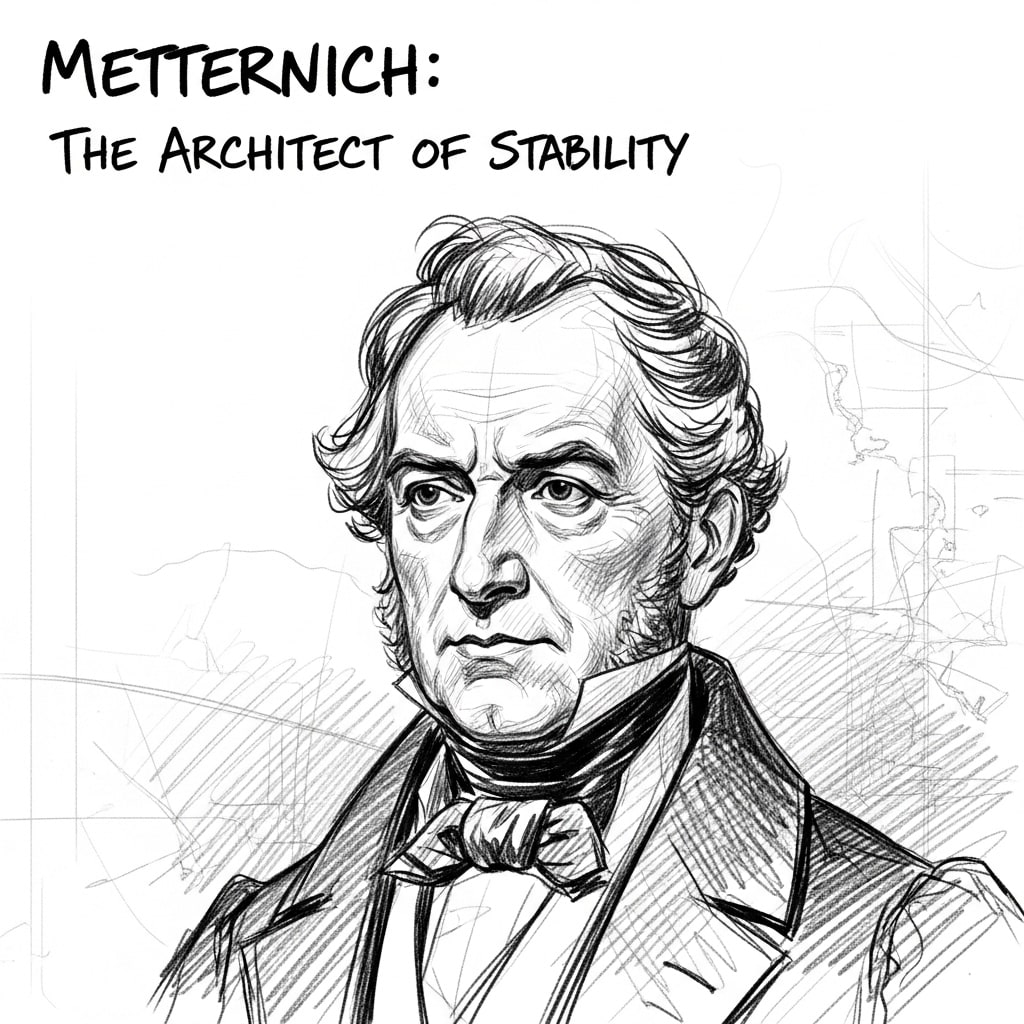
Klemens von Metternich stood almost alone in defending an unfashionable idea: stability. While others chased glory, ideology, or national destiny, Metternich pursued something far less dramatic but far more difficult—peace that lasts. He was not a conqueror, nor a visionary prophet. He was an architect, quietly designing a political structure strong enough to restrain chaos.
Born in 1773 into the aristocracy of the Holy Roman Empire, Metternich came of age as the French Revolution shattered Europe’s old order. To many, the revolution symbolized progress and liberation. To Metternich, it revealed something more dangerous—the speed at which moral certainty can turn into mass violence. He watched ideals descend into terror, crowds into mobs, and liberty into dictatorship. From this experience, his lifelong conviction was forged: rapid change destroys societies faster than tyranny ever could.
Metternich believed that politics must begin with human nature, not dreams. People, he argued, are driven by emotion more than reason, and when unleashed by ideology, those emotions become uncontrollable. Revolutions promise justice but often deliver blood. For Metternich, the role of leadership was not to excite the masses, but to restrain them—for their own survival.
His moment came after the defeat of Napoleon in 1815. Europe lay exhausted after two decades of near-constant war. Empires were broken, borders unstable, and vengeance simmered everywhere. Many leaders demanded punishment of France and radical redrawing of the continent. Metternich opposed both. He understood that humiliation breeds revenge, and revenge breeds war.
At the Congress of Vienna, Metternich emerged as the central figure shaping Europe’s future. His goal was not to reward virtue or punish guilt, but to restore balance. He believed no single power should dominate the continent. Each state, large or small, had to feel secure enough not to seek expansion. This balance-of-power system was not idealistic—it was preventative.
Remarkably, it worked.
For nearly a century after Vienna, Europe avoided continent-wide war. Conflicts occurred, but none approached the scale of the Napoleonic catastrophe. This period of relative peace—rare in European history—was Metternich’s true legacy. He achieved what generals could not: peace enforced not by armies, but by structure.
Metternich’s diplomacy relied on cooperation among great powers rather than constant rivalry. Through congresses, alliances, and negotiation, he promoted dialogue over confrontation. Problems were to be managed, not dramatized. Compromise was not weakness—it was maintenance.
Yet Metternich was deeply suspicious of nationalism and liberalism. He saw them as emotional forces that promised identity but delivered fragmentation. Nations built on passion, he believed, would inevitably seek enemies. Freedom without limits would dissolve order. To modern eyes, his conservatism appears oppressive. But in his time, it was shaped by memory—memory of revolution, terror, and war.
His critics called him reactionary. He accepted the label calmly. To Metternich, progress that destroys stability is not progress at all. He believed society evolves slowly, organically, and that forcing history forward produces only ruins.
Still, Metternich was not blind to reality. He did not oppose change absolutely—he opposed uncontrollable change. Reform, he believed, must be gradual, guided from above, and absorbed by institutions. Sudden transformation invites collapse.
Ultimately, Metternich’s greatest insight was this: peace is not the absence of conflict, but the management of it. Human ambition cannot be eliminated. It must be balanced. Power cannot be moralized. It must be restrained.
When Metternich fell from power in 1848 amid revolutionary waves, Europe cheered his departure. Yet within decades, the system he had built unraveled. Nationalism surged, alliances hardened, and diplomacy gave way to pride. The result, a century later, was two world wars—exactly the catastrophe Metternich had feared.
History’s verdict on Metternich is complicated, but profound. He was not loved. He was not inspiring. But he understood something rare: civilization survives not on passion, but on patience.
Metternich did not seek a perfect world. He sought a livable one. And in an era addicted to upheaval, that may be the most difficult vision of all.
About the Creator
Fred Bradford
Philosophy, for me, is not just an intellectual pursuit but a way to continuously grow, question, and connect with others on a deeper level. By reflecting on ideas we challenge how we see the world and our place in it.
Keep reading
More stories from Fred Bradford and writers in Art and other communities.
The Best Philosophy in the World Is the One You Can Live
Ask ten philosophers what the best philosophy in the world is, and you will receive at least ten different answers—possibly delivered with footnotes, counterarguments, and mild contempt for the other nine. This disagreement is not a flaw of philosophy; it is its essence. Philosophy was never meant to be a universal prescription handed down like a rulebook. It exists to help human beings live better lives. By that standard, the best philosophy in the world is not the most elegant or complex—it is the one that can be lived.
By Fred Bradford12 days ago in Art
📢 Raise Your Voice Thread: 01/22/2026
Our “Raise Your Voice Threads” are hosted most alternating Thursdays at 12PM ET to offer creators more avenues to uncover exceptional stories on Vocal. As we are continuously searching for fresh creators and inspiring stories, this thread provides an opportunity to exchange and discuss the stories that have moved and motivated us on Vocal.
By Raise Your Voice by Vocal5 days ago in Resources




Comments
There are no comments for this story
Be the first to respond and start the conversation.