
M.C. Escher
Dutch graphic artist

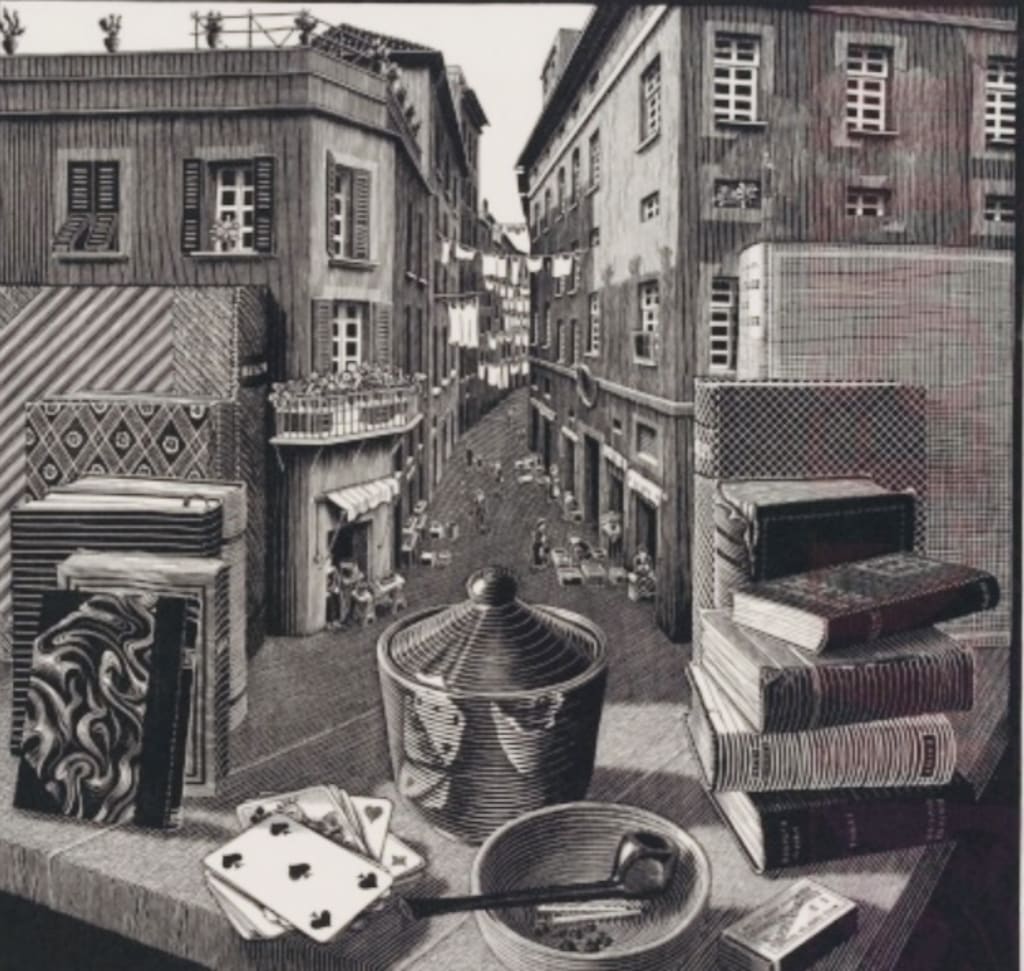
M.C. Escher, also known as Maurits Cornelis Escher, was a fascinating Dutch graphic artist whose work continues to astound audiences with its intricate and mind-bending illusions.
Escher was born on June 17, 1898, in Leeuwarden, Netherlands. The youngest of five boys, he grew up in a household where creativity and engineering intersected. His father George, was a civil engineer, and his stepmother, Sarah, played a significant role in nurturing his artistic inclinations. Despite being drawn to music and carpentry, young Maurits didn’t excel in mathematics, which might surprise you given the mathematical nature of his later work.
.................................
Escher faced health issues from an early age. As a child, he battled various diseases, which likely affected his performance at school. Despite these setbacks, he persevered.
His introverted nature made social interactions challenging. Social anxiety troubled him, but he managed to build meaningful friendships along the way.
Escher initially aspired to be an architect. However, his artistic inclinations led him to shift his focus toward drawing and printmaking.
His teacher, Samuel Mesquita, recognized his talent and encouraged him to explore the world of art.
In 1924, Escher married Jetta Umiker, and the couple settled in Rome. They raised a family together.
Escher’s primary work was as a printmaker, and his art would go on to captivate audiences worldwide.
Significant parts of his time was spent in Italy, where he immersed himself in the country’s landscapes. His early art often depicted the winding roads, hillside towns, and architectural marvels of Italy.
Inspired by the intricate tile work of the Alhambra in Granada, Spain, he left Italy to explore new directions in color and pattern.
Escher developed the concept of “the regular division of the plane,” which he used in creating his famous Metamorphosis prints. These prints showcased shapes transforming into something entirely different—a recurring theme in his work.

The themes of Metamorphosis sees pictorial images. After an indistinct grey, the symbols turn into a block pattern. These blocks in turn evolve into a chess board that dances, or other series of events.
His reclusive nature set him apart. Unlike the surrealists of his time, Escher didn’t follow any specific movement; instead, he developed his unique style.
.................................................
Escher lived in Switzerland and Belgium. During this period, he experimented with multiple perspectives, creating fantastical depictions of natural forms that defied conventional reality.
His works often portrayed impossible architectural spaces and unexpected metamorphoses of objects. One of his signature techniques was tessellation—using geometric grids to create intricate interlocking designs.

Escher worked in various mediums, including lithography, wood engraving, and mezzotint. His black-and-white works, such as “Eye” (1946), “Gallery” (1946), “Crystal” (1947), and “Dewdrop” (1948), showcase his technical virtuosity. These pieces play with perception, challenging viewers to question what’s real and what’s illusion.
📐 Mathematics: Escher’s fascination with mathematics influenced much of his work. He explored symmetry, infinity, and paradoxes. His art appealed not only to the general public but also to mathematicians and cognitive psychologists. His legacy lives on through approximately 450 lithographs, woodcuts, and wood engravings, along with around 2,000 drawings and sketches.
Legacy: Escher’s images continue to inspire awe and curiosity. Whether it’s the famous “Ascending and Descending” (which seems to defy gravity) or the mind-twisting “Relativity,” his art invites us to question our perception of reality.
.............................
His artwork
“Relativity” (1953):

In this masterpiece, Escher conjured a world where stairs defy both gravity and our usual perception. People traverse these crazy staircases as if it’s the most normal thing. It’s like Escher took the rules of up and down, mixed them up, and created an otherworldly puzzle. When you look at “Relativity,” your eyes might play tricks on you—it’s a playful riddle that challenges how we understand things. The figures in the drawing follow their paths without getting all mixed up, adding to its mysterious charm. It’s not just a drawing; it’s an invitation to a world where ordinary rules take a backseat, and stairs lead you on an endless journey of imagination.
“Drawing Hands” (1948):
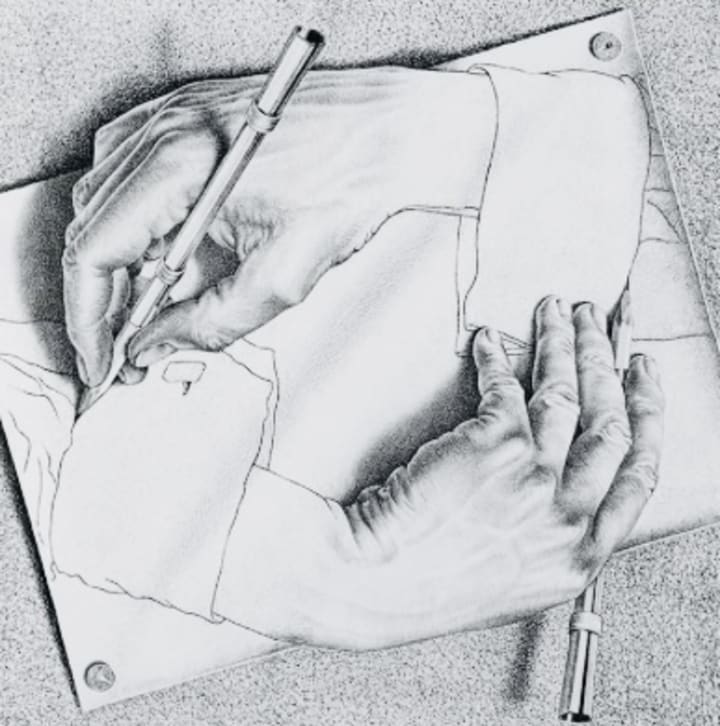
In this lithograph, Escher presents an impossible scene: two disembodied hands, each drawing the other into existence. Set against a blank background, the hands seem to float in an ambiguous space, connected by the impossible circularity of their act. The left hand sketches the contours of a right hand, while the emerging right hand draws its own cuff and sleeve. It’s as if Escher is playing with the idea that art has its own life—here, the hands are both artists and artwork simultaneously.
Other Notable Works:
“Ascending and Descending”: An impossible staircase where figures ascend and descend perpetually.
“Metamorphosis I, II, and III”: A series of prints showing gradual transformations between different forms.
“Air and Water I”: A tessellation of birds and fish seamlessly merging.
“Reptiles”: A captivating exploration of reptilian forms in tessellated patterns.
Escher’s art invites us to question reality, challenge our perceptions, and step into worlds where logic takes a delightful detour. His legacy lives on, captivating millions worldwide. If you ever find yourself lost in one of his prints, remember that reality isn’t always what it seems!
..........................................
M.C. Escher, the enigmatic artist known for his mind-bending prints, had a rather unique relationship with the art world and his fellow creators.
Isolation and Independence:
Escher was a bit of a lone wolf in the art scene. He didn’t affiliate himself with any specific artistic movement or group. While Surrealism was closest in spirit to his work, he had no contact with the Surrealists. No gallery openings, no joint exhibitions, no casual coffee chats with Salvador Dalí. Nada.
His independence allowed him to chart his own course, unencumbered by artistic dogmas. Escher’s art was a blend of intricate realism and fantasy, and he played his own visual tune.
Intellectual Kinship with Mathematicians:
Here’s where it gets interesting: Many other artists of his generation saw Escher as too cerebral—more of an intellectual than an artist. But others found common ground with him? Scientists and mathematicians!
Escher’s works were deeply rooted in mathematics, particularly principles of symmetry and geometry. His intricate tessellations, impossible constructions, and mind-bending transformations fascinated those who appreciated both art and science.
Family Tensions and Loneliness:
Escher’s intense work habits took a toll on his personal life. While he was prolific and productive, it came at a cost. His family relationships suffered, and a growing sense of loneliness crept into his later prints.
Escher was a solitary explorer—a man who wandered through enigmas, creating art that defied conventions. While he didn’t hobnob with fellow artists, he found kindred spirits among mathematicians and scientists. And as for Surrealists? Well, they missed out on the chance to discuss impossible staircases over espresso.
............
M.C. Escher left an indelible mark on modern art, captivating audiences with his intricate and mind-bending prints.
His ability to blend precise draftsmanship with mathematical concepts set him apart. Escher’s work bridges the gap between art and science, inviting viewers to question what’s possible.
Tessellations and Symmetry:
Escher’s fascination with tessellations—patterns that seamlessly repeat without gaps or overlaps—has influenced both art and design. His intricate designs of birds, fish, and reptiles fitting together like puzzle pieces showcase his mastery of symmetry.
Mathematicians and artists alike appreciate how he incorporated mathematical forms into his art. Escher’s prints provide visual metaphors for abstract concepts, including infinity.
Breaking Norms:
During a time when abstract art dominated, Escher stood out. His prints—often produced as lithographs or woodcuts—defied convention. While others explored abstraction, he delved into the intricacies of form, space, and illusion.
His unique vision and technical skill continue to inspire contemporary artists, designers, and mathematicians. Escher’s legacy lives on through his timeless creations.
Crossing Disciplines:
Architecture: Architects find inspiration in his impossible constructions, pushing the boundaries of spatial design.
Philosophy: Escher’s art prompts philosophical discussions about reality, perception, and the limits of human understanding.
Relativity and Cultural Impact:
“Relativity,” with its mind-bending staircases and figures defying gravity, has become iconic. It pops up in art exhibitions, scientific discussions, and popular culture.
Escher’s legacy isn’t just about aesthetics; it’s about challenging our minds and inviting us to explore the impossible.
So, whether you’re pondering paradoxes or simply admiring the beauty of his prints, remember that M.C. Escher’s impact on modern art is as intricate as the patterns he wove into his work.
Despite health issues and personal difficulties, he left an indelible mark on the art world. His legacy continues to inspire wonder and curiosity.
So, behind those mesmerizing prints lay a complex artist—a man who grappled with health, social anxiety, and the pursuit of his creative vision. Escher’s ability to blend mathematics, imagination, and visual trickery remains a legacy to his enduring influence
...............
M.C. Escher’s imaginative and mind-bending art continues to be celebrated through exhibitions around the world. Let’s take a tour of some recent showcases:
“Behind the Paradox” in Toyama, Japan:
In Toyama, Japan, it was a must-see!
Palazzo dei Diamanti, Ferrara, Italy:
Escher’s works graced the historic Palazzo dei Diamanti in Ferrara. The elegant setting provided the perfect backdrop for his mind-bending illusions. Visitors immersed themselves in tessellations, impossible constructions, and visual enigmas
Rome, Italy (Palazzo Bonaparte):
Until May 5th, 2024, an exhibition in Rome celebrated Escher’s legacy. The Palazzo Bonaparte hosted a collection that invited viewers to explore the artist’s intricate worlds.
The Hague, The Netherlands (Kunstmuseum Den Haag and Escher in The Palace):
The Dutch city of The Hague paid homage to its native son. Both the Kunstmuseum Den Haag and Escher in The Palace featured his works. The exhibition ran until September 2023.
Florence, Italy:
Until March 26th, 2023, Florence hosted an Escher exhibition. Imagine wandering through Renaissance streets while contemplating impossible geometries. It’s a delightful blend of old and new.
MFA Houston:
If you happened to be in Houston, Texas, the Museum of Fine Arts (MFA) hosted an Escher exhibition until September 2022. His prints adorned the walls, inviting visitors to question reality
Escher’s art isn’t just about optical illusions; it’s an invitation to explore the boundaries of perception and imagination. So, whether you’re in Japan, Italy, or anywhere else, keep an eye out for these Escher exhibitions—they may be portals to wonder.
About the Creator
Antoni De'Leon
Everything has its wonders, even darkness and silence, and I learn, whatever state I may be in, therein to be content. (Helen Keller).
Tiffany, Dhar, JBaz, Rommie, Grz, Paul, Mike, Sid, NA, Michelle L, Caitlin, Sarah P. List unfinished.
Keep reading
More stories from Antoni De'Leon and writers in Art and other communities.
Sahara Desert of Merzouga: The Complete Travel Blog Guide
Sahara Desert of Merzouga is one of the top places, you should not miss when visiting Morocco. It's place where golden dunes stretch endlessly, camels walk across the horizon, and nights sparkle with a sky full of stars. Located near the Algerian border, Merzouga is the gateway to the spectacular Erg Chebbi dunes, the most lovely sand dunes in Morocco. Merzouga desert is highly recommended among travelers due to its lovely high, clean and golden dunes offering visitors the chance to enjoy their vacation. Morocco Tours Company
By Othmane Anaamabout 16 hours ago in Art
When the Shelter Closes
Across the street from my house, a man slept under a tree, his dog by his side. My first, naive thought: he must be traveling through. But he kept coming back, often sleeping there during the day. Then it hit me—that person might not have a home.
By Bride of Sound5 days ago in Humans


Comments (4)
Very interesting artist.
Huge favourite of mine when I was at school. Would have been an influence, but I never felt I was good enough to even begin to emulate that style.
I find pieces like this soooo fascinating! About the title, you could email them about it and they'll move this piece to drafts for you and then you can correct it
When will Vocal allow us to correct the Title of stories with quick edit. I made an error in my title. Oh dear!