


A lunar eclipse occurs when the Moon passes into the Earth's shadow, leading to a darkening of its surface. This alignment happens during an eclipse season, which occurs roughly every six months. For a lunar eclipse to take place, it must be during a full moon when the Moon's orbital path intersects closely with the Earth's orbital plane, specifically near one of the two points known as lunar nodes.
The alignment required for a lunar eclipse involves the Sun, Earth, and Moon being in a straight line or very close to it, with the Earth positioned between the Sun and the Moon. This alignment, known as syzygy, occurs only when the Moon is at or near a lunar node during the full moon phase.

The type of lunar eclipse and its duration are influenced by how close the Moon is to the lunar node. A total lunar eclipse, where the Moon is completely covered by Earth's umbra (the central, darkest part of its shadow), results in a "deep eclipse." During such an event, the Moon often takes on a reddish hue. This reddish color happens because, although direct sunlight is blocked by the Earth, some sunlight still reaches the Moon. This light is refracted through the Earth's atmosphere and scatters; shorter blue wavelengths scatter out, leaving longer red wavelengths to illuminate the Moon, a phenomenon known as Rayleigh scattering. This effect also accounts for the orange hues observed in sunrises and sunsets.
About the Creator
SK
Sajawal is an 18-year-old student in Class 13, known for his curiosity and determination. With his fair complexion and thoughtful demeanor, Sajawal stands out among his peers. He is dedicated to his studies and has a passion for storytellin
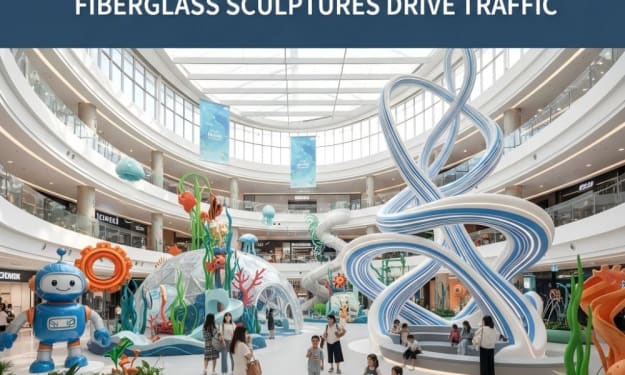
2026 Commercial Space Design:How Fbierglass Sculpture Drives Traffic
Today, offline commercial spaces are facing continuous pressure. With e-commerce offering convenient and fast services, physical stores must showcase unique features to attract customers. In this context, fiberglass sculptures are no longer merely decorative items; they have become visual focal points in shopping malls, brand stores, pop-up shops, and mixed-use commercial projects, playing a crucial role in increasing foot traffic.
By Shenzhen Ruiheng Craftsa day ago in Art
Why Strategic Branding Is Essential for Long-Term Business Growth
In today’s fast-paced digital environment, businesses face constant pressure to stand out. Consumers are exposed to endless choices every day, making attention harder to earn and trust harder to keep. While quality products and services are important, they are no longer the only factors that determine success. Strategic branding plays a key role in helping businesses grow steadily and remain relevant over time.
By Ayush Bagwaria day ago in Art



Comments
There are no comments for this story
Be the first to respond and start the conversation.