

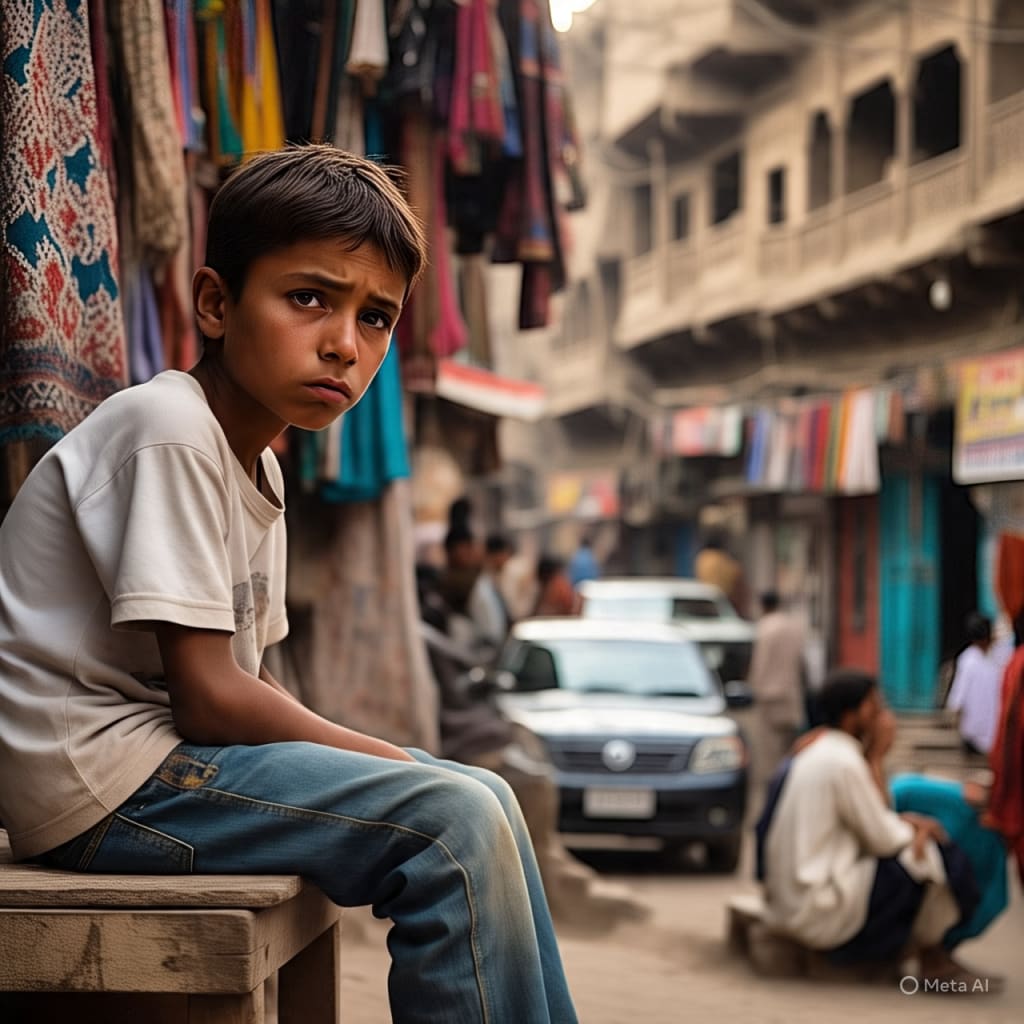
*The Lonely Boy*
In the heart of Pakistan, in a small, dusty town surrounded by endless fields of wheat and cotton, there lived a teenager named Ali. He was a shy and introverted boy with eyes that seemed to hold a thousand stories, each one a reflection of the deep thoughts that often consumed him. Ali's life had taken a dramatic turn when he was just a child; his parents had passed away in a tragic accident, leaving him alone in a world that seemed too big and too cruel.
After their death, Ali was taken in by his distant relatives, the Khans. They were kind-hearted people, but their home felt foreign to Ali. The Khans had children of their own, but they were much younger than Ali, and their laughter and playfulness only highlighted the emptiness he felt inside. Ali's days became a routine of school, home, and solitude. He found solace in books, escaping into worlds where love and loss were themes he could understand.
As Ali navigated his teenage years, he felt like a ship without an anchor, drifting aimlessly on the sea of life. His classmates would talk about their parents, their family vacations, and their dreams for the future. Ali would listen quietly, his heart aching with every word. He longed for the warmth of a mother's hug, the firm guidance of a father's hand, and the simple joy of sharing his thoughts with someone who truly understood him.
Despite his loneliness, Ali was a bright student. He had a particular affinity for poetry, finding solace in the words of Faiz Ahmad Faiz, Allama Iqbal, and other great Urdu poets. Writing became his escape, a way to express the emotions he couldn't verbalize. In his poetry, Ali poured out his heart, sharing his pain, his dreams, and his longing for connection.
One day, while wandering through the town's old library, Ali stumbled upon a group of young writers who met weekly to share their work and discuss literature. They welcomed him with open arms, and for the first time since his parents' death, Ali felt a sense of belonging. The group became his haven, a place where he could be himself without fear of judgment.
Among the group was a girl named Ayesha, who shared Ali's love for poetry. She was confident and expressive, with a smile that could light up the darkest room. Ayesha took a particular interest in Ali's work, encouraging him to share his poetry with others. Through their discussions and debates, Ali and Ayesha grew closer, their shared passion for literature bridging the gap between them.
As the months passed, Ali's poetry began to gain recognition in the town's literary circles. People would approach him after his readings, praising his ability to capture the human experience in his words. For Ali, this recognition was a double-edged sword. On one hand, it brought him a sense of validation and purpose. On the other, it made him feel like he was living in two worlds: the world of his words, where he was understood, and the real world, where he was still alone.
Ayesha remained a constant source of support and encouragement. She believed in Ali's talent and encouraged him to pursue his dreams, no matter how daunting they seemed. Together, they explored the town, finding inspiration in its streets, its people, and its stories. Ali began to see the world through Ayesha's eyes, and for the first time, he felt like he was not walking alone.
But life had its challenges. The Khans, while kind, were struggling financially. Ali knew he had to find a way to support himself and contribute to the household. He started working part-time at a local bookstore, surrounded by books that had become his friends. The owner, Mr. Rahman, was a wise and gentle man who took Ali under his wing, teaching him the value of hard work and the joy of sharing knowledge.
As Ali balanced his work, writing, and studies, he began to realize that his loneliness had given him a unique perspective on life. His experiences, though painful, had shaped him into a compassionate and thoughtful individual. He started to see the beauty in the small things: a sunrise over the fields, a child's laughter, or a stranger's smile.
Ali's poetry evolved, reflecting his growth and newfound appreciation for life. He wrote about love, loss, hope, and resilience. His words resonated with people from all walks of life, and soon, he was invited to read at larger venues, sharing his story with audiences beyond his town.
One evening, as Ali stood on the stage, his heart pounding with excitement and nerves, he looked out into the crowd and saw Ayesha in the front row, smiling at him. He took a deep breath, and his words flowed like a river. He spoke of his journey, of the pain and the beauty he had encountered along the way. The audience listened, entranced, as Ali's words painted a picture of a young
About the Creator
'Till Death We Do Art
There would be nothing divine in this world without art. Nature may surpass the divine to all intents and purposes, but like everything it absorbs and is absorbed by, it remains here, stuck on the surface of this world, ever-present, physically bound to the universe.
By Avocado Nunzella BSc (Psych) -- M.A.P 15 days ago in Art
Things to do in Casablanca:
Casablanca is one of lovely destinations around Morocco. Casablanca is considered the largest city in Morocco. It's famously known for its historic attractions, cultural sites and natural landscapes. Additionally, the city is well- known for its clean beaches offering visitors a lifetime experience. This blog cover the top things to do in Casablanca:
By Othmane Anaamabout 11 hours ago in Art




Comments (1)
muja bhi support karo bro