
King Kei and the Magnificent Mango Tree:
A Royal Garden’s Treasured Fruits
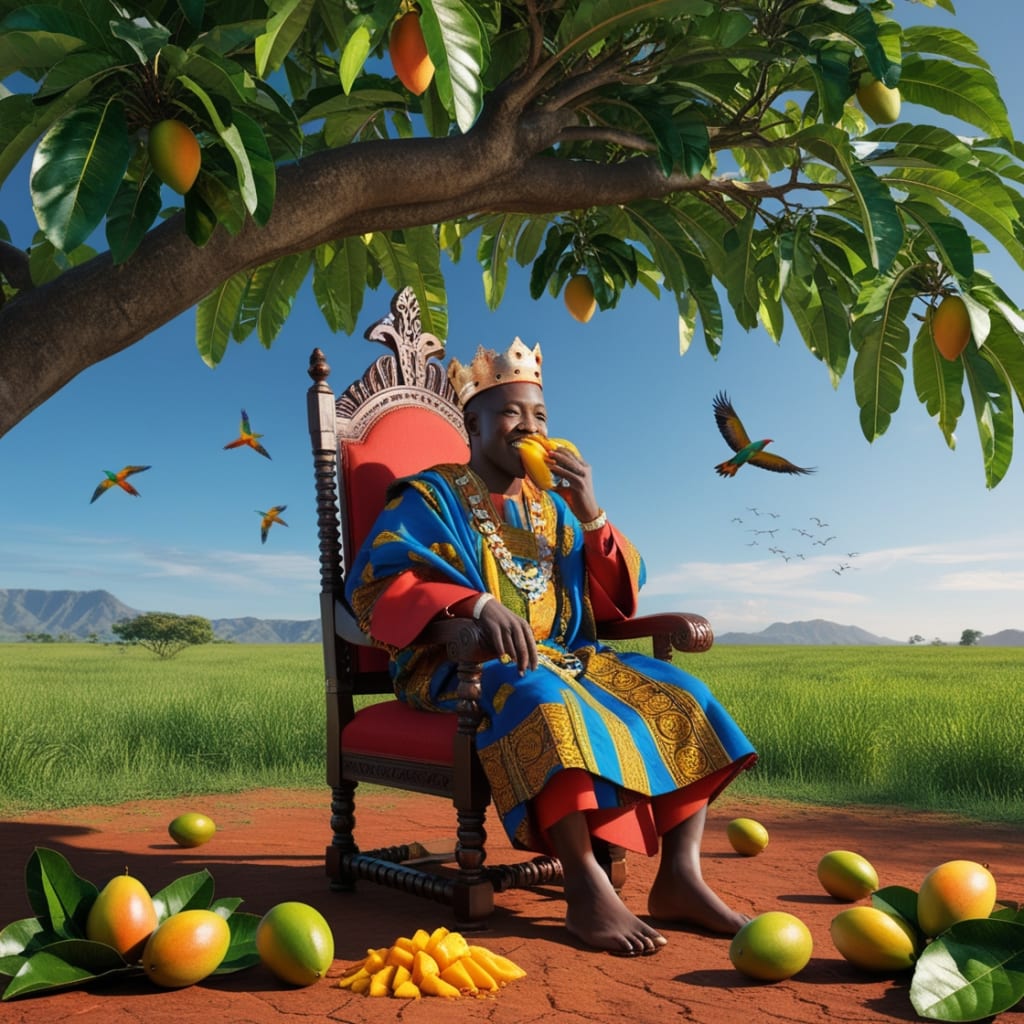
In a kingdom surrounded by lush green hills and sparkling rivers, there lived a wise and Kind King named Kei. King Kei had a grand palace with gleaming marble floors. He had a collection of the best art, and his palace was filled with ancient and modern collections of precious stones, jewels and gold. He was in fact a very wealthy and contented King. Amongst everything he owned in all his kingdom, what King Kei loved most was his beautiful garden. In the heart of this garden stood a magnificent Mango tree, tall and strong, with branches that spread wide and bore the juiciest and sweetest mangoes anyone had ever tasted in that land of Masiebi. The tree had been planted by the king's father Keke and it held a special place in the king's heart. The King never lets anyone into that garden not even his most trusted allies and friends. Every day, King Kei would visit his beloved mango tree, sitting under its shade and savoring the crisp mangoes it offered. But one fateful morning, the king noticed that the leaves on his precious tree were beginning to wither. The vibrant green leaves were turning yellow and brown, and the mangoes were falling to the ground before they could ripen. Distressed, the king summoned the best gardeners, scholars, and herbalists from across the kingdom.
“Whoever can save my mango tree will be rewarded with a royal assignment”, the king proclaimed.
Excited by the promise of such a reward, young men from the village and beyond flocked to the palace. They brought with them potions, herbs, special soils, and all sorts of remedies.
They were let into the garden one after another to try and revive the tree, they would go in, apply their remedies and were given a few days for the remedy to take effect, but no matter what they tried, the tree continued to wither. Days turned into weeks, and still, the tree's condition worsened.
The king was beginning to lose hope at this point, and he was extremely sad that the one thing his father left him would be lost. One day, a poor farmer named Pukudu, who lived on the outskirts of the village, heard about the king's plight. Pukudu was known for his simple life, and many in the village looked down on him because he was poor and often kept to himself.
But Pukudu had a gift—he had a deep knowledge of plants and understood the language of nature, something he had learned from his father and grandfather in the early years of his life.
Determined to help, Pukudu made his way to the palace. When he arrived at the gate of the palace, the guards refused to let him in. Go tell the king that I can revive his mango tree,
he said to the guards. The King was exhausted at that point but there is no harm in trying, he muttered. Let him in, he commanded. The king was surprised to see him. “Why have you come, Pukudu the farmer?” asked King Kei. The finest minds in the kingdom have tried and failed. What makes you think you can succeed?” Pukudu bowed humbly and replied, “Your Majesty, I may not have wealth or status, but I know the language of the earth. If you allow me to try, I would be able to revive the tree in a couple of days. However, he added, I do not want a special assignment as that might be too much to ask, I only want to be granted my freedom and allowed to return to the kingdom if I succeed.
The king, impressed by Pukudu’s courage and sincerity, agreed. “Very well, Pukudu,” said King Kei. “If you can save my tree, you shall have your freedom.” The news spread throughout the village like wildfire and the villagers were all keen to know the result of this daring move by the hunter.
Pukudu wasted no time. He examined the roots of the tree and the soil around it. He touched the bark and felt the breeze that whispered through its branches. Then, he did something unexpected—he spoke to the tree. “What troubles you, dear friend?” he whispered softly, as if the tree could hear him. He put his ear on the tree and nodded with a smile on his face, the king and his guards, watched on in surprise.
The next morning, Pukudu began his work. He mixed a special blend of natural herbs and ingredients he had gathered from the forest and gently spread it around the base of the tree. Each day, he watered the tree with care and made sure it had just the right amount of sunlight.
He also sang to the tree, ancient songs his father had taught him, believing that the tree could feel his kindness.
Days passed, and something miraculous began to happen. The leaves of the tree slowly turned green again, and new buds began to form. The mangoes that grew were more vibrant and sweeter than ever before. The once withering tree had come back to life, stronger and healthier than it had ever been. When the king saw the tree, his heart was filled with joy. He summoned Pukudu to the palace and embraced him. “You have done the impossible,
Pukudu,” King Kei said. “You have saved my most cherished tree, and for that, I will keep my promise. You are a free man.” But the king did not stop there. He appointed Pukudu as the Royal Gardener, a position of great honor and respect. The villagers, who once shunned Pukudu, now looked up to him with admiration. And so, the once-ostracized farmer became a trusted advisor to the king, and the mango tree in the garden continued to flourish for many years to come. The kingdom prospered, and King Kei and Pukudu the farmer became close friends and allies.
This story is a quick reminder that the stone the builders rejected, can become the corner stone at the least expected time.
This is the end of my story.
About the Creator
Keep reading
More stories from Leonard Omina and writers in Art and other communities.
Bobo the Gardener and the Queen's Quest
In a sprawling kingdom nestled amidst lush forests and rolling hills, there lived a man named Bobo, renowned for his insatiable appetite for women with ample hips and shapely legs. Driven by this desire, Bobo secured a job as a gardener in the royal palace, hoping to feast his eyes on the beauty of the queen.
By Leonard Ominaabout a year ago in Art
Why 316 stainless steel sculpture is the gold standard for coastal sculptures
If stainless steel sculptures are installed in coastal environments, corrosion caused by sea breezes becomes an important issue to consider. Salt in the air, high humidity, and frequent temperature changes can all accelerate surface deterioration if the material or finish is not suitable.
By Shenzhen Ruiheng Crafts6 days ago in Art




Comments
There are no comments for this story
Be the first to respond and start the conversation.