
Kehinde Wiley: Redefining Representation in Contemporary Art
Kehinde a Modern African American Artist

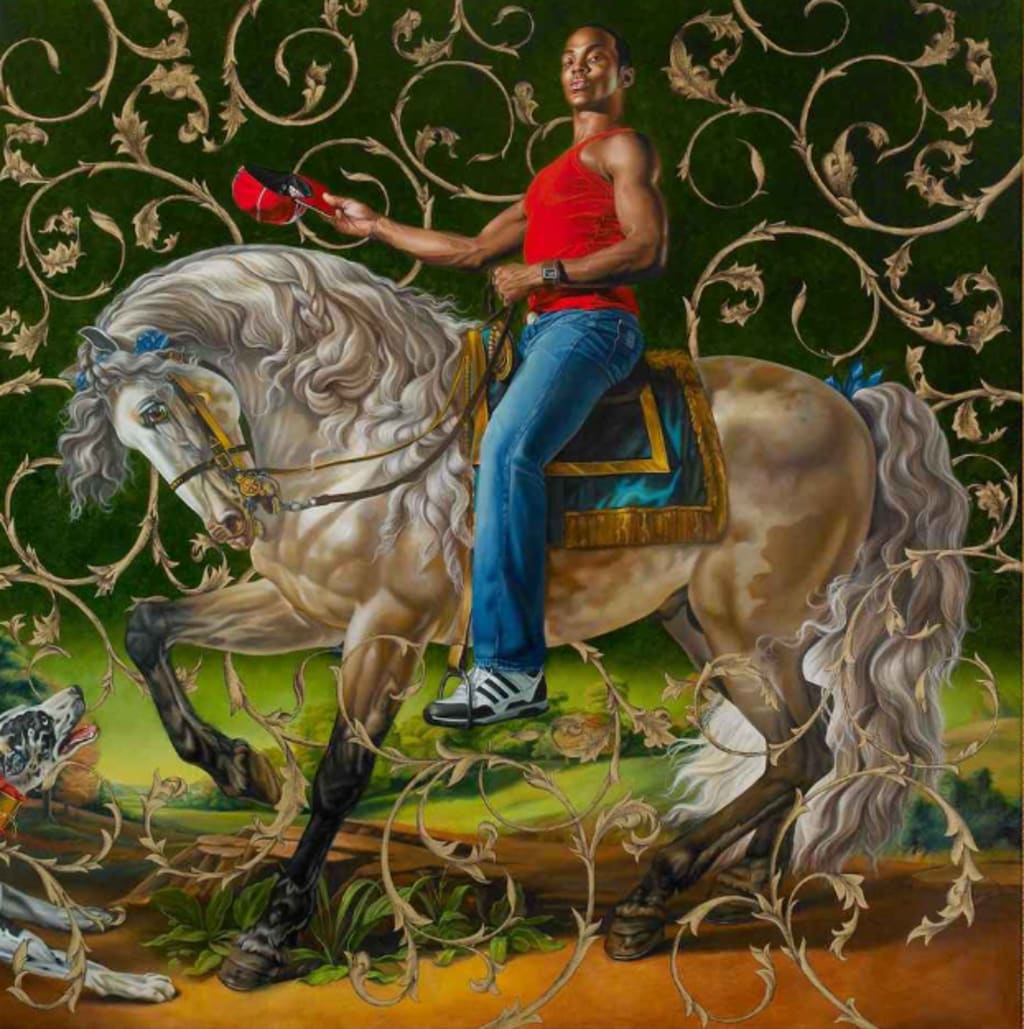
In the vast tapestry of contemporary art, Kehinde Wiley emerges as a beacon of innovation and introspection, reshaping the landscape of portraiture with his vibrant, dynamic, and deeply symbolic compositions. Renowned for his striking juxtapositions of urban culture and classical European aesthetics, Wiley's work transcends boundaries of race, gender, and identity, inviting viewers to reconsider traditional notions of power, beauty, and representation.
Born in Los Angeles in 1977, Kehinde Wiley's artistic journey began at an early age, nurtured by a passion for drawing and painting. His formative years were marked by a quest for identity and belonging, navigating the complexities of race and class in America's urban landscape. It was during his studies at the San Francisco Art Institute and later at Yale University that Wiley honed his craft and developed his distinctive style, drawing inspiration from a diverse array of influences, including classical portraiture, hip-hop culture, and the streets of Harlem.
At the heart of Kehinde Wiley's art lies a profound exploration of power dynamics and representation. Central to his practice is the concept of "reclamation," wherein marginalized subjects are placed in positions of authority and agency, subverting traditional hierarchies and challenging dominant narratives. Through his meticulously crafted portraits, Wiley seeks to amplify the voices of those who have been historically marginalized and overlooked, imbuing them with dignity, grace, and resilience.
One of Wiley's most iconic series is his "The World Stage" project, which began in the early 2000s and has since taken him to various countries around the world, including Nigeria, Brazil, and India. In each locale, Wiley selects local residents—often young men of color—as his subjects, inviting them to pose for portraits that fuse elements of their cultural heritage with references to Western art history. The result is a powerful visual dialogue that transcends geographical boundaries and underscores the universality of human experience.
In "The World Stage" series, Wiley's subjects are depicted against ornate, decorative backgrounds inspired by historical paintings, creating a tension between the grandeur of the past and the vibrancy of the present. By situating his subjects within this context, Wiley highlights the enduring legacy of colonialism and the ongoing struggle for self-determination in a globalized world. Yet, amid these complexities, there is a sense of celebration and empowerment, as each individual asserts their presence and claims their rightful place in the narrative of history.
Wiley's portraits are characterized by a meticulous attention to detail, with each brushstroke imbued with meaning and intention. His subjects are often depicted in regal poses, adorned with symbols of power and prestige, yet there is a vulnerability and humanity to their expressions that belies their status. Through subtle gestures and expressions, Wiley captures the nuances of identity and emotion, inviting viewers to engage with the complexities of race, gender, and power dynamics.
In addition to his portraiture, Kehinde Wiley is also known for his monumental public sculptures, which similarly challenge conventional notions of representation and identity. One of his most notable works is "Rumors of War," unveiled in 2019 in Times Square, New York City. The sculpture features a young African American man seated atop a rearing horse, echoing the equestrian statues of Confederate generals that dot the American South. By recontextualizing this symbol of power and authority, Wiley invites viewers to reconsider the legacy of slavery and racism in America, while also celebrating the resilience and strength of the Black community.
Throughout his career, Kehinde Wiley has been a tireless advocate for diversity and inclusion in the arts, using his platform to amplify underrepresented voices and challenge the status quo. In 2018, he made history as the first African American artist to paint an official presidential portrait for the Smithsonian National Portrait Gallery, capturing President Barack Obama with characteristic grace and dignity. The portrait, which depicts Obama seated against a backdrop of foliage and flowers, is a testament to Wiley's skill as a painter and his commitment to reimagining the possibilities of portraiture in the 21st century.
In conclusion, Kehinde Wiley's art stands as a testament to the power of representation and the importance of diverse perspectives in shaping our understanding of the world. Through his bold, vibrant portraits and monumental sculptures, Wiley challenges us to reconsider the narratives that have shaped our collective consciousness, inviting us to see beauty, strength, and resilience in the faces of those who have been marginalized and overlooked. As we continue to grapple with issues of race, identity, and power in the modern era, Wiley's work serves as a poignant reminder of the transformative potential of art to inspire empathy, foster understanding, and provoke meaningful dialogue.
About the Creator
Janie
Passionate about unraveling the intricate tapestry of art history and contemporary artistic expressions. Beyond brushstrokes and colors, into the mental and physical struggles of artists.
The Best Philosophy in the World Is the One You Can Live
Ask ten philosophers what the best philosophy in the world is, and you will receive at least ten different answers—possibly delivered with footnotes, counterarguments, and mild contempt for the other nine. This disagreement is not a flaw of philosophy; it is its essence. Philosophy was never meant to be a universal prescription handed down like a rulebook. It exists to help human beings live better lives. By that standard, the best philosophy in the world is not the most elegant or complex—it is the one that can be lived.
By Fred Bradford3 days ago in Art
A Dart at Dusk
Seconds ago, the sullen sun set on the two of us… my exuberant furry companion and me. A fresh breeze embraces us, delivering welcome relief from the day’s oppressive heat. His typical stumbling and staggering along — apace with a sloth — has turned into trip-trapping, high-stepping, almost skipping along.
By Angie the Archivist 📚🪶5 days ago in Petlife




Comments