
Indoor vs Outdoor Amusement Parks
Selecting the Optimal Model for the Current Market
1. Industry Context and Structural Shifts
The amusement industry is no longer driven solely by novelty or scale. It is increasingly shaped by macroeconomic prudence, urban density, climate volatility, and evolving leisure behavior. Investors and operators are re-evaluating legacy assumptions about land use, attendance cycles, and capital intensity. In this environment, the comparison between indoor and outdoor amusement models has shifted from a conceptual debate to a strategic decision with long-term financial implications.
Indoor amusement facilities have expanded rapidly in metropolitan areas, often embedded within commercial complexes or standalone urban properties. Outdoor amusement parks, while still influential, face rising pressure from land scarcity, extended development timelines, and heightened regulatory scrutiny. Both models remain viable. However, their suitability varies significantly depending on market maturity, consumer behavior, and operational objectives.
2. Capital Structure and Spatial Economics
Capital allocation is a primary differentiator between indoor and outdoor projects. Outdoor amusement parks typically demand extensive land acquisition, heavy civil works, and long construction cycles. The cost structure includes terrain preparation, drainage systems, landscaping, and peripheral infrastructure. These investments are largely irreversible and sensitive to policy changes related to land use and environmental compliance.
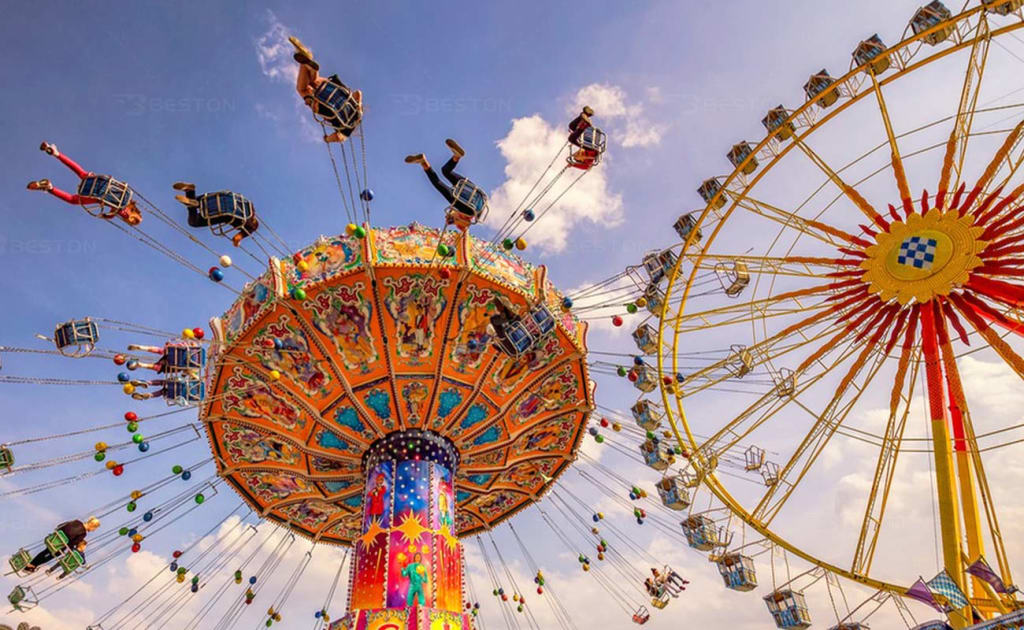
Indoor amusement projects operate within a more controlled spatial framework. Floor area efficiency is prioritized through compact layouts and vertical design strategies. A single carousel swing ride, for example, can be integrated into a limited footprint while still delivering visual appeal and kinetic engagement. This spatial economy reduces upfront investment and improves capital turnover. It also allows developers to align project scale with realistic demand forecasts rather than speculative attendance projections.

3. Operational Stability and Environmental Control
Operational continuity is a decisive advantage in contemporary amusement management. Indoor venues benefit from engineered environmental conditions. Temperature, humidity, and lighting are stabilized, which directly improves equipment reliability and visitor comfort. Maintenance cycles are predictable. Downtime is minimized.
Outdoor parks operate under constant exposure to environmental variables. Weather disruptions affect daily attendance, safety protocols, and staff deployment. While outdoor settings can accommodate large-format amusement ride installations with strong visual impact, their operational calendars remain inherently seasonal in most regions. This seasonality complicates revenue smoothing and increases reliance on peak-period performance.

4. Market Demand and Consumer Behavior
Consumer leisure patterns have become increasingly fragmented. Families and young adults favor shorter, repeatable experiences over infrequent full-day outings. Indoor amusement centers align with this trend by offering accessible entertainment that fits into routine urban life. Visit duration is shorter, but frequency is higher.
Outdoor amusement parks continue to attract destination-oriented visitors. Their experiential depth is significant, but attendance is more episodic. Travel time, weather dependency, and higher per-visit costs can suppress repeat visitation. As convenience becomes a dominant decision factor, indoor models demonstrate stronger elasticity in demand response.
5. Revenue Composition and Cash Flow Dynamics
Revenue resilience depends on diversification. Indoor amusement venues generate income from multiple sources beyond admission, including food and beverage, retail, events, and educational programming. Revenue per square meter is often higher due to concentrated foot traffic and cross-consumption with adjacent commercial tenants.
Outdoor parks rely heavily on gate revenue and seasonal peaks. Ancillary income streams exist but are constrained by operating calendars and visitor dwell time variability. Cash flow volatility is a structural characteristic, requiring substantial reserve planning and conservative financial modeling.
6. Safety Governance and Regulatory Exposure
Safety management has become a defining factor in project approval and public perception. Indoor environments support centralized monitoring, controlled access points, and standardized evacuation planning. Compliance with safety regulations is more straightforward due to consistent operating conditions.
Outdoor parks manage dispersed risk across large areas. Environmental exposure increases inspection requirements and operational complexity. Regulatory approvals often involve multiple agencies and extended review cycles, adding time and cost to project development.
7. Scalability and Replication Strategy
From an expansion standpoint, indoor amusement projects offer superior replicability. Design modules, equipment specifications, and operational procedures can be standardized across multiple locations. This supports chain development and brand consistency.
Outdoor amusement parks are inherently site-specific. Replication requires significant adaptation to local geography, climate, and regulation. As a result, scalability is slower and capital intensive.
8. Strategic Assessment and Market Fit
Neither model is universally superior. Outdoor amusement parks retain strategic value in tourism-centric regions with stable climates and supportive land policies. They function well as landmark destinations with long-term brand equity.
However, under current market conditions characterized by capital caution, urban concentration, and demand for operational predictability, indoor amusement models demonstrate broader applicability. Their alignment with modern consumption patterns, lower entry thresholds, and scalable frameworks position them as a pragmatic choice for a wide range of investors.
Conclusion
The choice between indoor and outdoor amusement development is no longer a question of preference but of strategic alignment. Market volatility, regulatory complexity, and consumer behavior now favor models that emphasize flexibility, efficiency, and risk control. Indoor amusement facilities meet these criteria with greater consistency. For stakeholders navigating a recalibrated global market, they represent a structurally adaptive and commercially resilient path forward.
About the Creator
Beston Amusement Rides
As a leading amusement facility manufacturer, we provide safe and interesting amusement equipment to customers around the world, including roller coasters, Ferris wheels, pirate ships and so on.
Website:https://bestonamusementrides.com/
Keep reading
More stories from Beston Amusement Rides and writers in Art and other communities.
Spatial Optimization Strategies in Modern Amusement Environments
Designing an amusement environment that ensures efficient visitor flow, intuitive navigation, and balanced attraction distribution requires more than simple spatial arrangement. It demands precise coordination between human behavior, ride typology, and operational logistics. Modern parks—regardless of scale—depend on spatial optimization strategies to increase capacity, reduce congestion, and elevate overall experience quality. The following analysis outlines the fundamental and advanced methods widely adopted to enhance the functional performance of theme parks, urban playgrounds, and mixed-use leisure destinations.
By Beston Amusement Rides3 months ago in Art
'Till Death We Do Art
There would be nothing divine in this world without art. Nature may surpass the divine to all intents and purposes, but like everything it absorbs and is absorbed by, it remains here, stuck on the surface of this world, ever-present, physically bound to the universe.
By Avocado Nunzella BSc (Psych) -- M.A.P 22 days ago in Art
Keto and Kote
This story has been sitting in my drafts for a long time because I didn't have good pictures for it. Murphy's law: I went to the performance with my phone discharged. But then I found the entire performance on YouTube and am now delightfully happy to share it with you.
By Lana V Lynxa day ago in Art
📢 Raise Your Voice Thread: 03/05/2026
Our “Raise Your Voice Threads” are hosted most alternating Thursdays at 12PM ET to offer creators more avenues to uncover exceptional stories on Vocal. As we are continuously searching for fresh creators and inspiring stories, this thread provides an opportunity to exchange and discuss the stories that have moved and motivated us on Vocal.
By Raise Your Voice by Vocal6 days ago in Resources




Comments
There are no comments for this story
Be the first to respond and start the conversation.