
IBN BATTUTA THE GREATEST TRAVLER MAROCCAN
Unexpected Journey of Ibn Battuta

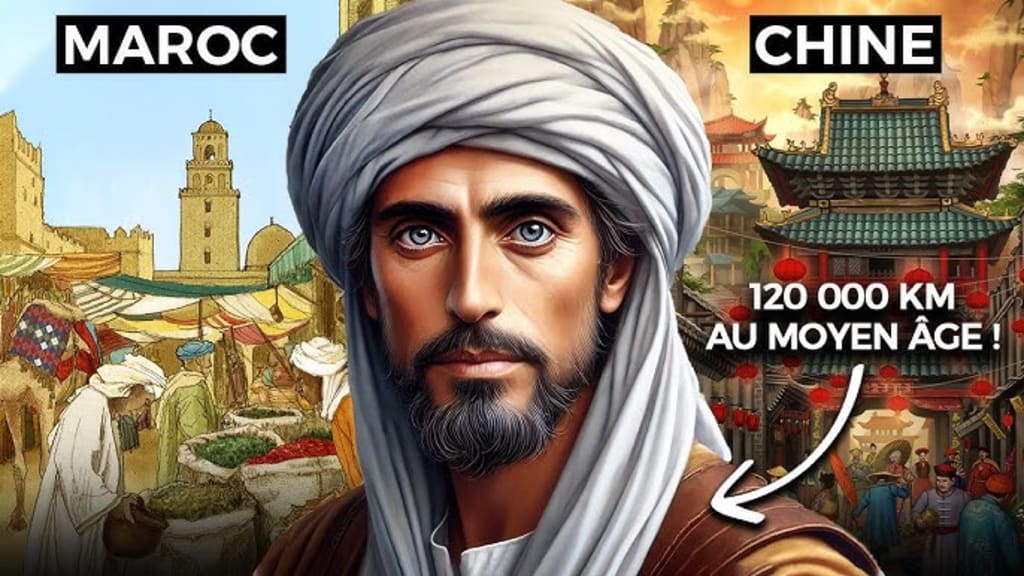
Ibn Battuta: The Greatest Traveler of the Medieval World
Early Life and Education
Ibn Battuta, born on February 25, 1304, in Tangier, Morocco, is widely regarded as one of the greatest travelers in history. His full name was Abu Abdullah Muhammad ibn Battuta, and he hailed from a family of Islamic legal scholars. Ibn Battuta received a traditional Islamic education, studying law, theology, and literature. At the age of 21, he embarked on a pilgrimage to Mecca, a journey that would mark the beginning of his extraordinary travels across the known world.
The Pilgrimage that Became a Lifetime Journey
What started as a pilgrimage (Hajj) in 1325 became a series of travels that spanned nearly 30 years. His original goal was to perform the Hajj, but after completing the pilgrimage, his thirst for exploration grew. Ibn Battuta would go on to visit North Africa, the Middle East, Sub-Saharan Africa, Central Asia, South Asia, and even parts of China. He traveled more than 75,000 miles, far surpassing any known traveler of his time, including Marco Polo.
Adventures Across the Islamic World
Ibn Battuta’s journeys took him across much of the Islamic world, which was at its peak of influence and expansion during his lifetime. He visited Egypt, where he marveled at the pyramids and the grandeur of Cairo. He also crossed the Arabian Peninsula and traveled throughout the Persian Gulf, visiting cities like Basra and Baghdad. His accounts of the sophisticated cities, the diversity of cultures, and the political intrigue in these regions offer invaluable insights into medieval Islamic civilization.
In India: From Traveler to Judge
One of the most remarkable chapters in Ibn Battuta's life occurred in India. In 1333, he reached the court of the Sultan of Delhi, Muhammad bin Tughluq, who appointed him as a judge due to his knowledge of Islamic law. Ibn Battuta lived in India for several years, and his time there was marked by luxury, intrigue, and even danger. Eventually, after falling out of favor at the court, he left India to travel once again.
Exploring the Far East
Ibn Battuta’s travels also took him to the Far East, including Sri Lanka, the Maldives, and even China. His descriptions of these regions provide some of the earliest and most detailed accounts from a Muslim traveler. In China, he described the grandiosity of the imperial courts, the thriving cities, and the advanced technologies he witnessed. His observations about the local customs, religions, and governance shed light on how different civilizations interacted during this period.
West African Expedition
Up on his return to North Africa, Ibn Battuta embarked on another significant journey—this time to Sub-Saharan Africa. He traveled to the Mali Empire, where he visited the legendary city of Timbuktu. He recorded detailed accounts of the empire’s wealth, its Islamic scholars, and the unique customs of West Africa. Ibn Battuta’s writings remain one of the few firsthand records of the Mali Empire during its golden age.
The Rihla: A Legacy of Exploration
After decades of exploration, Ibn Battuta returned to Morocco in 1354, where he was commissioned by the Sultan of Morocco to compile a record of his travels. This work, known as the "Rihla" (meaning "Journey"), is a masterpiece of medieval literature. In the Rihla, Ibn Battuta provides detailed accounts of the people, cultures, and landscapes he encountered. His observations remain one of the most comprehensive travelogues from the medieval world, providing invaluable insights into the global civilizations of his time.
Ibn Battuta’s Legacy
Ibn Battuta’s legacy endures as one of the greatest explorers in history. His travels connected the Islamic world with distant lands, and his writings offer a glimpse into the diversity and complexity of the 14th-century world. Today, he is remembered not only for his extensive travels but also for his ability to observe and document the cultures, religions, and societies he encountered with remarkable clarity and detail. His work has inspired countless historians, travelers, and writers, ensuring that his name remains synonymous with the spirit of exploratio
About the Creator
Driss El fani
"I write to explore the human experience, sharing stories that connect and inspire. From personal insights to global perspectives, join me in discovering the moments that shape our lives."
Keep reading
More stories from Driss El fani and writers in Art and other communities.
THE BATTLE OF WADI AL MAKHAZIN
The Battle of Wadi Al-Makhazin: The Triumph of Moroccan Sovereignty The Battle of Wadi Al-Makhazin, also known as the Battle of the Three Kings, was one of the most significant battles in the history of Morocco. Fought on August 4, 1578, it marked a turning point in Moroccan and Portuguese history, as well as in the balance of power between Christian Europe and the Muslim world.
By Driss El faniabout a year ago in Art
'Till Death We Do Art
There would be nothing divine in this world without art. Nature may surpass the divine to all intents and purposes, but like everything it absorbs and is absorbed by, it remains here, stuck on the surface of this world, ever-present, physically bound to the universe.
By Avocado Nunzella BSc (Psych) -- M.A.P 24 days ago in Art
The Front Seat
I found myself waking up in the front seat of the bus. My eyes were filled with the early morning darkness. I had been asleep, but I wasn’t sure for how long. I tried to wake up my body, but my head felt heavy, as though I had been sleeping for an eternity, although I couldn’t pinpoint how much time had passed.
By Aunty Sadaabout 22 hours ago in Art




Comments
There are no comments for this story
Be the first to respond and start the conversation.